

Wheel bearings serve as the critical interface between the wheel hub and the axle in a vehicle’s suspension system. These components reduce friction, allowing the wheels to spin smoothly with minimal energy loss. In the context of the UAE’s unforgiving climate and road conditions, where vehicles endure extreme heat, sand, and aggressive driving styles, the stress placed on wheel bearings is significantly higher. A bearing failure does not happen overnight; it is a progressive wear process that compromises vehicle safety and handling. Ignoring the early warning signs allows the damage to escalate from a nuisance to a catastrophic mechanical failure that can lead to a wheel detachment.
The Mechanics of Bearing Wear
Modern wheel bearings are typically sealed units containing ball bearings or tapered rollers enclosed within an outer race and inner race. Under normal operation, the lubricant inside the bearing cage ensures near-frictionless rotation. However, the abrasive nature of desert dust and the thermal expansion caused by high ambient temperatures degrade the lubricant over time. As the oil breaks down, metal-on-metal contact occurs, leading to pitting and eventual spalling of the races. This microscopic damage eventually creates play or looseness within the hub assembly, fundamentally altering the geometry of the wheel alignment.
Recognizing Auditory and Tactile Symptoms
The most distinct symptom of a failing wheel bearing is a rhythmic humming or growling noise. This sound is almost always proportional to vehicle speed; as the car accelerates, the noise pitch rises, and as it slows down, the pitch lowers. Unlike tire noise, which often changes with steering input or load, bearing noise remains constant regardless of which direction the vehicle is steered or what speed is maintained. Tactile feedback is also a reliable indicator. If a driver feels a vibration pulsating through the steering wheel or the floor pan at highway speeds, it suggests that the bearing is no longer rotating concentrically.
- Humming/Growling Noise: Increases with vehicle speed; constant during steady driving.
- Visual Inspection Signs: Rust accumulation around the hub cap or water seepage indicating a compromised seal.
- Play in the Wheel: Visually checking for wheel wobble or looseness when the vehicle is lifted.
The Critical Connection to ABS Functionality
Wheel bearings play a dual role in vehicle safety: facilitating wheel rotation and housing the components required for the Anti-lock Braking System (ABS). Most modern wheel hubs are integrated with an ABS sensor and a reluctor ring, which is a toothed metal ring attached to the back of the hub. When a wheel bearing is worn, the hub assembly can wobble or shift. This movement causes the reluctor ring to move erratically or even become unseated from the hub. The ABS sensor detects these irregularities as erratic signals, triggering the ABS warning light on the dashboard.
Drivers often mistake a damaged wheel bearing for a simple ABS sensor failure because both result in the same dashboard warning light. However, replacing the sensor without addressing the root cause—the worn bearing—will not fix the issue. The sensor will continue to read the warped or loose reluctor ring, causing the ABS system to malfunction repeatedly. Furthermore, if the bearing failure is severe enough to break the reluctor ring teeth, the ABS system may disable entirely, removing a vital safety feature during emergency braking scenarios.
Diagnostic Protocols for Professional Inspectors
A certified vehicle inspector does not diagnose bearing wear based solely on the sound of the vehicle. The inspection process involves a multi-stage approach combining auditory analysis with physical measurements. First, an inspection technician will perform a road test to categorize the noise, noting if it is constant or changes with steering angle. This helps isolate whether the noise is originating from a specific wheel or if it is related to tire condition.
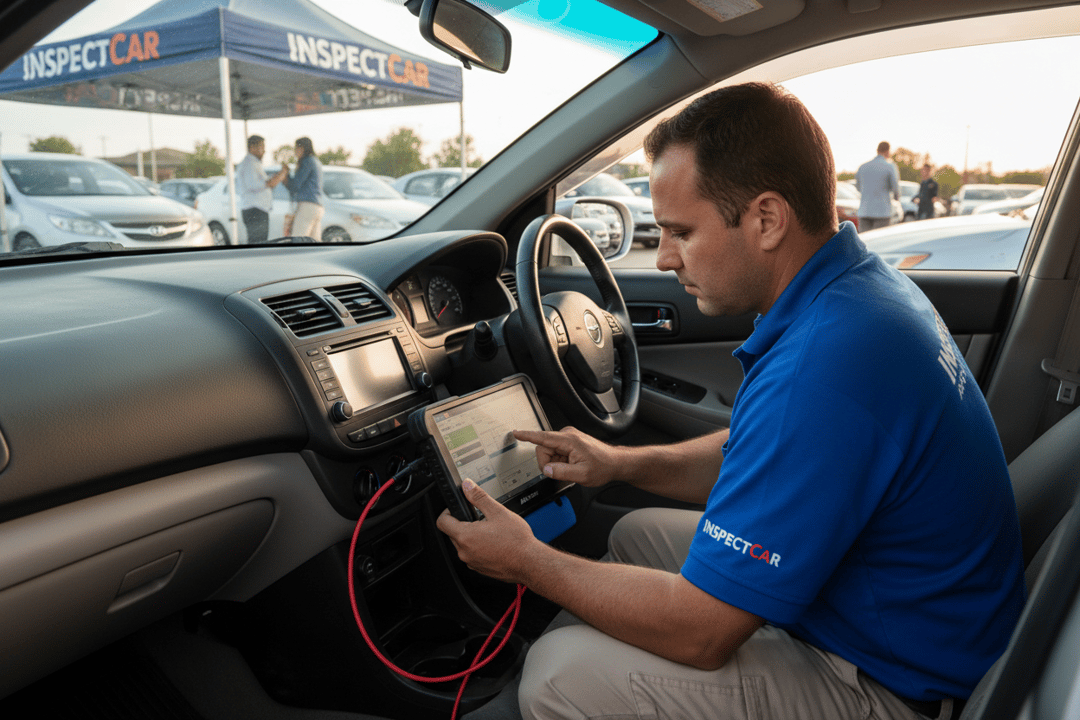
During the physical inspection, the vehicle is lifted to inspect the wheel hub assembly. The inspector checks for any play by attempting to wiggle the wheel by hand at the top and bottom (12 and 6 o’clock positions) and at the front and back (3 and 9 o’clock positions). Excessive movement indicates a lack of preload on the bearing. Technicians also inspect the rear of the hub for any signs of oil leakage, which is a primary indicator of a failed internal seal. Finally, a computer diagnostic scan is crucial to determine if the ABS module has stored error codes related to wheel speed sensors.
- Visual Check: Inspecting the hub for rust, leaks, and damage to the ABS sensor connector.
- Tactile Check: Lifting the vehicle and applying pressure to the wheel to detect play or looseness.
- Diagnostic Scan: Connecting an OBD scanner to read ABS and wheel speed sensor data.
- Road Test: Verifying that the noise correlates with speed and is not masked by tire noise.
The Impact on Suspension and Alignment
A compromised wheel bearing directly affects the vehicle’s suspension geometry and tire health. Because the hub is no longer rigidly fixed, the wheel can tilt slightly on the axle. This condition, known as "axle tramp" or irregular scrub, causes the tires to wear unevenly. Inspectors check tire tread wear patterns to identify if cupping or feathering is present, which may point back to a suspension component or bearing issue. Furthermore, a worn bearing alters the vehicle's alignment settings. This can lead to the car pulling to one side or experiencing instability at high speeds, requiring more frequent and costly suspension adjustments.
Comprehensive Inspection Packages
Given the critical nature of wheel bearings and their interaction with the ABS system, relying on a basic visual check is often insufficient. A thorough inspection must cover the entire vehicle to ensure no other related systems are failing. Using a professional on-location inspection service ensures that the vehicle is tested under real-world conditions and that all 410+ checkpoints are reviewed.
| Inspection Package | Price | Inclusions & Key Focus |
|---|---|---|
| Computer Diagnostic | AED 99 | Scans engine, transmission, ABS, and airbag modules for error codes. |
| Body & Computer | AED 250 | Adds panel-by-panel paint inspection and collision damage assessment. |
| Comprehensive | AED 299 | Includes Road Test, Brakes, Suspension, Tires, Fluids, and Frame integrity. |
The comprehensive package is the most recommended option for vehicles showing signs of bearing wear. It covers the specific suspension and road test categories required to diagnose bearing play accurately. For buyers in the UAE market, understanding the true condition of a vehicle's suspension components is essential for avoiding future repair bills. An inspector will document the wear on the bearings in the final report, providing a clear timeline for maintenance.
Addressing wheel bearing wear immediately prevents the need for more extensive repairs. Neglecting a bad bearing can lead to the destruction of the axle shaft or the steering knuckle, which are significantly more expensive to replace than the bearing itself. Furthermore, a seized bearing can cause the wheel to lock up completely, leading to loss of control. It is a safety critical component that demands professional evaluation. Ensuring that the ABS system is functioning correctly is equally important; a damaged bearing can disable the braking system's safety net.
For vehicle owners and buyers in Dubai, Abu Dhabi, and the other Emirates, utilizing a professional inspection service provides the necessary transparency. Inspectors document the condition of the suspension system, including the wheel bearings, with HD photos and a detailed PDF report. This documentation is vital for negotiation and for planning future maintenance. Do not rely on guesswork when it comes to the integrity of your vehicle’s rolling stock. A professional inspection bridges the gap between a simple visual check and a complete mechanical diagnosis.
AutoFay inspects 410+ checkpoints with HD photos and PDF report. Book at autofay.ae or call +971542584458




0 Comments
No comments yet. Be the first to share your thoughts!