

Why You Need a Checklist
Buying a used car without a checklist is like signing a contract without reading it. In the UAE's fast-moving market, sellers know how to make any car look perfect. A systematic 410+ checkpointlist ensures nothing slips through the cracks — from hidden accident damage to electrical gremlins that only show up after you've paid.
Engine & Mechanical (25 Points)
- Cold start test — arrive before the seller warms up the car. A cold engine reveals startup issues, smoke, and unusual noises that disappear once warm.
- Oil dipstick check — clean amber oil is good. Grey, foamy, or milky oil signals a blown head gasket (a notable sum–15,000 repair).
- Coolant condition — should be green/pink. Oily or brown coolant means internal contamination.
- Transmission test — shift through all gears (P-R-N-D). Any delay, jerk, or grinding sound means expensive repair ahead.
- Belt inspection — cracked or glazed belts need immediate replacement.
- Exhaust smoke — white smoke = coolant leak, blue = burning oil, black = rich fuel mixture.
- Engine mounts — excessive vibration at idle means worn mounts.
- Turbo check — listen for whining or whistling sounds, check for oil leaks around the turbo unit.
Body, Paint & Frame (35 Points)
- Paint thickness gauge — the single most important tool. Factory paint reads 80–150 microns. Above 200 = repainted. Above 400 = body filler (accident repair).
- Panel gaps — check every gap between doors, hood, trunk, and fenders. Uneven gaps = collision damage and poor repair.
- Pillar inspection — A, B, and C pillars. Any welding, bending, or repair here means a serious structural accident.
- Underbody scan — look for rust, frame damage, oil leaks, and signs of flood damage.
- Door hinges — open each door fully. Replaced hinges or misaligned doors signal repairs.
- Windshield date code — if the glass manufacture date doesn't match the car's year, it was replaced (possible accident).
- Trunk floor — lift the carpet. Rust, water stains, or welding means rear-end collision or flood.
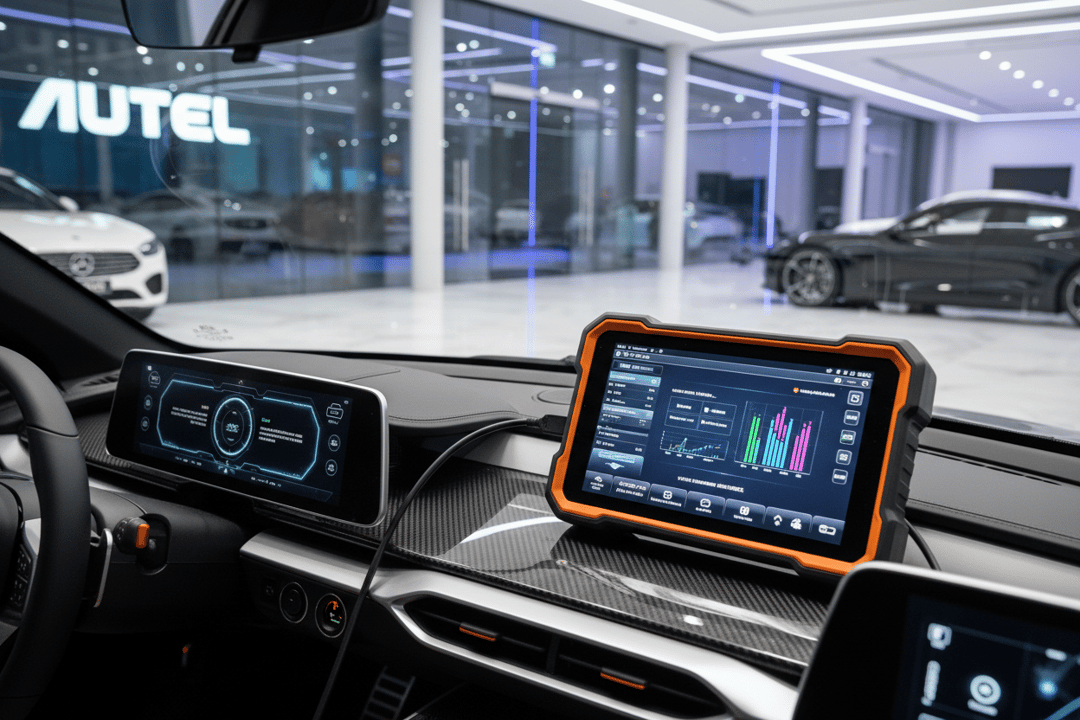
Computer Diagnostics / OBD (15 Points)
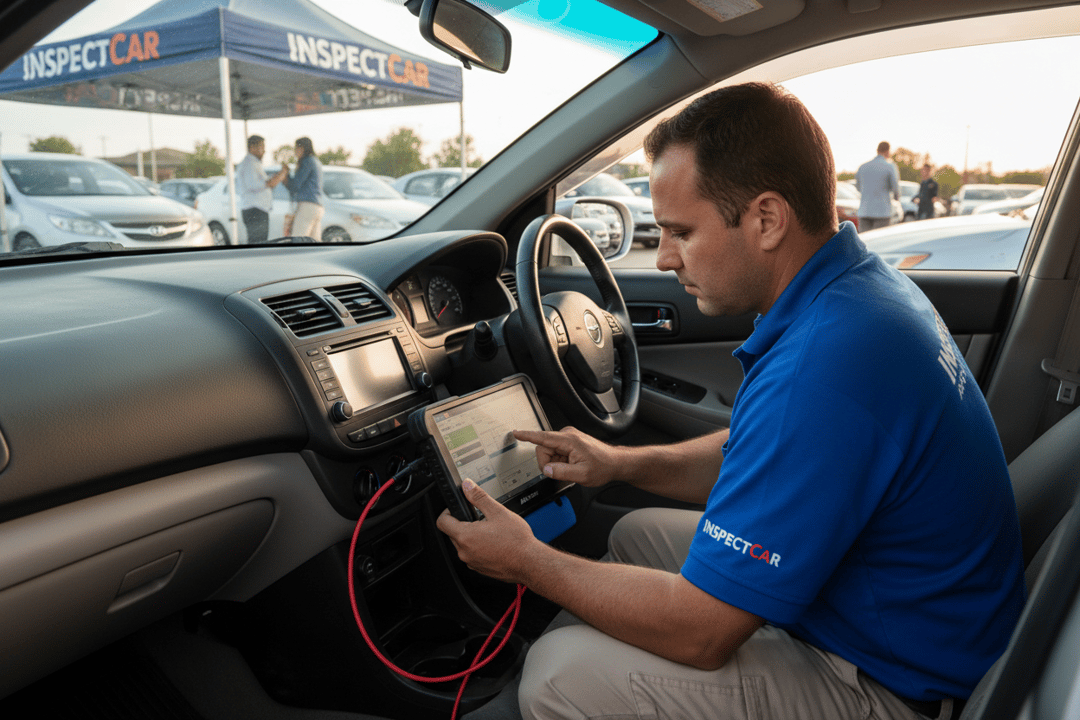
- Full system scan — not just engine codes. Scan transmission, ABS, airbag, and body control modules.
- Airbag status — deployed airbags with warning lights cleared is a common scam. A deep scan reveals this.
- Odometer verification — compare digital reading with ECU stored mileage and service history.
- Pending codes — codes that haven't triggered the warning light yet but indicate developing problems.
- Live data — engine temperature, sensor readings, fuel trim values all tell the health story.
Tires & Brakes (20 Points)
- Tread depth — minimum 1.6mm legal limit in UAE, but below 3mm needs replacement soon.
- Tire age — check the DOT code on sidewall. Tires older than 5 years are unsafe in UAE heat regardless of tread.
- Wear pattern — inner wear = alignment issue, center wear = over-inflation, outer wear = under-inflation or suspension problem.
- Brake pad thickness — less than 3mm means replacement needed (a notable sum–800 per axle).
- Rotor condition — grooves, warping, or blue discoloration from overheating.
- Brake test — car should stop straight without pulling, pulsating, or making noise.
Interior & Electronics (30 Points)
- A/C performance — must blow cold within 2 minutes. In UAE, a weak A/C is a dealbreaker. Compressor replacement costs a notable sum–5,000.
- All windows — test every power window up and down completely.
- Infotainment — screen responsiveness, Bluetooth, CarPlay/Android Auto, all speakers.
- Seats — power adjustment, heating, cooling, memory functions.
- Smell test — musty smell = flood damage or A/C mold. Smoke smell is almost impossible to fully remove.
- Headliner — sagging headliner indicates heat damage or age.
- Carpet under mats — lift floor mats and check for water stains, mold, or sand deposits (flood indicators).
Road Test (25 Points)
- Drive at least 15 minutes — short drives hide problems that only appear when the car is fully warm.
- Highway speed test — vibrations at 100–highway speeds indicate wheel balance, tire, or drivetrain issues.
- Braking from speed — the car should stop straight without shaking or pulling.
- Steering test — drive hands-light on a straight road. Any pulling means alignment issue.
- Bump test — drive over speed bumps. Clunking or excessive bouncing = worn suspension (a notable sum–4,000 to fix).
- Parking test — full steering lock both directions. Listen for clicking (CV joints) or whining (power steering).
- Reverse test — back up slowly and listen for unusual sounds from the transmission or drivetrain.
Download Our Free Checklist
Save time and never miss a point — book a professional inspection with AutoFay and we'll check all 150+ points for you with a detailed photo report. Starting from just AED 99 for computer diagnostics.

0 Comments
No comments yet. Be the first to share your thoughts!