

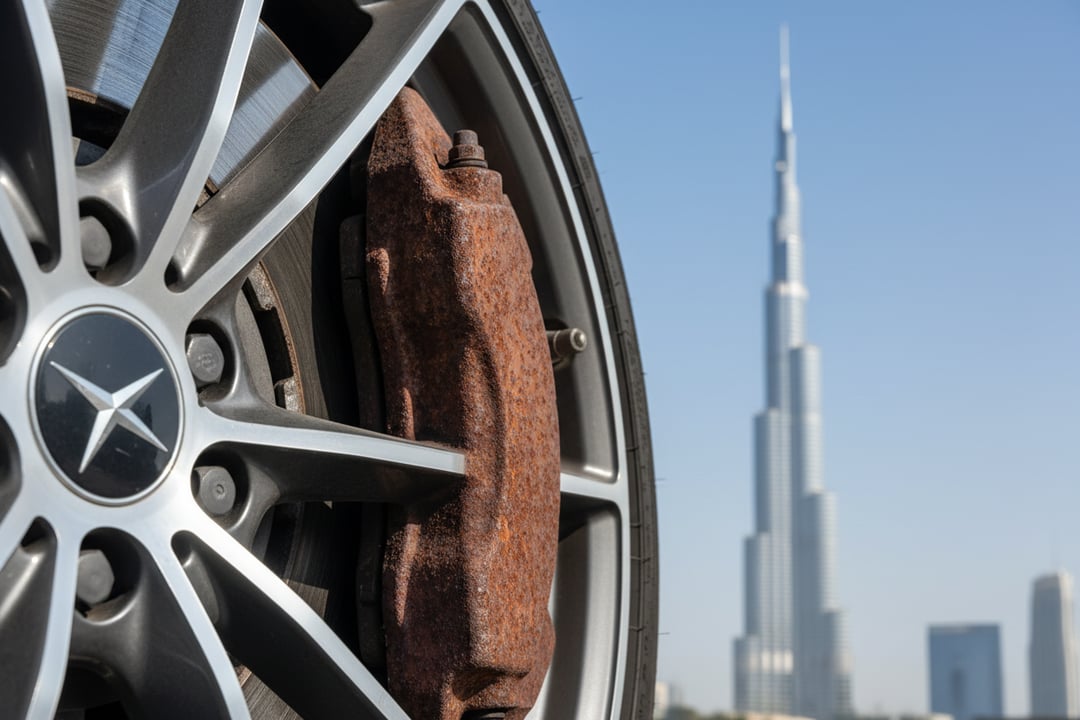
The intense heat of the UAE climate and the prevalent stop-and-go traffic in major cities like Dubai and Abu Dhabi place immense stress on automotive braking systems. A vehicle’s ability to stop safely is non-negotiable, and the brake caliper serves as the critical locking mechanism that clamps the brake pads against the rotor. When a caliper fails, the consequences range from reduced stopping power to complete brake failure, creating a significant risk for the driver and other road users. For buyers inspecting used vehicles in the region, identifying a failing caliper before the purchase is essential to avoid costly repairs and safety hazards. This inspection requires a keen eye for detail, an understanding of mechanical sounds, and the use of diagnostic tools to confirm issues that are not immediately visible.
Visual Indicators of Caliper Condition
The first step in assessing a used vehicle is a thorough visual examination of the brake components. A major warning sign is the presence of rust or corrosion on the caliper body, specifically around the mounting pins and the piston seal. In the UAE, coastal humidity and road salt can accelerate this corrosion, leading to "freezing" of the caliper in place. If the caliper housing looks heavily pitted or swollen, it indicates internal seal failure and fluid contamination. Furthermore, inspect the brake lines and the area around the caliper for fresh fluid leaks. Brake fluid is typically clear or yellowish, and a wet, oily residue dripping from the caliper piston or slide pins suggests a compromised seal that requires immediate attention.
Another visual cue is the condition of the brake pads themselves. A seized caliper will cause the pad on that specific wheel to wear down unevenly or prematurely. If the pad lining appears significantly thinner than the pads on the opposite side of the vehicle, it indicates that the caliper is stuck in the "applied" position, constantly rubbing against the rotor. Conversely, if a pad appears brand new while the other side is worn out, that specific caliper may be stuck in the "released" position, rendering the brakes on that axle ineffective.
Auditory Warning Signals
Sound provides a critical line of defense when the eyes cannot see the damage. Many modern vehicles are equipped with brake pad wear sensors that trigger a warning light on the dashboard when the lining material reaches a critical thickness. However, before the warning light activates, drivers may hear high-pitched squealing or squeaking noises. This sound is generated by a metal tab (the wear sensor) vibrating against the rotor surface. While this usually indicates thin pads, a persistent grinding noise that gets louder over time suggests that the metal backing plate of the pad is grinding directly into the rotor. This metal-on-metal contact is often caused by a caliper that is no longer applying even pressure, allowing the pad to chatter against the spinning rotor.
Listen for a rhythmic clicking or clicking sound while driving. This is frequently caused by a loose or broken caliper bolt, which allows the caliper to shift and slap against the suspension components during braking. In some cases, a stuck caliper can cause a rhythmic "thumping" sensation through the brake pedal, signaling that the rotor is no longer flat and smooth due to constant friction from a seized piston.
Handling and Vibration Symptoms
A failing caliper often manifests itself through changes in vehicle handling. If the car pulls noticeably to the left or right when braking, it indicates an imbalance in braking force between the left and right wheels. This is almost always caused by a stuck caliper on one side, causing excessive drag on that axle while the opposite side functions normally. The driver must steer harder to compensate, which is dangerous at high speeds or during emergency stops. Additionally, a pulsating or vibrating sensation felt through the steering wheel or brake pedal is a tell-tale sign of a warped rotor. While rotors can warp from heat, they often warp as a secondary symptom of a sticking caliper that applies uneven, excessive pressure to the rotor surface.
Uneven tire wear is another indirect but significant indicator. If the inner or outer edge of one tire is worn down significantly faster than the others, it suggests that the vehicle is tracking improperly due to a seized caliper on the opposite side. This creates a rolling resistance that deforms the tire tread over time, leading to the need for premature tire replacement.
Thermal Anomalies on the Wheels
After a short drive, a manual inspection of the wheel temperatures can reveal hidden mechanical faults. The temperature of the wheels should be relatively consistent. If one wheel feels significantly hotter than the others, it is a strong indication that the brake caliper on that wheel is stuck in the "applied" position. This constant friction generates excessive heat, which can transfer to the wheel hub and bearing. Over time, this heat degrades the brake fluid, causing it to boil and lose its stopping power, leading to a dangerous condition known as brake fade. In severe cases, the heat can damage the wheel bearing, leading to a grinding noise and potential wheel separation if left unaddressed.
The Importance of Diagnostic Scanning
Visual and auditory inspections are vital, but electronic diagnostics provide definitive proof of caliper and brake system health. The Anti-lock Braking System (ABS) module monitors the speed of each wheel independently. A stuck caliper that is not releasing will drastically alter the wheel speed sensor readings, often triggering specific ABS error codes on the vehicle's computer. These codes can pinpoint which wheel is experiencing the issue and whether the problem is related to the sensor, the wiring, or the mechanical caliper itself.
Professional inspection services utilize these tools to uncover hidden faults. AutoFay offers a comprehensive Computer Diagnostic service starting at AED 99. This initial scan checks for ABS and engine codes that may point to braking irregularities. However, a full inspection requires looking beyond the computer to the physical components. A stuck caliper can cause the entire brake system to overheat, leading to brake fluid degradation and air in the lines. The consequences of ignoring these diagnostic codes can be severe, resulting in the complete failure of the braking system during a critical maneuver.
| Service Package | Included Services | Price (AED) |
|---|---|---|
| Computer Diagnostic | Engine, Transmission, ABS, Airbag codes | 99 |
| Body & Computer | Panel-by-panel paint inspection, Computer Diagnostic | 250 |
| Comprehensive | 410+ checkpoints (Body/Paint, Frame, Engine, Brakes, Suspension, Tires, Fluids, Road Test) | 399 |
The Consequences of Ignoring Caliper Issues
Failure to detect a failing caliper results in a domino effect of mechanical failures that far exceed the cost of a simple repair. A sticking caliper causes the brake pads to wear out rapidly and the rotors to warp or crack due to uneven heat distribution. The constant heat transfer can also damage the wheel bearing, necessitating a hub assembly replacement. Furthermore, the brake fluid will absorb the heat and moisture from the caliper seal failure, lowering its boiling point and reducing its effectiveness. In the UAE's high-speed environment, this loss of braking performance is a recipe for disaster. The financial consequences of these cascading failures are substantial, requiring repairs to multiple components that could have been avoided with a simple caliper service.
Why a On-Location Inspection is Essential
Given the complexity of identifying caliper issues, a professional on-location inspection service is the most efficient way to verify a vehicle's condition before ownership transfer. A comprehensive inspection covers 25 categories, including a specific focus on the braking system's pad percentage rating and road test performance. Services like AutoFay provide a detailed report with HD photos and PDF documentation, allowing buyers to document any pre-existing issues. With a on-location inspection available in all 7 Emirates, vehicle inspection can be conducted at the seller's location, ensuring the vehicle is fully evaluated in real-world driving conditions without the buyer needing to arrange separate tests.
AutoFay inspects 410+ checkpoints with HD photos and PDF report. Book at autofay.ae or call +971542584458





0 Comments
No comments yet. Be the first to share your thoughts!