

Securing a sedan in the UAE market requires more than just visual appeal; structural integrity determines occupant survival during high-velocity impacts. While regulatory standards mandate a baseline of protection, the actual safety of a used vehicle depends on the preservation of its original safety cages and active braking systems. Vehicle inspection is a technical necessity to uncover hidden degradation that impacts survival probability. A professional inspection identifies compromised structural components and malfunctions in safety-critical electronics before they cause injury. Buyers must prioritize verified safety hardware over cosmetic finishes to ensure the vehicle performs as designed in accident scenarios.
The Physics of Sedan Safety: Structural Integrity
Sedans are designed with crumple zones that absorb kinetic energy during a collision, preserving space for the cabin. Structural rails and the floor pan act as the primary load-bearing framework, transferring impact force away from passengers. Damage to the frame, even if hidden beneath bodywork, compromises the vehicle's ability to protect occupants in a rollover or side-impact event. Rust propagation is a specific threat in the UAE’s coastal humidity, weakening the metal matrix of the chassis and pillars. An inspection must verify that the main structural members remain straight and free of corrosion dilution.
Deciphering Crash Test Ratings vs. Reality
Manufacturers publish laboratory crash test results to demonstrate theoretical safety performance, but these ratings assume the vehicle is unmodified and well-maintained. A high rating from a testing body like Euro NCAP or C-NCAP becomes meaningless if the vehicle has sustained frame deformation in a prior accident. The vehicle’s current state cannot be accurately gauged by paper ratings alone; it requires physical verification of the safety cage. Professional inspectors examine the alignment of the hood, doors, and trunk to detect misalignment caused by frame damage. Furthermore, hidden damage to the firewall can sever airbag deployment paths, rendering safety systems ineffective during a crash.
Essential Safety Features to Verify During Inspection
Modern sedans rely on a network of sensors and actuators to prevent accidents and mitigate damage. Verifying these systems ensures the vehicle's active and passive safety layers function correctly. Inspectors must specifically check the deployment status of airbags and the readiness of seatbelt pre-tensioners. The Anti-lock Braking System (ABS) and Electronic Stability Control (ESC) must engage without error codes. Additionally, the integrity of side impact beams and the condition of the windshield (which provides structural support in modern designs) are critical factors. A malfunctioning brake light system also poses a significant risk by failing to warn following traffic of deceleration.
- Structural Rails: Inspectors verify the main longitudinal rails and floor pan for straightness and rust.
- Frame Integrity: Pillars and B-pillars must be checked for bends or welding repairs that indicate prior accidents.
- Airbag Systems: The SRS (Supplemental Restraint System) module must be scanned for crash data or deployment history.
Systems Critical for Accident Avoidance
Preventing an accident often relies on the vehicle's ability to maintain traction and stopping power under extreme conditions. The braking system requires immediate attention, specifically checking brake pad thickness and rotor condition to ensure adequate stopping distance. Suspension components, including control arms and bushings, affect tire contact with the road, influencing the vehicle's stability during evasive maneuvers. Uneven tire wear patterns can indicate suspension misalignment or brake binding, leading to loss of control. A comprehensive inspection confirms that tires are free of dry rot and the suspension geometry has not drifted from factory specifications.
Advanced Diagnostics and Inspection Packages
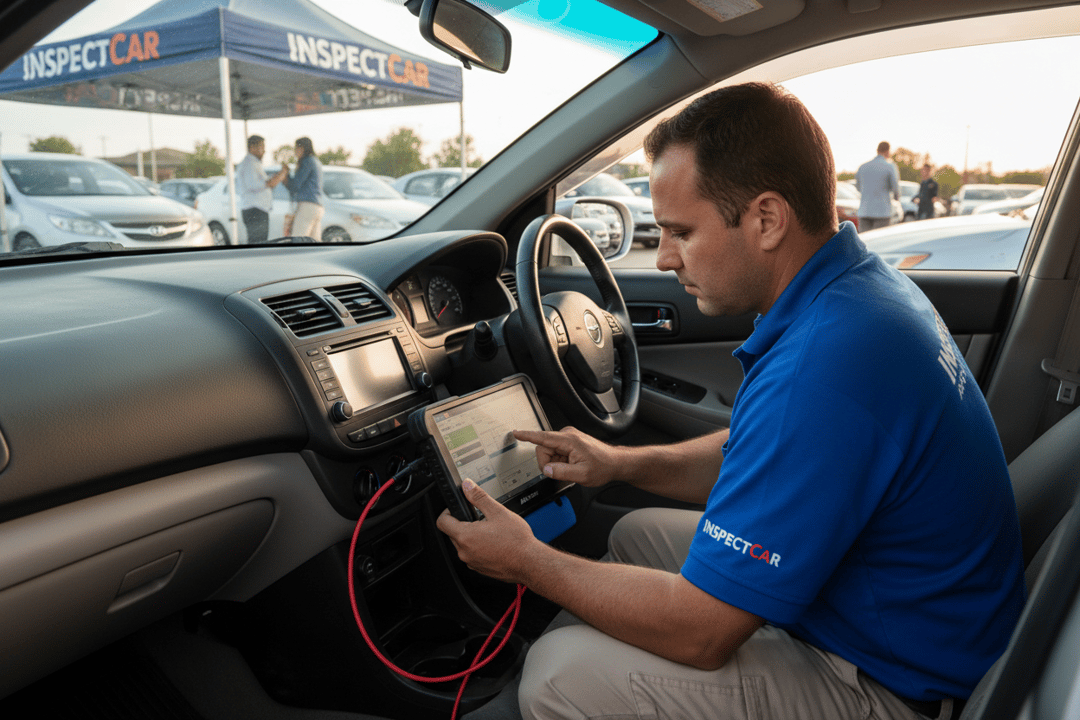
Detecting electronic safety faults requires more than a visual check; it demands specialized diagnostic equipment capable of reading Controller Area Network (CAN) data. Modern sedans use complex sensor networks to manage safety features, and a malfunctioning sensor can disable a critical system like ABS or traction control. Specialized diagnostic tools scan the Engine Control Unit (ECU) and Body Control Modules to retrieve error codes related to safety systems. Inspectors analyze the specific error codes to determine if a sensor is faulty or if a safety system has been deactivated, such as an airbag being unplugged for repairs.
| Inspection Package | Price (AED) | Key Focus Areas |
|---|---|---|
| Computer Diagnostic | 99 | Engine, Transmission, ABS, Airbag codes |
| Body & Computer | 250 | Panel-by-panel paint check + Full diagnostics |
| Comprehensive | 399 | 410+ checkpoints: Frame, Fluids, Brakes, Suspension, Road Test |
Choosing the appropriate level of inspection ensures that all safety variables are accounted for without unnecessary expense. The basic diagnostic service provides a quick overview of electronic faults, while the comprehensive package offers a granular look at mechanical safety. The highest tier covers 25 categories, including a detailed road test to assess braking stability and steering response. This thoroughness is vital for identifying issues like axle wear or differential damage that could lead to a mechanical failure on the highway. HD photos and a detailed PDF report accompany all inspections, providing a permanent record of the vehicle's condition.
AutoFay inspects 410+ checkpoints with HD photos and PDF report. Book at autofay.ae or call +971542584458.


0 Comments
No comments yet. Be the first to share your thoughts!