

The prevalence of hatchbacks in the United Arab Emirates market requires a rigorous approach to vehicle safety assessment. Unlike larger sedans or SUVs, hatchbacks prioritize compact dimensions and agility, often compromising cabin space for structural rigidity. When purchasing a used hatchback in the region, relying solely on manufacturer specifications or showroom brochures is insufficient. The harsh desert climate, high humidity, and aggressive driving styles encountered on UAE highways accelerate wear on safety-critical systems. Therefore, a deep dive into the vehicle's physical condition and electronic integrity is non-negotiable for anyone prioritizing occupant protection.
Understanding Crash Test Ratings and Real-World Reality
Certified crash test ratings provide a baseline for safety, yet they represent idealized laboratory conditions rather than the chaotic variables of daily driving in the Emirates. Ratings typically measure the vehicle's ability to protect occupants during frontal, side, and rollover impacts. However, these scores do not account for the age of the vehicle, the degradation of crumple zones, or the accumulation of corrosion. A five-star rating is only relevant if the vehicle has never been involved in a collision that compromised its structural load path. Buyers must understand that a vehicle's safety rating is a snapshot in time, not a permanent guarantee of protection against future damage or fatigue.
Key metrics to scrutinize in these ratings include "Occupant Retention," which evaluates seatbelt effectiveness, and "Structural Safety," which measures cabin intrusion. A vehicle with high crash-test scores may still fail to protect occupants if the battery has been moved to the trunk to create more rear space, or if aftermarket modifications have altered the vehicle's center of gravity and braking dynamics.
Essential Passive Safety Features to Verify
Passive safety systems are designed to activate during a collision to minimize injury. During an inspection, you must verify that these systems are fully functional and intact. The presence of hardware is not enough; the electronics must be operational.
- Occupant Restraint Systems: Ensure all seatbelts are free of fraying, cuts, and webbing tears. Check the retractors for smooth operation and inspect pretensioners for any signs of deployment or damage.
- Airbag System Integrity: Verify the status of the airbag warning light. If the light illuminates upon ignition and does not turn off, the airbag system is faulty. Inspect the airbag covers for damage or rips, which can indicate previous deployment or tampering.
- Crumple Zones: These areas are designed to absorb impact energy. Inspect the front and rear bumpers, fenders, and hood for misalignment, gaps, or signs of welding that suggest previous impact damage.
Active Safety and Electronic Reliability
Modern hatchbacks rely heavily on electronic stability control and braking assistance to prevent accidents before they occur. These systems are complex and prone to failure over time. The Electronic Stability Control (ESC) is crucial for maintaining traction during sudden lane changes or on loose gravel roads, which are common outside city centers.
One of the most critical electronic safety components is the Anti-lock Braking System (ABS). If the ABS module fails, the brakes may still function mechanically, but the driver loses the ability to steer while braking hard, significantly increasing stopping distances. Furthermore, the sensors responsible for determining the vehicle's angle and speed must be free of dirt and debris accumulation, which is a common issue in the UAE due to dust storms.
Structural Integrity and Chassis Inspection
The structural integrity of a hatchback is its first line of defense against collision forces. In the UAE, corrosion is a primary enemy of chassis integrity, particularly at the bottom of the vehicle where salt or moisture may accumulate. Even if the bodywork looks pristine, a compromised chassis renders all safety features ineffective.
Inspectors must check the vehicle's "Rails," floor pan, and A-pillars for signs of rust, corrosion, or repair. A damaged frame can alter the geometry of the suspension, leading to unpredictable handling and reduced braking efficiency. Misaligned doors or bonnets that catch on the rubber seals often indicate a frame that has been bent and subsequently straightened—a process that rarely restores 100% of the original structural strength.
The Role of Professional Inspection Services
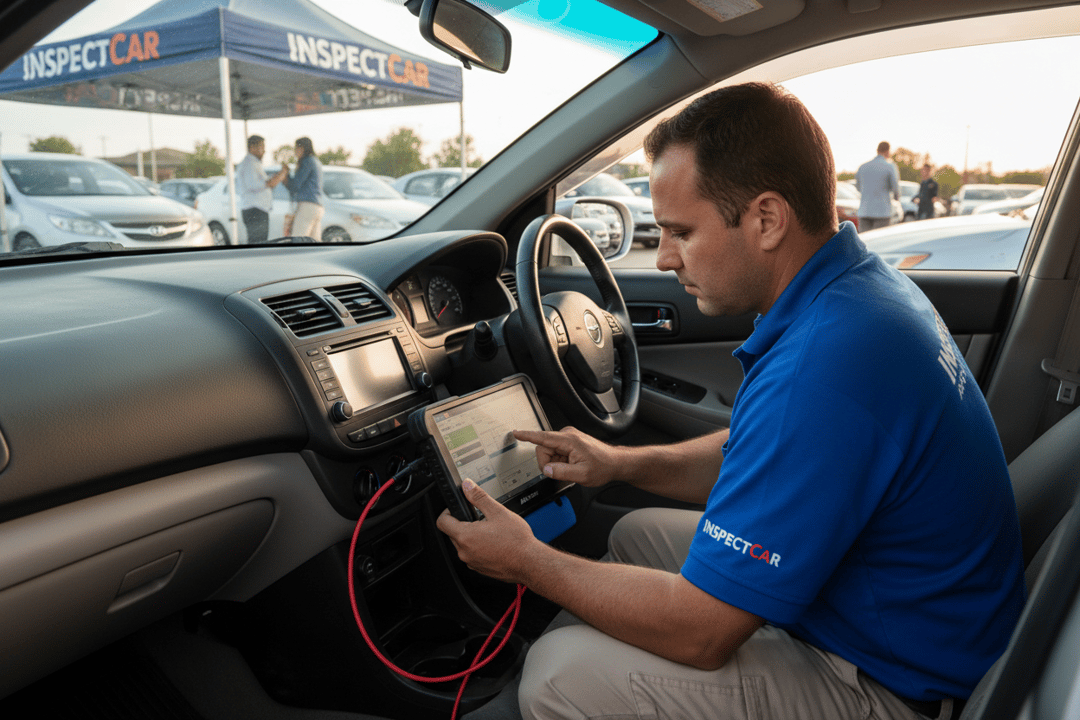
Verifying these safety factors requires a detailed examination that goes beyond the visual inspection capabilities of the average buyer. Professional inspection services provide a structured approach to uncovering hidden safety hazards. Services like AutoFay offer comprehensive on-location inspections across all seven Emirates, delivering a detailed report rather than a subjective opinion.
Using a professional service ensures that the following checkpoints are rigorously assessed:
- Computer Diagnostics: Hidden error codes can disable safety systems. A diagnostic scan reveals faults in the ABS, airbag, and ESC modules that are invisible to the naked eye.
- Brake Performance: Brake pads, rotors, and fluid condition are checked to ensure the vehicle can stop effectively. Worn brakes are a primary cause of accidents in stop-and-go traffic.
- Tire Condition: Tread depth and manufacturing dates are critical. Old tires degrade rapidly in high heat, losing their ability to grip the road, especially when wet.
- Suspension and Steering: Worn ball joints or tie rods can cause a sudden loss of steering control, a significant failure for a small, lightweight hatchback.
AutoFay provides specialized packages designed to address these specific safety concerns. The Computer Diagnostic AED 99 service is essential for identifying electronic faults in safety systems like airbags and ABS. For buyers concerned with accident history, the Body & Computer AED 250 inspection covers panel-by-panel analysis to detect repaired accident damage. For complete peace of mind regarding mechanical and structural safety, the Comprehensive AED 299 package offers the most thorough check, including a road test to verify acceleration, braking, and noise levels.
| Inspection Package | Safety Focus |
|---|---|
| Computer Diagnostic | Checks for airbag, ABS, and ESC error codes; ensures electronic safety systems are active. |
| Body & Computer | Inspecting for accident damage, frame deformation, and corrosion affecting structural safety. |
| Comprehensive | Full mechanical and structural safety check including brakes, suspension, tires, and fluids. |
Operational Checks and Fluid Integrity
Fluids are the lifeblood of a vehicle's safety systems. Brake fluid, for example, absorbs moisture over time, which lowers its boiling point. In the UAE's hot climate, this can lead to brake fade during high-speed driving. Coolant levels and condition must also be checked to prevent engine overheating, which can lead to sudden loss of power steering or brake assist.
During a road test, listen for unusual noises from the tires or suspension that indicate worn components. A vehicle that rattles over bumps may have loose or worn suspension parts that fail under hard braking. Ensuring the steering wheel is centered when driving straight and that there is significant play in the wheel indicates worn tie rods, which must be replaced immediately.
Verifying the safety of a hatchback requires a systematic approach that separates cosmetic appeal from functional reliability. By utilizing professional inspection services, buyers can uncover the true condition of the vehicle. AutoFay inspects 410+ checkpoints with HD photos and PDF report. Book at autofay.ae or call +971542584458.


0 Comments
No comments yet. Be the first to share your thoughts!