

Buying a coupe in the UAE requires a specific understanding of safety beyond standard sedans. These vehicles often feature lower frames and stiffer suspensions designed for high-speed cornering, which can affect their behavior during a collision. A coupe’s structural design prioritizes aesthetic lines and performance, sometimes compromising the crumple zones necessary for maximum impact absorption. Therefore, verifying the integrity of the chassis and the functionality of safety systems is critical before finalizing any purchase.
Understanding Coupe Structural Dynamics
The unique architecture of a coupe, characterized by its sloping roofline and shorter wheelbase, creates specific safety challenges. Engineers must balance rigidity with energy dissipation; excessive rigidity can transfer impact force directly to the passenger cabin rather than absorbing it in the crumple zones. In the UAE’s high-velocity highways, this distinction becomes a matter of survival. A vehicle with compromised structural rigidity may deform unpredictably during a frontal or side impact, increasing the risk of injury to occupants.
Inspectors must look for chassis straightness, particularly focusing on the "B-pillar" and frame rails, which often bear the brunt of side impacts in two-door configurations. Any deviation from factory specifications indicates prior damage that has been repaired using substandard methods, severely reducing the vehicle’s crashworthiness.
Essential Safety Features to Verify
Modern coupes are equipped with advanced driver-assistance systems, but these features fail if the underlying sensors or mechanical components are damaged. During an inspection, you must verify the functionality of the braking system, as coupes often have higher unsprung weight due to smaller wheels, which affects stopping distances.
- Electronic Stability Control (ESC): This system prevents loss of traction during sudden maneuvers, critical for maintaining control on slippery UAE roads.
- Curtain Airbags: These provide head protection in side collisions and rollovers, a feature often integrated with the roof structure in coupes.
- Anti-lock Braking System (ABS): Ensures brakes do not lock up during hard braking, allowing the driver to steer around obstacles.
- Traction Control: Monitors wheel slip to prevent the driven wheels from spinning on loose surfaces like sand or wet roads.
The Critical Role of Diagnostics
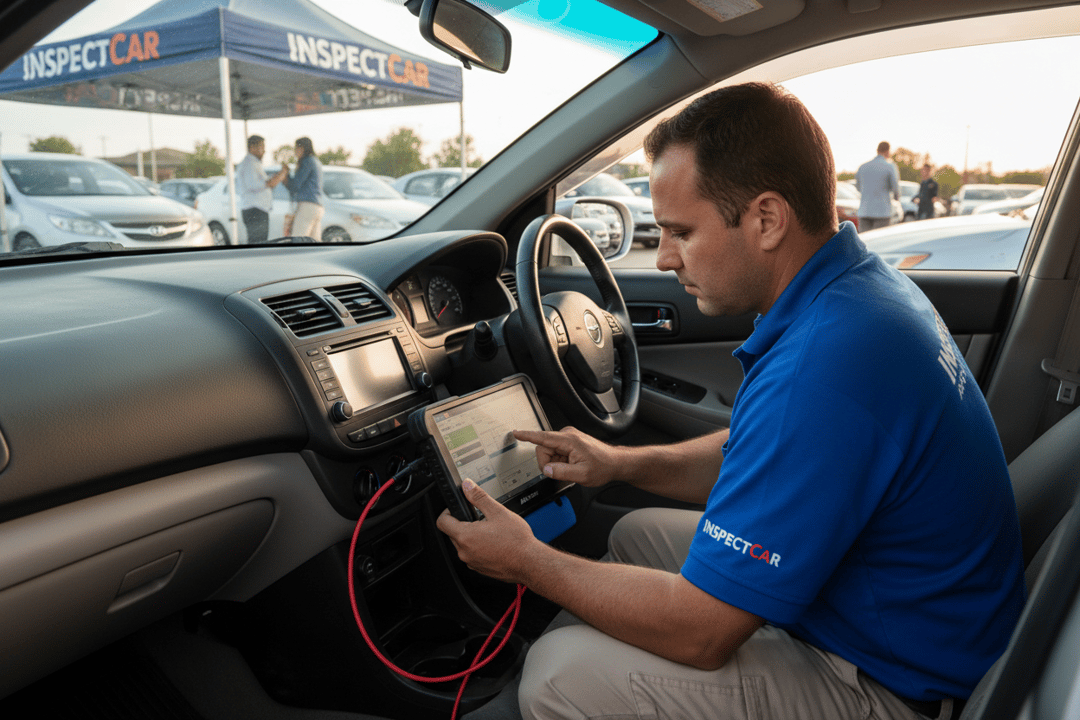
Many safety systems are electronically controlled and rely on complex sensor networks. An illuminated dashboard warning light does not always pinpoint the exact fault, which could be a minor loose connector or a catastrophic sensor failure. Without a proper diagnostic scan, you risk purchasing a vehicle where the ABS module is unresponsive or the airbag system is inactive.
Engineered sensors monitor everything from tire pressure to seat belt tension. A failure in these systems can disable the vehicle’s ability to communicate with the brakes or the stability control unit. Professional diagnostics are required to read error codes stored in the Engine Control Unit (ECU) to confirm the operational status of these safety-critical modules.
AutoFay Inspection Packages
Professional inspection services provide a technical baseline for the vehicle’s condition. AutoFay offers specialized on-location inspection services across all seven Emirates, covering over 410+ checkpoints across 25 distinct categories. These inspections go beyond a visual glance, utilizing High Definition photography to document every finding in a detailed PDF report.
Selecting the appropriate package ensures that specific safety-critical areas are thoroughly evaluated without paying for unnecessary services. The following table outlines the available tiers and their focus areas.
| Package | Price | Inclusions |
|---|---|---|
| Computer Diagnostic | AED 99 | Engine, Transmission, ABS, Airbag codes read and analyzed. |
| Body & Computer | AED 250 | Adds suspension, brakes, tires, and fluids to the diagnostic scan. |
| Comprehensive | AED 299 | Full vehicle check: Body/paint, Frame (rails/pillars), Engine sound, Road test, and all electronic systems. |
Visual and Mechanical Verification
A visual inspection must be paired with a mechanical road test to validate the safety features. The inspector should listen for abnormal noises that could indicate worn suspension bushings or failing brakes, both of which compromise handling and stopping power.
Panel-by-panel analysis is vital to identifying accidents. Original paint texture and gaps between panels must be consistent. If a door fits loosely or if the paint has a different orange peel effect than the rest of the car, the structural integrity may have been altered during a collision. Furthermore, the condition of the fluids is a direct indicator of long-term maintenance; degraded brake fluid, for example, cannot provide the hydraulic pressure necessary for modern safety systems to function.
Conclusion
Ensuring a coupe's safety is a multifaceted process involving structural analysis, electronic diagnostics, and mechanical performance testing. Neglecting these steps can lead to buying a vehicle with hidden defects that pose significant risks on the road. Relying on a experienced professional to interpret these complex data points is the only way to guarantee the vehicle's condition.
AutoFay inspects 410+ checkpoints with HD photos and PDF report. Book at autofay.ae or call +971542584458

0 Comments
No comments yet. Be the first to share your thoughts!