

Driving a convertible in the United Arab Emirates offers an unrivaled open-air experience, but it comes with financial implications that go beyond the sticker price. Insurers assess risk based on structural integrity, repair complexity, and vehicle reliability. A retractable roof inherently alters the vehicle's safety profile, which directly influences the premium an owner pays. Understanding these factors allows buyers to anticipate costs and make informed choices about vehicle maintenance and inspection.
The Structural Compromise of Convertibles
Insurance premiums for convertibles are typically higher than for their coupe counterparts due to the physics of the vehicle design. When the roof is removed, the structural rigidity of the cabin is reduced, making the passenger cell less effective at absorbing impact forces during a collision. Insurers categorize this as a higher liability risk, necessitating a higher premium to cover potential claims involving structural damage.
The mechanism that folds the roof is also a frequent point of failure. Complex hydraulic or electrical systems required to deploy a soft-top or retractable hard-top are expensive to repair. A mechanical failure in this system can render the vehicle undrivable or unsafe, further increasing the likelihood of a claim. Therefore, the inspection of the roof mechanism is paramount when determining the vehicle's long-term insurability.
The Frame: The Foundation of Risk Assessment
When assessing the value and insurability of a vehicle, the frame is the most critical component an inspector examines. The "rails" and "floor pan" constitute the skeleton of the car; any deviation from the manufacturer's specifications indicates past accident damage. Insurance providers view frame damage as a catastrophic risk because it compromises the vehicle's ability to protect occupants in a subsequent crash.
Even if the car appears to drive straight, internal frame damage can affect handling and safety. A professional inspection identifies these hidden defects before a buyer hands over cash or before an insurance company underwrites a policy. If a vehicle has a history of frame correction, it may be deemed a "totaled" risk in the eyes of an insurer, leading to significantly higher premiums or outright denial of coverage.
Key Inspection Categories for Structural Integrity
- Rail Integrity: Verifying the straightness of the side rails to ensure the chassis has not been bent.
- Pillar Condition: Checking the A, B, and C-pillars for stress fractures or uneven gaps that suggest collision impact.
- Floor Pan Inspection: Assessing the bottom of the cabin for rust, corrosion, or damage from road debris.
- Roof Seal Integrity: Ensuring the mechanism is free of rust and leaks that could cause interior water damage.
Engine Health and Transmission Reliability
The condition of the powertrain is a primary determinant of insurance premiums. Convertibles often feature high-performance engines that demand specific maintenance schedules. If an engine exhibits excessive smoke, unusual noises, or poor compression, the likelihood of catastrophic mechanical failure rises. An insurer calculates premiums based on the probability of a claim; a vehicle with pre-existing engine issues is a mathematical certainty for future claims.
Transmission health is equally important. A slipping transmission or a unit that hesitates to engage gears introduces a safety hazard, particularly in heavy traffic or highway merging scenarios. Insurers require evidence that the vehicle is mechanically sound before assuming the risk.
Braking, Suspension, and Road Test Analysis
Stopping distance and handling stability are non-negotiable safety factors that heavily influence insurance rates. During a comprehensive inspection, the percentage of brake pad wear is calculated to determine the remaining life of the braking system. Insurance companies prefer vehicles with healthy brakes; worn pads indicate a higher likelihood of an accident and immediate repair costs.
Similarly, the suspension system dictates how the vehicle reacts to undulations in the Dubai and Abu Dhabi roads. A worn suspension leads to poor handling, especially at high speeds, increasing the risk of rollovers or loss of control. Suspension components, including shocks and struts, must be rated within specific limits to ensure the vehicle remains safe and stable.
The Road Test Findings
- Acceleration: Verifying that the engine delivers power smoothly without hesitation or hesitation.
- Braking Performance: Testing pedal feel and stopping power across various speeds to ensure system responsiveness.
- Noise and Vibration: Identifying abnormal sounds from the drivetrain that may indicate bearing or transmission failure.
- Steering Alignment: Ensuring the wheel stays straight without constant correction from the driver.
The Role of Diagnostics and OBD Scans
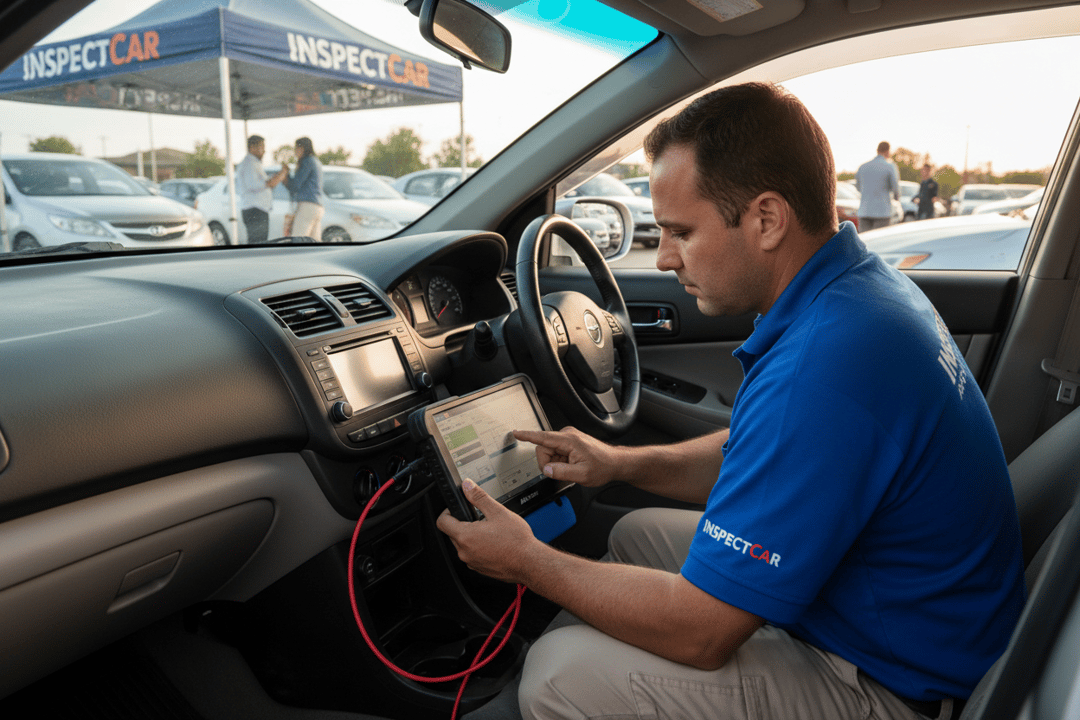
Modern vehicles rely on complex electronic systems to manage engine timing, emissions, and safety features. An On-Board Diagnostics (OBD) scan is an essential tool for uncovering errors that may not be immediately visible during a visual inspection. Codes stored in the engine, transmission, ABS, or airbag systems reveal hidden faults that could lead to breakdowns or expensive repairs.
Insurance providers appreciate transparency in vehicle history. A vehicle with a clean OBD scan demonstrates that the owner has maintained the car’s electronic integrity. Conversely, a vehicle with unresolved fault codes suggests a history of neglect, which justifies higher premiums to mitigate the risk of future electronic system failures.
Strategic Inspection Packages to Mitigate Risk
Acquiring accurate data about a vehicle’s condition is the most effective way to manage insurance costs. Buying a vehicle without a professional inspection exposes the buyer to the inspection findings that drive up premiums. AutoFay provides a on-location inspection service that covers all seven Emirates, offering a detailed analysis of the vehicle's state.
Choosing the right inspection package ensures that the specific areas of concern for insurance calculations are thoroughly examined. A basic computer diagnostic can identify engine faults, while a comprehensive package covers the full gamut of mechanical and structural health.
| Package Name | Price (AED) | Key Inclusions |
|---|---|---|
| Computer Diagnostic | 99 | Engine, transmission, ABS, and airbag code scanning. |
| Body & Computer | 250 | Panel-by-panel paint analysis, rust assessment, and OBD scanning. |
| Comprehensive Inspection | 399 | Full 410+ checkpoint analysis including frame, fluids, tires, and road test. |
These packages are designed to provide the evidence needed to negotiate a fair price or secure an appropriate insurance policy. By identifying issues such as bent frames or failing brakes before purchase, a buyer can avoid inheriting a vehicle with a high risk profile.
Securing accurate data regarding a convertible's condition is the only way to ensure fair valuation and appropriate coverage. A professional inspection provides the objective evidence needed to assess risk accurately. Do not rely on visual cues alone; rely on a professional evaluation. AutoFay inspects 410+ checkpoints with HD photos and PDF report. Book at autofay.ae or call +971542584458.


0 Comments
No comments yet. Be the first to share your thoughts!