

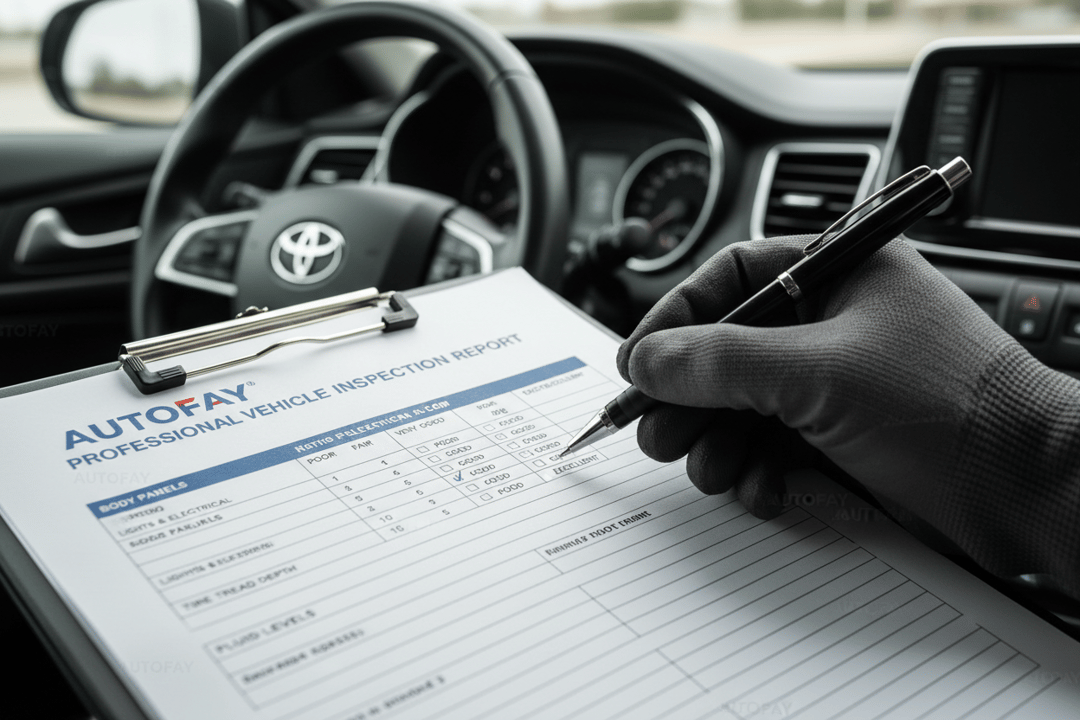
A vehicle inspection report filled with checkmarks and ratings is worthless if you do not understand what each rating means. AutoFay uses graduated rating scales rather than simple pass/fail marks — because the difference between Good and Average, or between Seeping and Leaking, determines whether a finding is informational, worth monitoring, or requires immediate action.
Color-Coded Results: Green, Yellow, Red
The report uses a three-color system for quick interpretation. Green indicates the component is in good condition and requires no action. Yellow means the component shows wear or has been previously repaired — it is functional but worth noting for future maintenance planning. Red indicates a significant issue that requires attention before or shortly after purchase. This color coding lets you scan the entire report in minutes and identify areas that need deeper reading.
Body and Paint: What Original, Repainted, and Replaced Mean
Every body panel receives two separate ratings. The condition rating includes No Visible Fault, Dent, Repainted, Repaired, Scratch, Multiple Scratches, Replaced, and Damaged. The paint rating is Original, Repainted, or Total Repainted. Understanding the difference matters: a panel rated Original with a Minor Scratch is a cosmetic issue. A panel rated Replaced tells you that panel was removed and a new one installed — typically indicating significant damage from an accident.
Repainted means the panel has been painted over its original finish, usually to hide scratches, dents, or prior damage. Total Repainted means the entire panel was stripped and refinished. Neither is inherently bad, but they affect value and indicate history. When multiple adjacent panels are repainted — for example, the front left door and the front left fender — it suggests a single incident affected that side of the car.
Brake Ratings: The Percentage Scale
Brake pad life is rated on a percentage scale: Good (over 50%), Average (25-50%), Worn (under 25%), and Needs Replacement. Good means the pads have more than half their usable material remaining. Average means you have some life left but should plan for replacement within the next few months. Worn means replacement should happen soon — the pads are approaching the minimum safe thickness. Needs Replacement means the pads are at or below minimum and the car should not be driven extensively until they are changed.
Brake rotors use a condition scale: Good, Scored, Warped, or Needs Replacement. Scored rotors have grooves cut into the surface from worn brake pads — they can sometimes be resurfaced. Warped rotors cause the brake pedal to pulsate during braking and typically need replacement.
Fluid Conditions: What Colors Mean
Each fluid is rated for both level and condition. Engine oil condition rated Clean means recently changed and properly maintained. Dark is normal for oil with several thousand kilometers of use. Dirty indicates overdue change. Milky suggests coolant contamination — a serious engine problem. Coolant condition rated Oily similarly indicates cross-contamination between oil and coolant systems.
Transmission fluid rated Good is clean and translucent. Acceptable shows some darkening from use. Dirty means it is overdue for service. Burnt Smell indicates the fluid has been overheated — a sign of transmission stress. Contaminated means foreign material is present in the fluid.
OBD Results: No Faults, Stored, Active
The OBD scan results for each system — engine, transmission, ABS, airbag/SRS, and body control module — use three ratings. No Faults means the system has no current or historical error codes. Stored Codes means the system recorded a fault in the past that is no longer active — it may have been resolved or may recur. Active Faults means the problem is happening now. Active faults in safety systems like ABS or airbags are red-level findings that require immediate attention.
Road Test Ratings: The Driving Experience
The road test provides subjective but structured assessments. Engine performance, acceleration, transmission shifting, braking performance, steering feel, and ride comfort each get graduated ratings from Excellent through Good, to Average or Poor. Vibrations are rated by when they occur — None, At Idle, At Speed, During Braking, or Constant. Unusual noises are categorized — None, Clicking, Grinding, Squealing, or Knocking — and documented so you know exactly what the inspector experienced during the test drive.
AutoFay checks 410+ checkpoints with HD photos and a detailed PDF report. On-location inspection across all 7 Emirates. Book at autofay.ae or call +971-54-258-4458.




0 Comments
No comments yet. Be the first to share your thoughts!