

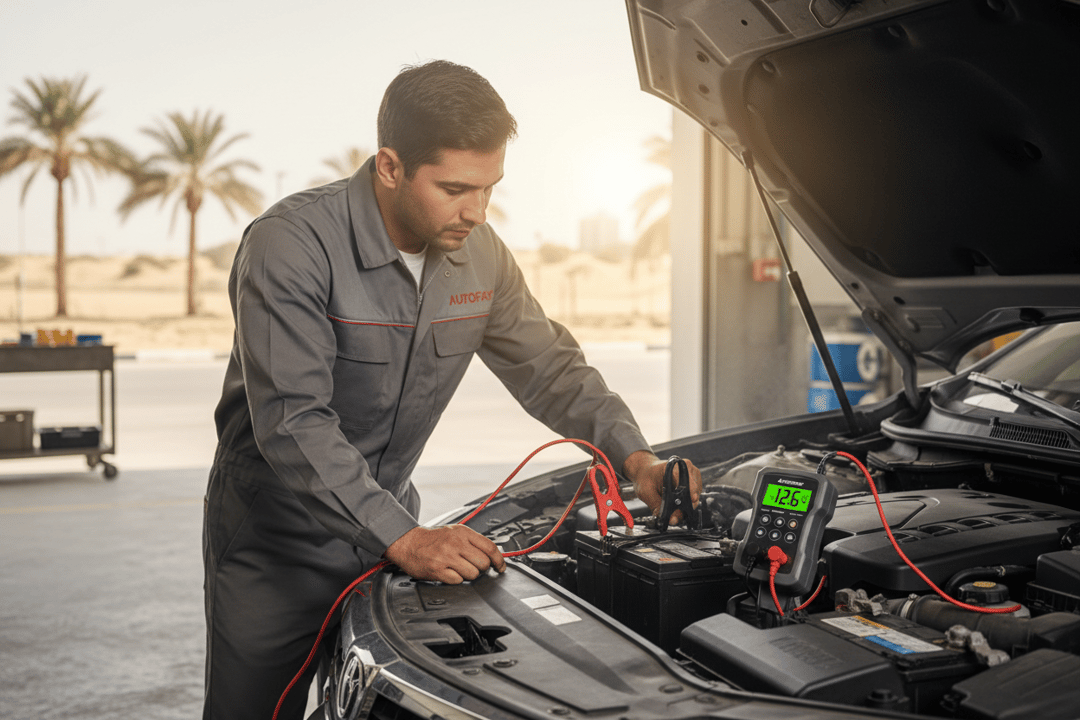
Opening the hood reveals the mechanical heart of the car. But beyond the engine itself, the engine bay contains dozens of components that keep everything running — the battery that starts the car, the belts that drive accessories, the alternator that charges the electrical system, and the air filtration that protects the engine. AutoFay inspects 17 under-the-hood checkpoints to evaluate these supporting systems.
Battery: The Starting Point
Battery Terminals are rated Clean, Corroded, or Loose. Corroded terminals — visible as a white or greenish powder buildup — create resistance that reduces the voltage reaching the starter. This causes slow cranking and can prevent starting entirely. Battery Cables are checked for condition — Good, Worn, or Damaged. Frayed or cracked cables are a fire risk. The Battery Mount is verified as Secure, Loose, or Missing. A loose battery can shift during hard braking or turns, potentially shorting against surrounding metal. Battery Capacity is recorded — this measurement tells you how much life remains in the battery and whether it can reliably start the car in all conditions.
Starter, Alternator, and Electrical
The Starter is rated Working, Slow Crank, Grinding, or Not Working. Slow crank means the starter turns the engine sluggishly — either the battery is weak or the starter motor itself is wearing out. A grinding noise during starting indicates the starter gear is not engaging the flywheel cleanly. The Alternator is rated Working, Weak Output, or Not Working. A weak alternator charges the battery below specification, leading to gradual battery drain and eventual no-start conditions. The Fuse Box Condition is inspected for corrosion or missing fuses that could disable various electrical systems.
Belts, Filters, and Air Intake
Drive and Accessory Belts are rated Good, Worn, Cracked, or Needs Replacement. These belts drive the alternator, power steering pump, AC compressor, and sometimes the water pump. A cracked belt can snap without warning, disabling multiple systems simultaneously. In UAE heat, rubber belts degrade faster — heat breaks down the rubber compound and causes surface cracking that is visible during inspection. The Engine Air Filter is checked as Clean, Dirty, or Needs Replacement. UAE air carries significantly more dust and sand particles than most environments, which means air filters clog faster and need more frequent replacement. A clogged air filter restricts airflow to the engine, reducing performance and fuel efficiency.
The Air Intake System is assessed as Good, Dirty, or Damaged. The Throttle Body is rated Clean, Dirty, or Needs Cleaning — a dirty throttle body causes rough idling and hesitation during acceleration. The MAF (Mass Air Flow) Sensor is checked as Good, Dirty, or Faulty — this sensor measures incoming air volume, and a dirty MAF sensor sends incorrect readings to the engine computer, causing poor fuel mixture and reduced performance. The PCV (Positive Crankcase Ventilation) Valve is tested.
Power Steering and Engine Bay Condition
The Power Steering Pump is rated Working, Noisy, Leaking, or N/A for electric power steering vehicles. A noisy power steering pump — whining when turning the wheel — typically indicates low fluid or a failing pump bearing. Hood Shocks and Struts are tested — these gas struts hold the hood open, and when they weaken, the hood will not stay up on its own. The Horn is tested for function. Engine Bay Cleanliness is noted as Clean, Dirty, or Very Dirty. A very dirty engine bay makes it harder to spot leaks and indicates general maintenance neglect, while an excessively clean bay on a high-mileage vehicle could mean it was steam-cleaned to hide oil leaks.
AutoFay checks 410+ checkpoints including 17 under-the-hood checkpoints, with HD photos and a detailed PDF report. On-location inspection across all 7 Emirates. Book at autofay.ae or call +971-54-258-4458.



0 Comments
No comments yet. Be the first to share your thoughts!