
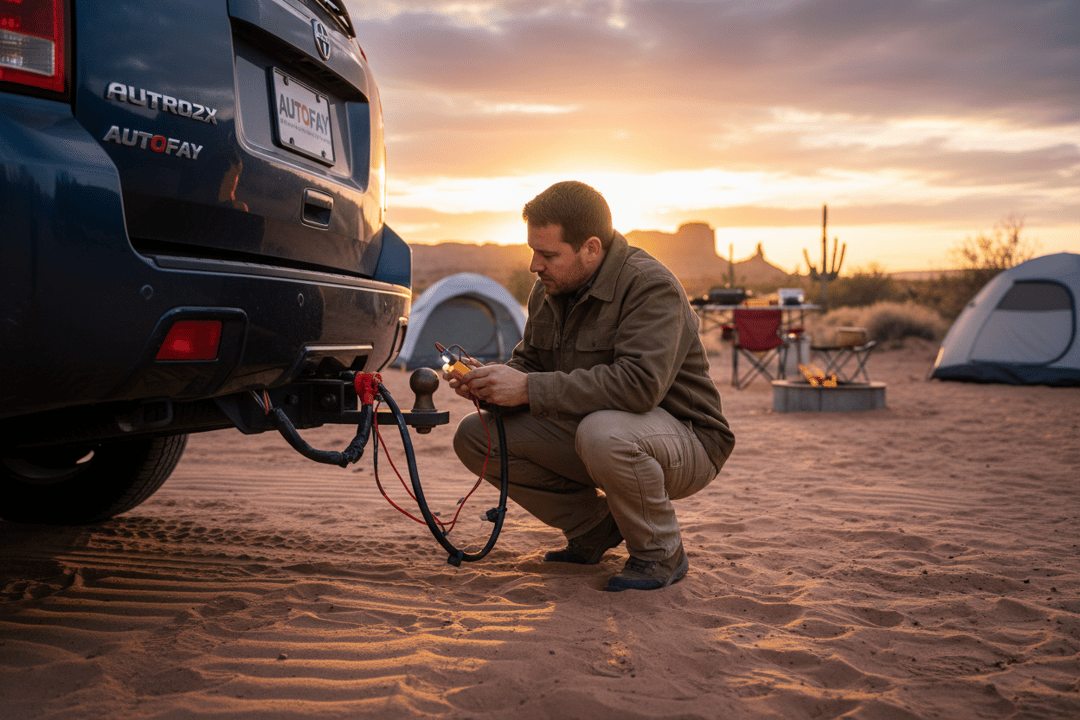
The UAE's outdoor lifestyle — desert camping, boat launching, jet ski transport, and caravan trips — means many vehicles are used for towing. A used vehicle with towing history has experienced mechanical stress that a non-towing vehicle has not. Even if the seller does not mention towing, the inspection can reveal the telltale signs. AutoFay's comprehensive inspection covers the specific components that towing affects most, providing buyers with clear information about whether a vehicle has been worked hard.
Tow Hitch and Trailer Wiring: Direct Evidence
AutoFay's exterior features inspection checks the tow hitch — rated Good, Rusted, Damaged, or N/A. The presence of a tow hitch is the most obvious indicator of towing use. The hitch is inspected for rust, bent components, and wear patterns on the ball mount that indicate regular use. The trailer wiring connector is checked separately — Working, Not Working, or N/A. A working connector with weathered wiring confirms active towing use.
Even when a tow hitch has been removed, inspectors look for mounting holes in the rear bumper support or frame, which are documented in the frame condition section. The rear bumper condition (No Visible Fault through Damaged) and rear bumper paint may show scuff marks or discoloration from trailer coupler contact.
Transmission: The Component That Suffers Most
Towing puts the transmission under sustained heavy load, especially in UAE heat. AutoFay rates transmission operation as Smooth, Slight Delay, Hard Shifting, or Slipping. A transmission that has been used for regular towing may shift differently than one that has not — delayed engagement from park to drive, slight flare between gears, or a shudder under load can all indicate heat-related wear.
Transmission fluid condition is the key indicator — Good, Acceptable, Dirty, Burnt Smell, Contaminated, or Needs Replacement. Burnt-smelling transmission fluid on a vehicle with a tow hitch is strong evidence of towing under thermal stress. Transmission mounts are checked — worn or broken mounts from the additional strain of towing loads transfer vibration to the cabin.
Cooling System: Heat Is the Enemy
Towing increases engine and transmission operating temperatures significantly. AutoFay checks the complete cooling system — radiator condition, radiator cap, cooling fans, water pump, coolant overflow tank, cooling hoses, hose clamps, and coolant leaks. A vehicle that has towed in UAE summer conditions has pushed its cooling system to the limit repeatedly. Cooling hoses rated as Soft or Cracked may have been weakened by sustained high temperatures.
Coolant level and condition are assessed — Low level or Contaminated coolant on a towing vehicle suggests the system has been stressed. Engine oil condition is checked because sustained high temperatures cause oil to break down faster. The engine air filter is assessed — a vehicle that tows in dusty conditions accumulates contamination faster.
Brakes: Stopping the Combined Weight
Towing increases braking demands proportionally to the additional weight. Front and rear brake pads are rated on remaining life — a towing vehicle with worn pads at relatively low mileage confirms heavy use. Brake rotors are checked for scoring and warping — warped rotors from repeated hard braking while loaded are a common finding on towing vehicles. Brake fluid condition reflects heat exposure — Dark or Contaminated fluid may have been overheated.
The brake booster is checked — Working, Weak, or Not Working. A brake booster that feels weak on a full-size SUV may be adequate for the vehicle alone but insufficient when towing. The parking brake is tested — Working, Weak, Not Holding, or Not Working. A parking brake that does not hold reliably is a safety concern for any vehicle used to tow on inclines.
Suspension and Frame: Load-Bearing Assessment
Rear suspension components bear additional load during towing. Rear shocks/struts are rated individually — Worn or Needs Replacement findings on a towing vehicle are expected at lower mileages than non-towing vehicles. Rear coil springs or leaf springs are checked for sagging. The frame is inspected with particular attention to the rear section — rear rails, rear bumper support, and trunk floor condition all reflect how the vehicle has handled towing loads.
Wheel bearings are checked for noise — towing increases bearing load and accelerates wear, producing humming or growling sounds. Rear tires may show different wear patterns from the additional weight — tread depth, wear pattern, and tire age are documented per wheel.
AutoFay checks 410+ checkpoints including towing-related wear assessment, with HD photos and a detailed PDF report. On-location inspection across all 7 Emirates. Book at autofay.ae or call +971-54-258-4458.


0 Comments
No comments yet. Be the first to share your thoughts!