
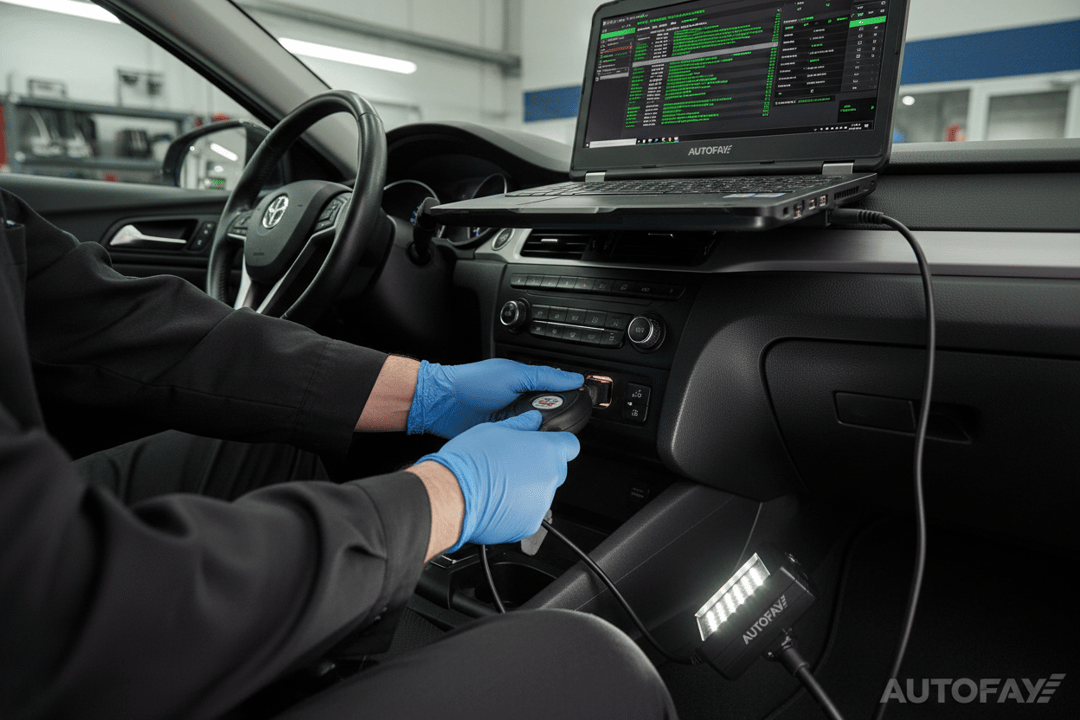
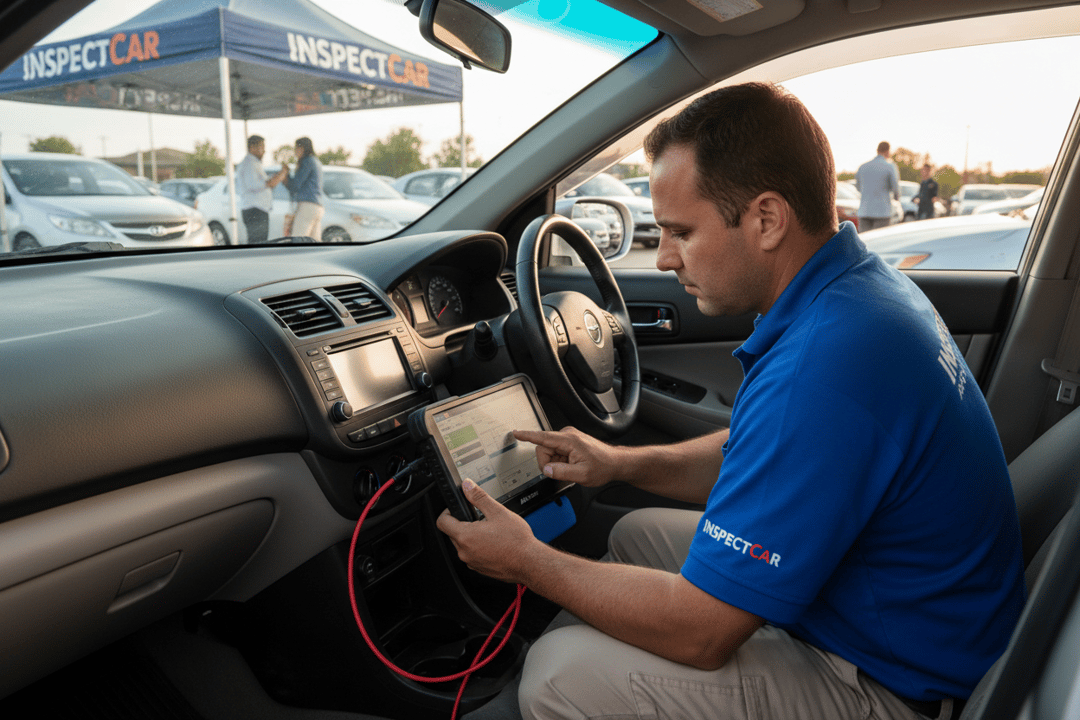
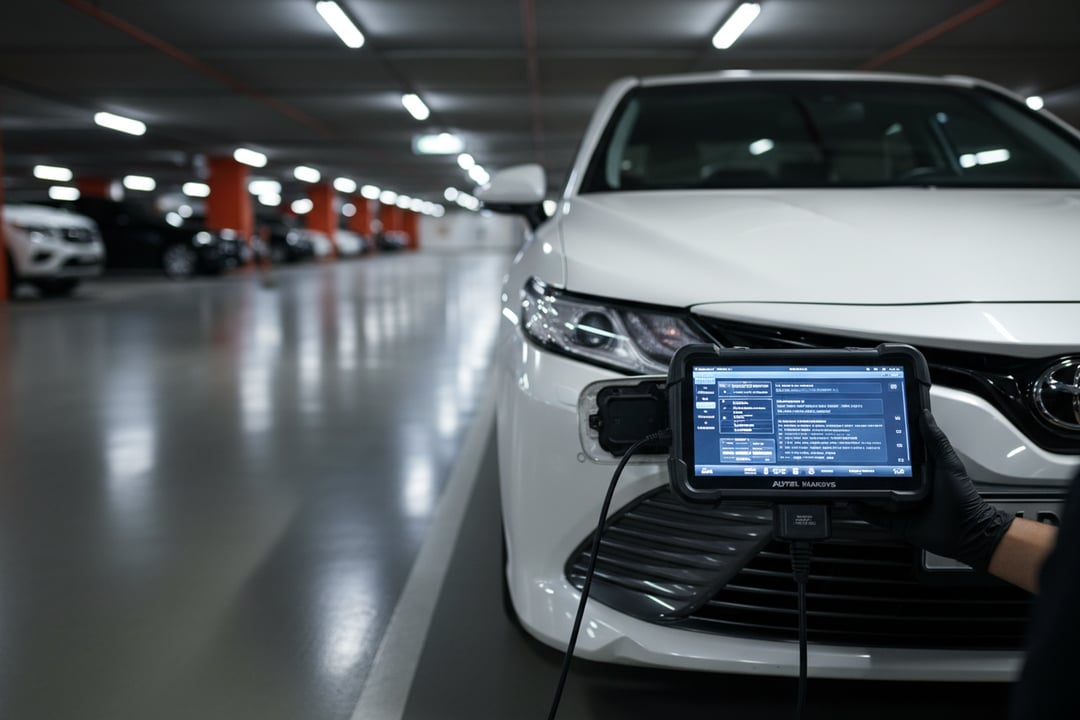
An engine can run smoothly during a test drive and still carry fault codes that indicate developing problems. The OBD (On-Board Diagnostics) scanner connects to the car's diagnostic port and reads trouble codes stored by the engine management computer. AutoFay's diagnostic scan checks engine fault codes as one of five system categories, rating the engine as No Faults, Stored Codes, or Active Faults. Here are the engine issues that appear most frequently in UAE inspection reports.
Misfire Codes: P0300 Through P0312
Engine misfire codes are among the most common findings. A misfire means one or more cylinders failed to ignite the fuel-air mixture properly. P0300 indicates a random misfire across multiple cylinders. P0301 through P0312 identify the specific cylinder — P0301 is cylinder 1, P0302 is cylinder 2, and so on. A single-cylinder misfire often points to a failing ignition coil or spark plug. A random multi-cylinder misfire suggests a fuel delivery problem, intake air leak, or worn injectors.
Misfires are especially relevant in the UAE because extreme under-hood temperatures accelerate ignition coil degradation. The rubber boots on coil packs harden and crack, allowing electrical arcing that weakens the spark. During the engine inspection, the inspector also checks for abnormal engine noises — a misfiring engine may produce a rough idle rated as Rough Idle rather than Normal, confirming the OBD findings with physical symptoms.
Oxygen Sensor Codes: P0130 Through P0167
Oxygen sensors monitor exhaust gas composition and help the engine computer adjust the fuel mixture. These sensors operate in extreme heat — mounted in the exhaust manifold and downstream of the catalytic converter — making them prone to degradation in UAE temperatures. Common codes include P0130 (O2 sensor circuit malfunction, Bank 1 Sensor 1) and P0136 (Bank 1 Sensor 2, downstream).
A failing oxygen sensor causes the engine to run either too rich or too lean. Running rich wastes fuel and can damage the catalytic converter over time. Running lean produces more heat, increasing the risk of engine damage. During the exhaust and emissions inspection, the inspector checks the oxygen sensors as Working, Faulty, or Code Present, and the catalytic converter for rattling, clogging, or absence — a downstream consequence of prolonged oxygen sensor failure.
Evaporative Emission System: P0440 Through P0457
The evaporative emission (EVAP) system captures fuel vapors from the tank and feeds them into the engine for combustion rather than releasing them into the atmosphere. In the UAE, extreme heat increases fuel vapor pressure inside the tank, stressing the EVAP system's seals, hoses, and purge valve. Common codes include P0440 (general EVAP malfunction), P0442 (small leak detected), P0455 (large leak detected), and P0456 (very small leak detected).
EVAP codes often correlate with the fuel system inspection findings. The fuel cap is checked — Good, Loose, or Missing — because a loose fuel cap is the simplest cause of an EVAP code. Fuel lines are checked for wear and leaks. A fuel smell rated as Slight or Strong during the inspection can indicate an EVAP leak that is releasing vapors. While EVAP codes are not immediately dangerous, they indicate a system that is not functioning correctly and will cause a check engine light.
Catalytic Converter Efficiency: P0420 and P0430
These codes indicate the catalytic converter is not processing exhaust gases efficiently. P0420 applies to Bank 1, P0430 to Bank 2 on V-configuration engines. The converter degrades over time from sustained high-temperature operation — a condition that defines UAE driving. A converter that has been damaged by running rich due to a failed oxygen sensor will trigger these codes even after the oxygen sensor is replaced.
During the exhaust inspection, the catalytic converter is rated No Visible Fault, Rattling, Clogged, or Missing. A rattling converter has internal substrate that has broken apart. A clogged converter restricts exhaust flow, reducing engine performance and potentially causing overheating. The exhaust smoke check — None, White, Blue, or Black — provides additional context. Blue smoke combined with a P0420 code suggests oil is entering the combustion chamber and damaging the converter.
Coolant Temperature and Thermostat Codes
Engine coolant temperature codes appear when the cooling system is not maintaining proper operating temperature. In the UAE, the cooling system works under constant stress from ambient temperatures above 45 degrees Celsius in summer. The cooling system inspection checks the radiator condition, radiator cap, cooling fans, water pump, coolant overflow tank, cooling hoses, and hose clamps — each with specific condition ratings. Coolant leaks are rated None, Minor, or Major.
A thermostat that sticks open keeps the engine running too cool, triggering an OBD code and causing poor fuel economy. A thermostat that sticks closed causes overheating, which can lead to head gasket failure — one of the most expensive engine repairs. The coolant condition check — Clean, Dirty, Contaminated, or Oily — is particularly revealing. Oily coolant is a strong indicator of head gasket failure, where engine oil has entered the cooling system.
What Cleared Codes Tell You
When the OBD scanner shows that readiness monitors are not complete — meaning the system has not finished its self-testing cycle — it often indicates the codes were recently cleared. The inspector notes this finding because a recent code clear is an attempt to hide problems. The engine may run perfectly today, but the fault codes will return within a few drive cycles once the system completes its monitors.
AutoFay includes comprehensive OBD scanning in every 410+ checkpoint inspection, with HD photos and a detailed PDF report. On-location inspection across all 7 Emirates. Book at autofay.ae or call +971-54-258-4458.


0 Comments
No comments yet. Be the first to share your thoughts!