

Driving a sedan in the harsh environment of the UAE demands rigorous scrutiny of rubber components. Tires are the sole contact point between the vehicle and the road surface, dictating handling, braking, and fuel efficiency. The extreme temperatures and high speeds common in the Emirates accelerate tire degradation, making inspection critical. A visual assessment by a layperson often misses subtle but dangerous defects. Professional evaluation ensures the vehicle is safe for daily commuting and highway travel.
The Critical Role of Tires in Sedan Dynamics
Sedans possess unique weight distribution and suspension characteristics compared to SUVs or coupes. This places specific demands on the tires regarding load-bearing capacity and cornering stability. Under-inflation increases rolling resistance, causing heat buildup that can lead to a blowout at high velocities. Conversely, over-inflation reduces the tire's contact patch, diminishing traction during sudden maneuvers or emergency braking. Both scenarios compromise the safety envelope of a passenger vehicle.
The sidewall of a tire acts as the backbone for the vehicle's weight. When the sidewall is compromised, the structural integrity of the tire fails, regardless of the tread depth. Inspectors must distinguish between normal cosmetic marks and structural damage that requires immediate replacement. Sedan owners must prioritize these checks to mitigate the risks associated with desert terrain and urban traffic.
Manufacturing Date: The Hidden Danger
Tires possess a finite lifespan that is independent of their mileage. Manufacturers adhere to strict guidelines regarding the storage and usage of rubber compounds. The manufacturing date is encoded on the tire's sidewall, typically in the DOT code. Understanding this code is essential for avoiding vehicles with aged rubber that has lost its elasticity.
- DOT Code Structure: The last four digits represent the week and year of production. For instance, 2521 indicates the 25th week of 2021.
- Age Factor: Rubber compounds degrade over time due to oxidation and UV exposure. A tire manufactured 6 to 10 years ago may exhibit dry rot even with minimal use.
- Heat Impact: The UAE climate subjects tires to extreme thermal cycling. Old tires become brittle, increasing the likelihood of sudden tread separation.
Using a calendar or a smartphone converter to read the DOT code is a necessary step in the inspection process. Inspectors verify this date to ensure the tires have not exceeded their manufacturer's recommended service life. Purchasing a used sedan with tires near the end of their lifecycle poses a significant liability.
Tread Depth Analysis and Safety Metrics
Tread depth directly correlates with a vehicle's ability to disperse water. In the UAE, sudden downpours can create slick conditions on highways. Insufficient tread depth leads to hydroplaning, where the tire loses contact with the road surface entirely. The legal minimum tread depth in the UAE is 1.6mm, but this is the absolute limit for road use, not a safe operating standard.
Visual indicators are built into the tire design to signal when replacement is necessary. Tread wear bars appear as small bridges of rubber between the tread lugs. When these bars become flush with the adjacent tread blocks, the tire has reached the legal limit. Sedans require a higher degree of safety margin than commercial vehicles, making 2mm or greater tread depth preferable for optimal stopping distances.
| Tread Depth (mm) | Safety Classification | Risk Assessment |
|---|---|---|
| > 3.0 mm | Optimal Performance | Excellent wet braking and high-speed stability. |
| 1.6 mm - 3.0 mm | Legal but Critical | Reduced traction in rain; increased stopping distance. |
| < 1.6 mm | Illegal / Dangerous | High risk of hydroplaning and tire failure. |
Uneven Wear Patterns
Uneven tread wear acts as a diagnostic tool for the vehicle's suspension and alignment. Cupping, scalloping, or feathering indicates mechanical faults that require immediate attention. For example, inner or outer shoulder wear suggests an alignment issue, while center wear points to over-inflation. Inspecting these patterns helps buyers understand the potential repair costs associated with the vehicle's chassis.
- Center Wear: Indicates the tire is over-inflated. The center of the tire bears the most load, wearing down faster.
- Edge Wear: Suggests under-inflation or incorrect toe angles. The tire squirms while cornering, causing rapid degradation at the edges.
- Cupping (Scalloping):> Often a sign of worn shocks or struts. The tire bounces on the road surface, leaving a scalloped pattern.
Sidewall Integrity and Structural Defects
The sidewall of a tire is the most vulnerable component, yet it bears the vehicle's entire weight. Inspectors must look for signs of impact damage and chemical degradation. The heat in the UAE accelerates the breakdown of rubber, leading to cracking known as dry rot. These cracks can propagate quickly, leading to sudden tire failure.
Bulges on the sidewall are a critical warning sign. They indicate that the internal steel belts have separated from the casing, often due to hitting a pothole or hitting the curb. A bulging tire will not hold air pressure correctly and is unsafe for highway driving. Inspectors use a flashlight to inspect the sidewall closely, looking for hairline fractures or bubbles that may not be visible to the naked eye.
Wheel Alignment and Balancing
Proper wheel alignment ensures the tires make uniform contact with the road. Misalignment causes rapid, irregular tire wear and can pull the vehicle to one side while driving. This not only wears out the tires prematurely but also reduces fuel efficiency. Sedans with electronic stability control rely on accurate wheel speed sensors; worn tires can send erroneous data to the vehicle's computer.
Wheel balancing ensures that the tire spins evenly without vibration. Imbalance causes the steering wheel to shake at high speeds, leading to driver fatigue and potential damage to suspension components. Inspectors verify that the tires are properly balanced and that the valve stems are intact and free from corrosion, which can cause slow leaks.
Professional Inspection Standards
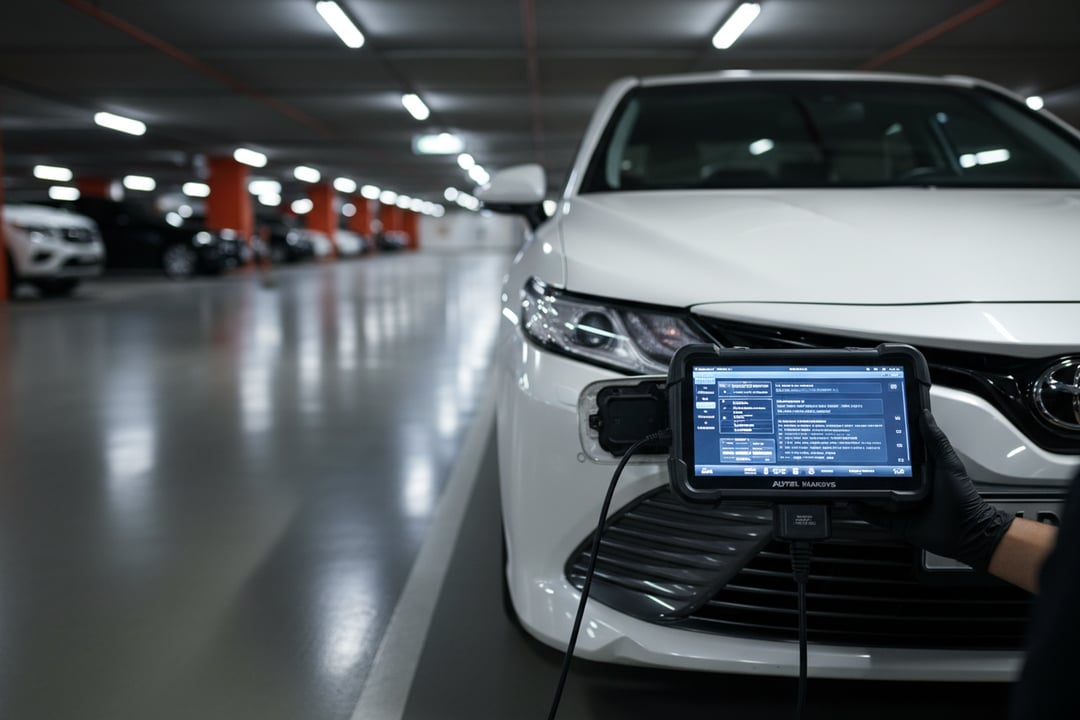
A visual inspection is insufficient for assessing the true condition of a used sedan. Mechanical faults often hide behind cosmetic panels. AutoFay provides a comprehensive inspection service that covers 410+ checkpoints across 25 distinct categories. The Tires category specifically targets the manufacturing date, tread depth, and structural integrity of the rubber components.
Our inspection process utilizes high-definition photography to document the condition of every wheel. We generate detailed PDF reports that highlight specific defects. This transparency allows buyers to make objective decisions based on data rather than assumption. Our inspections operate across all 7 Emirates, bringing professional inspection to the seller's location.
The inspection packages offered by AutoFay provide varying levels of detail. The Computer Diagnostic package for AED 99 includes an OBD scan for engine and transmission codes. The Body & Computer package for AED 250 adds a panel-by-panel paint and body assessment. The Comprehensive package for AED 299 covers all categories, including a full road test to evaluate acceleration, braking, and noise levels under load.
Investing in a professional inspection mitigates the risk of purchasing a vehicle with hidden tire defects. Tires are a safety-critical component that cannot be replaced without significant expense. The cost of a proper inspection is negligible compared to the cost of a tire blowout or the repair of associated suspension damage. By verifying the condition of the tires, buyers ensure the vehicle will perform reliably in the demanding UAE climate.
AutoFay inspects 410+ checkpoints with HD photos and PDF report. Book at autofay.ae or call +971542584458.



0 Comments
No comments yet. Be the first to share your thoughts!