
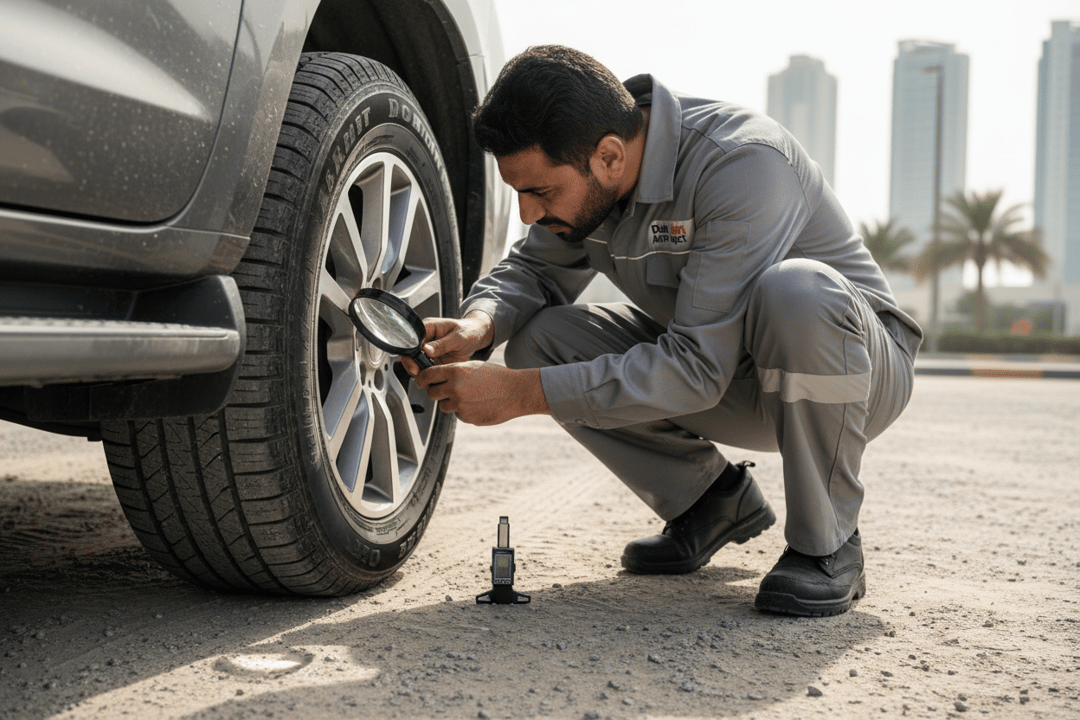
Tires are the only contact between your car and the road. Four patches of rubber, each roughly the size of a hand, carry the entire weight of the vehicle and determine how well it stops, turns, and grips in wet conditions. Our tire inspection checks each wheel individually — because mismatched tires are more common than most buyers realize.
Per-Wheel Inspection: Why Each Tire Gets Its Own Assessment
AutoFay inspects each tire separately. For all four positions — front right, front left, rear right, rear left — we record the manufacturing year and rate the condition: Good, Cracked, Bulge, Damaged, or Needs Replacement. The spare tire is checked separately for condition and pressure. A tire might look fine on the surface but carry sidewall cracks from UV exposure or a bulge from impact damage that makes it unsafe at highway speed.
Manufacturing date matters because rubber degrades over time regardless of tread depth. A tire with plenty of tread but manufactured five or more years ago has hardened rubber that grips poorly, especially in wet conditions. The manufacturing date is printed on every tire sidewall as a four-digit code — the first two digits are the week, the last two are the year. Our inspectors record this for each tire.
Wear Patterns Tell the Alignment Story
The way a tire wears reveals problems elsewhere in the car. Even wear across the tread surface indicates proper alignment and inflation. Inner edge wear suggests negative camber — the top of the wheel is tilted inward, which can result from worn suspension components or a previous impact. Outer edge wear points to positive camber. Center wear means the tires have been consistently overinflated, while wear on both edges indicates underinflation.
Cupping — a scalloped pattern around the circumference — is the most concerning wear pattern. It usually indicates worn shocks or struts that allow the tire to bounce rather than maintain consistent contact with the road. A car with cupped tires needs suspension work, not just new tires.
Wheels, Bearings, and TPMS
Rim condition is checked for scratches, bends, and cracks. A bent rim causes vibration at speed and can slowly leak air. Cracked rims are a safety hazard — they can fail without warning. Lug nuts are verified as all present and properly seated. Wheel center caps and hub condition are noted for completeness.
Wheel bearings are checked by listening for noise — a worn bearing produces a humming or growling sound that changes with speed and gets louder in turns. TPMS (Tire Pressure Monitoring System) sensors are verified: All Working, Warning On, or Faulty. A TPMS warning light could mean a faulty sensor or an actual pressure problem — the inspection determines which.
Tires in UAE: Heat, Speed, and Sand
UAE roads are among the harshest environments for tires. Summer asphalt temperatures can exceed 70°C, which accelerates rubber degradation and increases blowout risk on underinflated tires. Highway driving at sustained high speeds generates additional heat. Cars that do regular desert trips accumulate sand between the tire and rim, which can cause slow leaks and imbalanced rotation.
Tire age is especially critical in the UAE. UV exposure is intense year-round, and tires stored outdoors at dealerships may already have degraded before being installed. Our inspectors flag any tire older than four years, regardless of remaining tread depth, because the rubber compound has likely lost significant grip capability.
AutoFay inspects 410 checkpoints including per-wheel tire and wheel assessment, with HD photos and a detailed PDF report. On-location inspection across all 7 Emirates. Book at autofay.ae or call +971-54-258-4458.




0 Comments
No comments yet. Be the first to share your thoughts!