

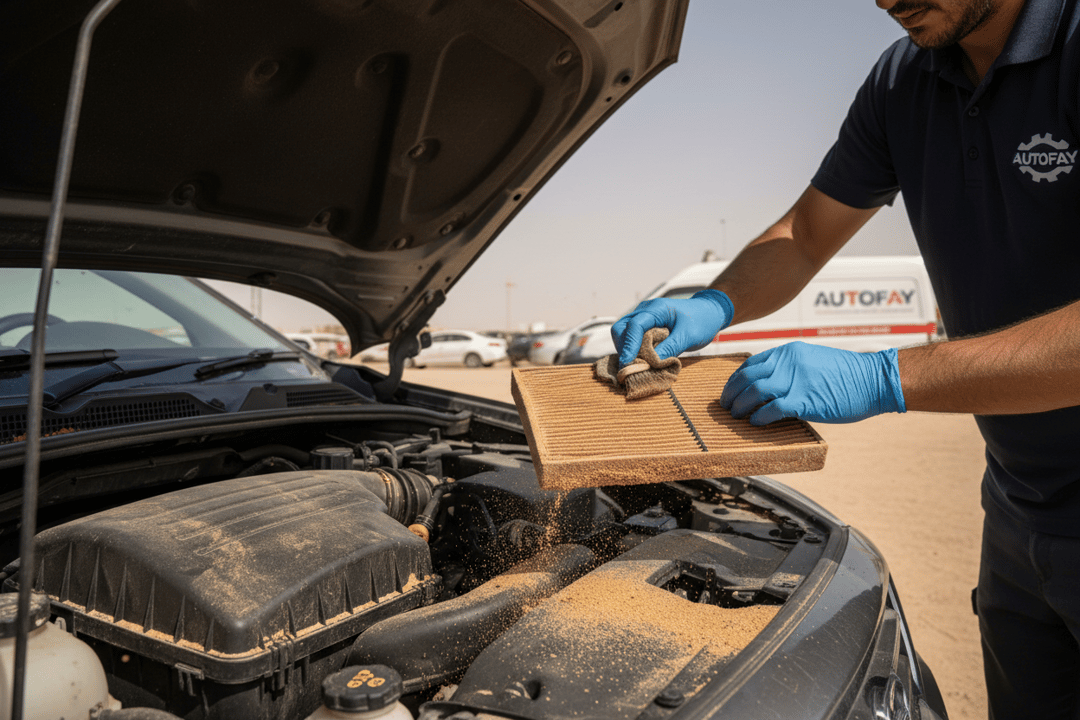
The UAE experiences sandstorms throughout the year, with peak frequency during spring and summer months. These are not gentle dustings — major sandstorms carry particles at speeds exceeding 60 km/h, turning every grain into a tiny projectile. A single severe sandstorm can cause more paint damage than years of normal driving. For buyers considering a used car in the UAE, understanding sand-related wear is essential because it affects nearly every system AutoFay inspectors check.
Paint and Body: The Visible Damage
Sand acts as a natural abrasive on paint surfaces. The front bumper, hood, and front fenders take the worst impact because they face oncoming sand head-on. Our body inspection checks each panel's paint condition — Original, Repainted, or Total Repainted. Sand-blasted panels often show paint chips rated from None through Minor, Moderate, to Severe. A car with severe paint chips on the front and clean paint on the rear has likely endured repeated sandstorm exposure without protection.
Headlight lens condition degrades significantly from sand exposure. Lenses are rated Clear, Hazy, Yellowed, or Cracked. Sand abrasion creates the hazy, clouded appearance that reduces light output and visibility. The windshield accumulates micro-pitting from sand impact — thousands of tiny chips that scatter light and create dangerous glare when driving into sunlight. Our glass inspection rates the windshield as No Visible Fault, Chipped, Cracked, Needs Replacement, Aftermarket, or Replaced.
Engine Air Filtration Under Assault
The engine air filter is the first line of defense against sand ingestion. During a sandstorm, the volume of particulate matter in the air increases dramatically, and the filter works overtime. Our under-the-hood inspection rates the engine air filter as Clean, Dirty, or Needs Replacement. A car driven regularly through sandy conditions without frequent filter changes will have restricted airflow to the engine, affecting performance and fuel consumption.
If the air filter fails to catch all particles, sand enters the engine through the air intake system (rated Good, Dirty, or Damaged) and passes through the throttle body (rated Clean, Dirty, or Needs Cleaning). Fine sand particles that reach the combustion chambers act as an abrasive on cylinder walls, accelerating engine wear. The MAF sensor, which measures incoming air volume, can become contaminated — rated Good, Dirty, or Faulty. A dirty MAF sensor sends incorrect readings to the engine computer, causing poor idle and hesitation during acceleration.
HVAC System: Sand in the Cabin
The cabin air filter protects the interior from sand and dust, but heavy exposure overwhelms it quickly. Our inspection rates it as Clean, Dirty, or Needs Replacement. A clogged cabin air filter reduces HVAC airflow, making the blower motor work harder — rated as All Speeds Working, Some Speeds, Noisy, or Not Working. Sand particles that pass through a deteriorated filter reach the AC evaporator and can damage the blend door actuators, causing clicking noises or stuck doors — rated Working, Clicking Noise, Stuck, or Not Working.
The AC condenser, mounted at the front of the car behind the bumper, collects sand between its fins. This reduces heat exchange efficiency and makes the AC compressor work harder to achieve the same cooling. In a UAE summer, a sand-clogged condenser can mean the difference between AC rated Very Cold and merely Cool — a significant downgrade for driver comfort and a sign of pending compressor strain.
Seals, Bearings, and Hidden Infiltration
Door rubber seals — rated No Visible Fault, Worn, Torn, or Missing — degrade faster in sandy environments. Sand trapped in door seals acts as an abrasive every time the door opens and closes, cutting into the rubber. Worn seals allow more sand into the cabin, creating a cycle of increasing contamination. Window seals suffer similarly, and sand caught between the glass and seal scratches windows as they are raised and lowered.
Wheel bearings are particularly vulnerable to sand infiltration. Sand entering past the bearing seal acts as a grinding compound that accelerates wear dramatically. Our inspection checks wheel bearings by sound — rated No Noise, Noisy, or Worn. A humming or growling noise that changes with speed and increases during turns is the classic sign of a failing wheel bearing, and sand exposure is one of the leading causes in the UAE.
Exterior chrome and trim pieces — rated Good, Faded, Peeling, or Missing — show accelerated deterioration from sand abrasion. Wiper blades degrade quickly, with rubber hardened and torn by sand particles on the windshield — rated Good, Streaking, Worn, or Needs Replacement.
AutoFay inspects 410 checkpoints including all sand-vulnerable systems, with HD photos and a detailed PDF report. On-location inspection across all 7 Emirates. Book at autofay.ae or call +971-54-258-4458.




0 Comments
No comments yet. Be the first to share your thoughts!