

The United Arab Emirates offers a premier driving environment, characterized by extensive highway networks and diverse terrain ranging from coastal highways to dune-heavy desert tracks. For enthusiasts and practical users alike, the Mercedes-Benz brand represents a blend of engineering excellence and luxury. However, selecting a pre-owned model for a long-distance journey or daily reliability requires a rigorous understanding of potential mechanical weaknesses. Unlike mass-market vehicles, Mercedes-Benz units often feature complex electronic architectures and hydraulic systems that demand specific attention. A thorough inspection is not merely a formality but a necessary prerequisite to ensure the vehicle can endure the demands of a road trip without compromising safety or incurring unexpected mechanical failure.
Model-Specific Architecture and Vulnerabilities
Different generations of Mercedes-Benz vehicles possess unique structural and mechanical layouts that dictate their reliability on UAE roads. The C-Class models, particularly those from the early 2000s and late 2010s, are known for their modular electrical architecture. This flexibility introduces a higher risk of software glitches or sensor failures, which can trigger the car’s extensive warning lights or affect power steering assistance. For the E-Class, the primary concern lies in the air suspension system, which is prevalent on many models. Over time, the compressors and air struts degrade, leading to a sagging ride height and potential active suspension failure. The GLE and M-Class SUVs, popular for family trips, often suffer from cooling system inefficiencies due to sand and dust ingress in the radiator core, which can lead to overheating under heavy load.
The Electrical Ecosystem and Software Glitches
Modern Mercedes-Benz vehicles rely heavily on the OBD (On-Board Diagnostics) system to manage everything from transmission shifting to airbag deployment. A frequent issue across various models is the failure of the CAN bus communication, where sensors fail to relay data back to the central computer. This can result in erratic behavior, such as the windows malfunctioning, the dashboard lighting up with warning icons, or the transmission refusing to shift out of Park. Before embarking on a road trip, verifying the stability of the vehicle's electrical network is critical. A persistent fault code in the ABS or airbag systems may seem minor but can disable critical safety features during high-speed travel.
Drivetrain and Transmission Health
The transmission is the heart of any road trip vehicle, and Mercedes-Benz units are no exception. The 7G-Tronic and 9G-Tronic automatic transmissions are generally robust but have specific failure modes. A common symptom is "slipping" between gears or a hesitation when accelerating from a standstill, often caused by a degraded transmission fluid or a failing torque converter. Another critical area is the cooling system for the transmission and engine, which works overtime in the UAE climate. If these fluids are not flushed and replaced at the recommended intervals, the risk of thermal damage increases significantly. Ignoring transmission fluid degradation can lead to complete failure, rendering the vehicle immobile and requiring costly recovery services.
Suspension Geometry and Ride Comfort
The suspension system of a Mercedes-Benz is engineered for comfort and handling, but the components are subject to wear that compromises safety. The most critical component in this system is the air suspension. A leak in an air strut causes the vehicle to sit unevenly, affecting the alignment and putting uneven stress on the tires and steering components. Additionally, the control arm bushings and ball joints wear out over time, leading to excessive play in the steering wheel or a "waddle" motion when driving at low speeds. For a long-distance journey, worn suspension components can lead to tire blowouts or loss of vehicle control during evasive maneuvers.
Fluids, Brakes, and Tires: Critical Safety Checks
The condition of the fluids is a direct indicator of the engine's health. Engine oil consumption is a known issue in some Mercedes-Benz models, where the engine burns oil due to piston ring wear or valve guide issues. Low oil levels can cause catastrophic engine failure if not monitored. Brake fluid absorbs moisture over time, reducing its boiling point and compromising braking performance. On the UAE highways, where speeds are high, brake fade can be dangerous. Tires must also be scrutinized not just for tread depth, but for manufacturing age, as rubber degrades even without use. A tire sidewall bulge indicates a structural failure that will lead to a blowout at high velocity.
The AutoFay Inspection Protocol
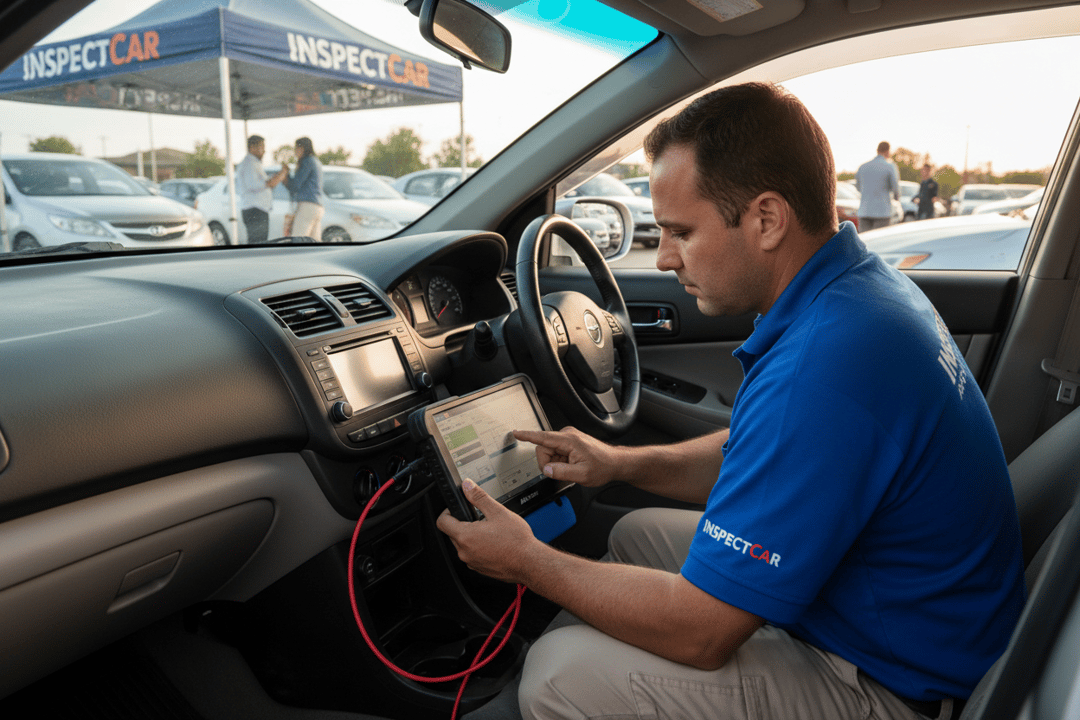
Given the complexity of these vehicles, a visual inspection is often insufficient. Professional inspection services provide a structured approach to uncovering hidden faults. AutoFay offers a comprehensive on-location inspection service across all seven Emirates, covering over 410+ checkpoints across 25 distinct categories. This ensures that no aspect of the vehicle is overlooked. The inspection process is methodical, moving from an OBD scan to a physical road test.
| Inspection Category | Key Focus Points | Potential Risk |
|---|---|---|
| Engine | Oil condition, noise levels, mounting integrity, smoke color | Internal wear, sludge buildup, significant failure |
| Transmission | Shifting smoothness, fluid level, OBD codes | Slipping gears, hard shifts, complete gearbox failure |
| Suspension | Air strut leaks, strut mount noise, suspension arms | Ride height issues, uneven tire wear, loss of control |
| Body & Frame | Panel-by-panel originality, rust, structural integrity | Accident damage, alignment issues, safety hazards |
| Brakes | Pad thickness, disc condition, fluid condition | td>Brake fade, reduced stopping power, safety failure
To accommodate different needs, AutoFay provides three distinct tiers of service. The Computer Diagnostic package, priced at AED 99, is the entry point, focusing specifically on engine, transmission, ABS, and airbag codes to identify electronic faults. For a more detailed assessment, the Body & Computer package at AED 250 adds a visual inspection for panel alignment, repainted areas, and structural damage. The most thorough option is the Comprehensive package at AED 299, which includes the road test to verify acceleration, braking, noise, and vibration under actual driving conditions.
- Prioritize the Comprehensive package if purchasing from a private seller or a dealership.
- Request a Computer Diagnostic scan if the vehicle has a check engine light.
- Ensure the Road Test is part of the inspection if the vehicle has suspension or drivetrain claims.
Strategic preparation before a road trip involves verifying the integrity of the vehicle’s core systems. While a visual check can reveal obvious issues, the consequences of neglecting a buried electrical fault or a developing transmission problem can be severe. A professional inspection bridges the gap between a visual glance and a deep-dive mechanical analysis. By utilizing a service like AutoFay, buyers and owners ensure that every component—from the frame rails and floor pan to the tires and fluids—is documented via HD photos and a detailed PDF report.
Addressing these model-specific issues before departure prevents mid-journey breakdowns and ensures the vehicle performs reliably on the open road.
AutoFay inspects 410+ checkpoints with HD photos and PDF report. Book at autofay.ae or call +971542584458.



0 Comments
No comments yet. Be the first to share your thoughts!