
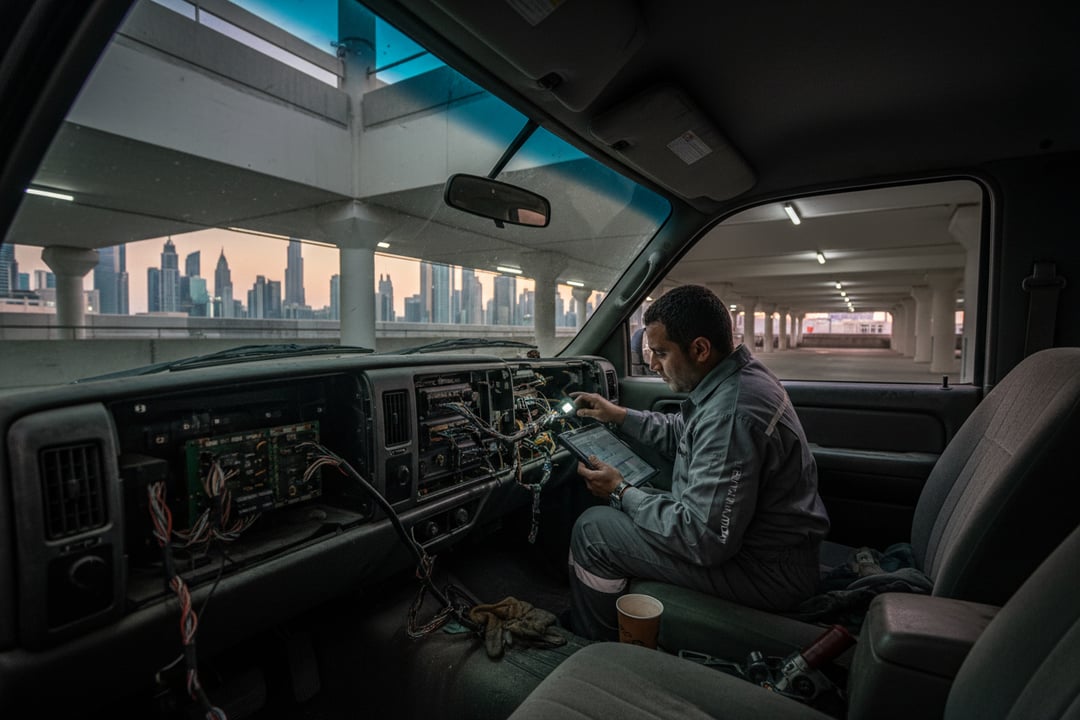
Pickup trucks dominate the UAE automotive landscape, serving as essential tools for work and utility. However, these vehicles are subjected to extreme environmental stress. Dust, heat, and vibration take a significant toll on electronic systems. While engine performance is often the primary focus, power features are critical for daily functionality and safety. Inspecting power windows, keyless entry, and mirrors requires a keen eye for electrical anomalies. AutoFay provides a professional lens through which used vehicle buyers can evaluate these complex systems.
Power Windows: Wiring Harnesses and Motor Integrity
The door frame of a pickup truck is tall, placing immense leverage on the window regulator mechanism. This repeated mechanical stress eventually leads to electrical or mechanical failure. When a window fails to function, the root cause is often not the switch, but the motor or the wiring harness. Inspectors must test the driver's master switch first, as it controls the entire circuit. If the master switch operates all windows but a specific door fails, the issue is isolated to that specific window motor.
Listen intently to the motor during operation. A high-pitched whine followed by silence indicates a burnt-out motor or stripped gears. Plastic gears are common in cheaper regulators; they strip easily under the load of a heavy door glass. Metal gears are more durable but heavier. Inspectors look for signs of overheating, such as melted insulation on the wires. Furthermore, checking the rubber weather stripping is vital. Tears in the seal allow sand to enter the door cavity, where it destroys electrical contacts and causes short circuits.
- Check the window track alignment: Misaligned tracks force the glass to rub against the frame. This friction generates heat that melts wire insulation and sears the regulator gears.
- Inspect the wiring harness: Examine the bundle of wires where they pass through the door hinge. Constant opening and closing cracks the insulation, leading to pinched wires and intermittent failures.
- Test the anti-pinch feature: Modern systems use sensors to detect resistance. If the anti-pinch system is malfunctioning, the window may close forcefully on an object or fail to reverse when encountering an obstacle.
Keyless Entry: Transmitter Range and System Sync
Keyless entry systems rely on radio frequency transmission and receiver modules. In a used pickup, the battery in the key fob is the first component to degrade. A weak battery reduces the signal range, often resulting in a door that unlocks only when the fob is held directly against the handle. However, a weak battery is a simple replacement. A more serious problem arises if the vehicle does not respond even at close range. This indicates a failure in the receiver module or the door lock actuators.
Inspectors verify the range from various angles and distances. They also test the "panic" button to ensure the alarm system functions correctly. If the central locking fails to operate simultaneously on all doors, the synchronization is lost. This often happens when the battery in the vehicle is disconnected and reconnected without a proper reset procedure. Additionally, inspect the condition of the key fob casing. Cracks allow moisture to enter, which can corrode the internal circuit board and cause erratic behavior.
The door lock actuators are physical mechanical components that push and pull the locking pins. These are prone to failure in high-use pickups. If a door locks remotely but the deadbolt does not engage, or if the door makes a grinding noise when locking, the actuator is likely stripped. This means the electronic signal has successfully reached the door, but the mechanical linkage has failed.
Power Mirrors: Heating Elements and Folding Mechanisms
Mirrors are the primary defense against blind spots, especially for tall pickup trucks. The heating element is a common failure point, particularly during the humid months of the UAE. The heating elements are thin wires embedded in the glass. If one element burns out, the mirror will not heat up, and viewing through the glass may become difficult if it fogs up. Inspectors test the heating function using a multimeter or by observing the mirror surface for warmth after activation.
Power folding mirrors are a convenient feature for tight parking spaces but add complexity to the door assembly. The folding mechanism consists of a motor, gears, and a limit switch. If the mirror stops halfway while folding, the gears are likely stripped, or the switch has failed. Inspectors watch the mirrors extend and retract during the road test. Banging sounds during this process suggest loose mounting brackets or broken internal components.
Adjustment switches must provide smooth, linear movement. A "dead" mirror that stays stuck at a fixed angle, even when the switch is pressed, indicates a failed motor or a damaged internal gearbox. This limitation prevents the driver from adjusting the mirror for optimal visibility, creating a significant safety hazard on the highway.
Environmental Stress Factors in Pickup Wiring
Electrical failures in pickups are rarely random; they are the result of cumulative environmental exposure. The UAE climate subjects vehicles to extreme temperature fluctuations. When a vehicle sits in the sun, the interior temperature can exceed 70 degrees Celsius. This heat softens and melts wire insulation. When the sun sets and the temperature drops, the insulation contracts, causing it to crack and peel away from the copper wire.
Vibration is another critical factor. Pickups carry heavy loads, causing the frame to flex. This flexing transmits through the body panels to the door hinges and wiring looms. Loose connections in the fuse box or relay connectors can vibrate apart, causing the system to cut in and out. Inspectors look for signs of previous repairs, such as mismatched wire colors, soldering, or electrical tape. These are indicators of past short circuits or poor wiring management.
Sand intrusion is the most destructive enemy of electronics. Once sand enters a switch or connector, it acts as an abrasive. It wears down the metal

0 Comments
No comments yet. Be the first to share your thoughts!