

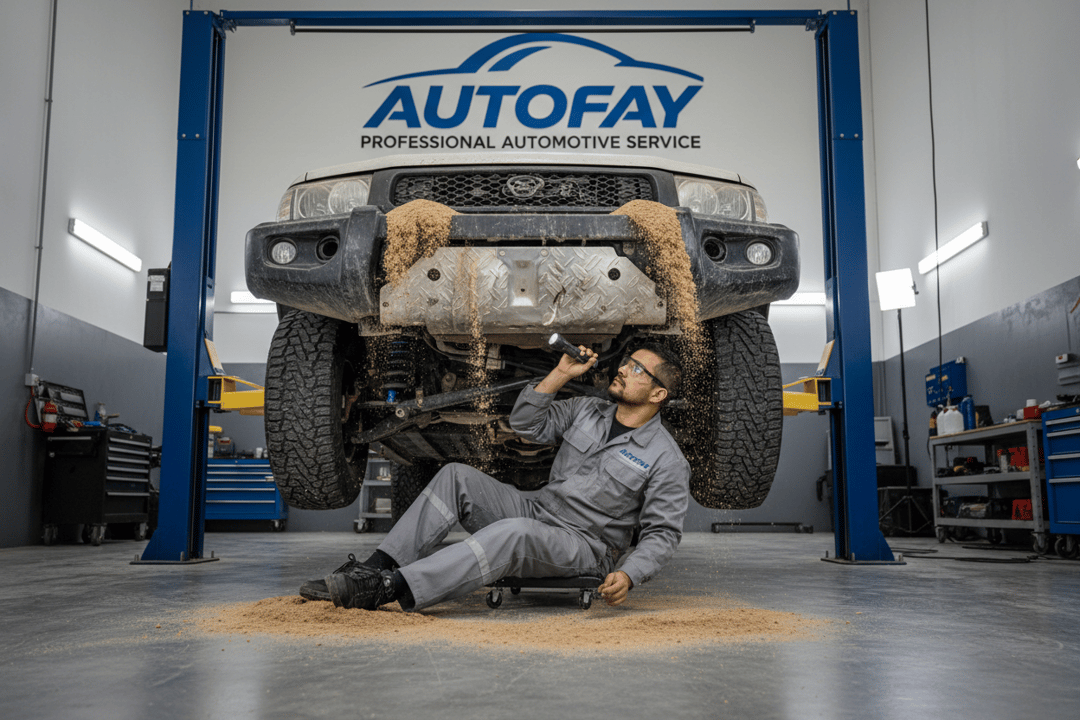
Desert driving is part of UAE culture — weekend trips to the dunes, camping in the desert, and exploring off-road trails are popular activities. But what makes for an exciting weekend takes a toll on the vehicle. Sand infiltrates every opening, impacts stress the frame and suspension, and the drivetrain operates under loads it would never see on pavement. Inspecting a vehicle with off-road history requires attention to systems that highway-only cars rarely stress.
Frame and Underbody: The Foundation Check
The frame condition inspection is where desert history reveals itself most clearly. AutoFay checks 27 structural points including bumper support, front and rear rails, chassis, cross members, floor pan, and all pillars. A vehicle driven in the desert shows impact evidence on underbody shields and covers — rated as Missing or Damaged from contact with rocks, sand ridges, and uneven terrain. The chassis itself may show scraping marks or minor dents from ground contact.
Skid plates under the exterior features category are the first line of defense. Good skid plates with scrape marks indicate the vehicle was driven off-road but the protection did its job. Missing or damaged skid plates mean the components behind them — oil pan, transfer case, fuel tank — were exposed to direct impact. The floor pan is checked for damage — a floor pan rated as Damaged on an off-road vehicle suggests a significant underbody impact that may have affected other components.
Drivetrain: Sand and Stress
The drivetrain inspection becomes critical on off-road vehicles. Transfer case operation is checked — the transfer case switches between 2WD and 4WD and includes low-range gearing for sand and steep terrain. A transfer case rated as Noisy has internal wear from heavy off-road use. The 4WD engagement is tested — delayed or rough engagement suggests the system has been stressed beyond casual use.
CV axles, CV boots, and CV joints are inspected individually. CV boots are rubber covers that protect the joints from contamination. Sand is devastating to exposed CV joints — a torn boot rated as Cracked or Torn on a desert-driven vehicle means sand has likely entered the joint, causing accelerated wear that manifests as clicking sounds during turns. Front and rear differentials are checked for noise and leaks — diff fluid contaminated with sand particles causes rapid gear wear.
Engine Air System: Sand Contamination
The under-the-hood inspection checks the engine air filter and air intake system. Desert driving exposes the air intake to fine sand particles. An air filter rated as Dirty or Needs Replacement is expected on a desert vehicle, but the condition of downstream components matters more. The MAF sensor rated as Dirty on a desert vehicle indicates sand particles have passed through the filter and contaminated the sensor, which affects fuel mixture accuracy.
The throttle body condition is checked — a throttle body rated as Dirty or Needs Cleaning on a desert vehicle confirms sand ingestion. The engine bay cleanliness rating often tells the story — an engine bay rated as Very Dirty with sand accumulation in crevices confirms significant off-road use.
Suspension: Impact Damage and Accelerated Wear
Desert driving subjects the suspension to forces it was not designed for continuous exposure to. The suspension inspection checks shocks, springs, control arms, ball joints, tie rod ends, sway bar links, and bushings. Shocks rated as Worn or Leaking on a relatively new off-road vehicle indicate aggressive desert driving. Ball joints rated as Worn or Loose from impacts with terrain features need replacement before the vehicle is used for highway driving.
Wheel alignment is typically compromised on off-road vehicles — rated as Needs Alignment from repeated impacts that shift suspension geometry. Tire wear patterns reveal this — Inner Wear on front tires indicates the alignment has changed from its factory specification. Wheel rims are checked for bends and cracks — a rim rated as Bent from desert driving causes vibration at highway speed.
Cooling System: Desert Heat Challenge
Off-road driving in UAE desert heat stresses the cooling system maximally. Low-speed driving in sand provides minimal airflow through the radiator while the engine works hard to maintain momentum. The radiator is checked for sand clogging — a radiator rated as Dirty on a desert vehicle has reduced cooling capacity. The cooling fans are verified as Working — fans that compensate for low-speed airflow are critical during off-road use. Coolant condition and level are checked — low coolant after desert use may indicate a leak caused by underbody impact.
AutoFay inspects 410 checkpoints including every system affected by off-road use, with HD photos and a detailed PDF report. On-location inspection across all 7 Emirates. Book at autofay.ae or call +971-54-258-4458.





0 Comments
No comments yet. Be the first to share your thoughts!