
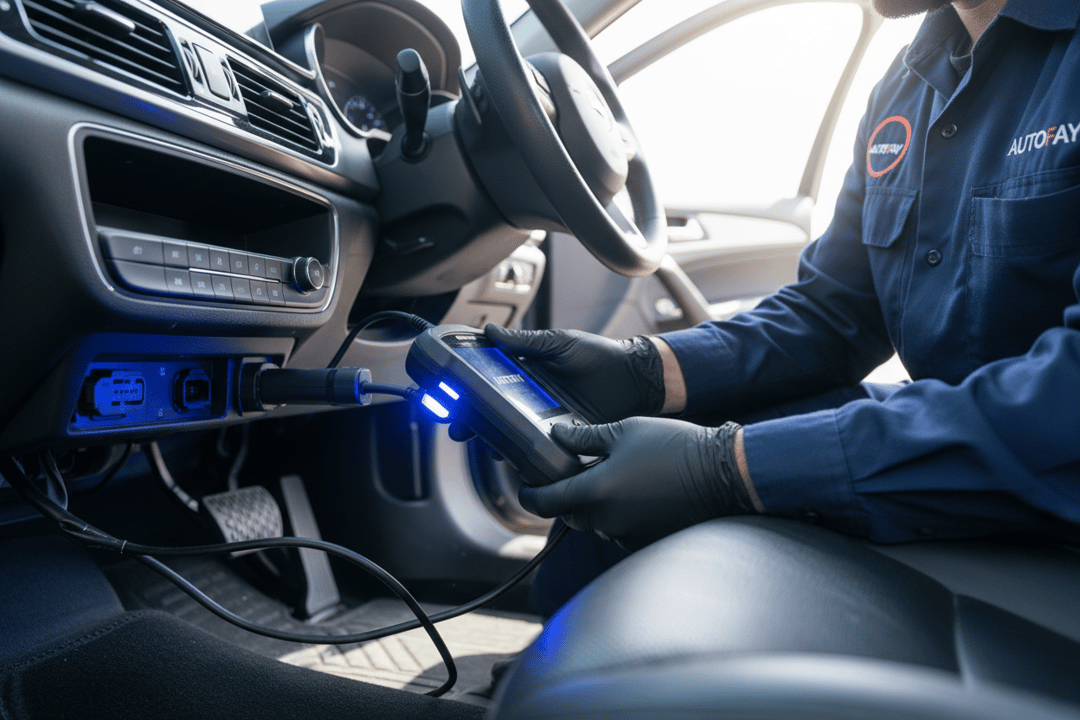
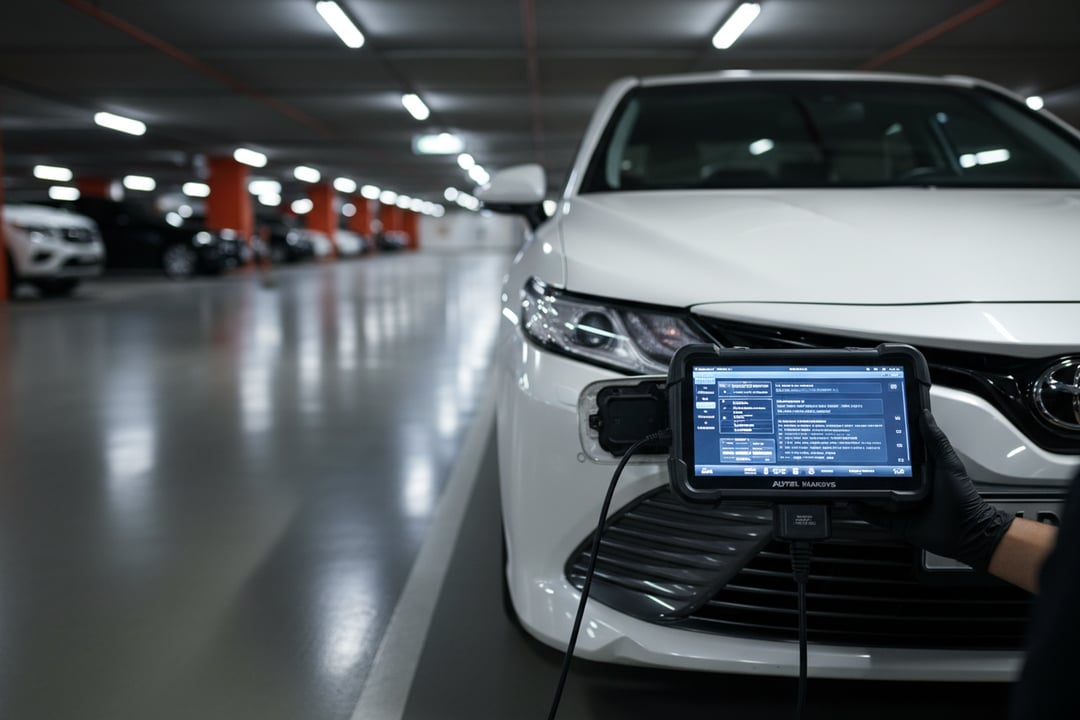
Every modern car has an on-board computer that monitors hundreds of sensors and systems. When something goes wrong, the computer stores a diagnostic trouble code (DTC). Sellers know this, which is why many clear these codes before showing the car — a fresh reset makes the dashboard look clean. Our OBD scanner reads deeper than the dashboard, pulling stored history that a simple reset cannot fully erase.
What the OBD Scanner Checks: 5 System Categories
AutoFay's diagnostic scan covers five major system categories, each rated independently: No Faults, Stored Codes, or Active Faults. Engine fault codes cover everything from misfires and sensor failures to emissions system problems. Transmission codes reveal shifting issues, solenoid failures, and torque converter problems that might not be felt during a short test drive.
ABS fault codes indicate problems with the anti-lock braking system — wheel speed sensors, hydraulic pump, or control module. Airbag and SRS codes are particularly important because they indicate whether the safety restraint system is fully functional. A stored airbag code could mean a previously deployed airbag that was replaced but not properly recalibrated, or a faulty sensor that might prevent deployment in an accident. Body control module codes cover electrical systems like power windows, door locks, and lighting.
Stored Codes vs Active Faults: The Critical Difference
An active fault means the problem is happening right now — the sensor is currently reading out of range, or the system is currently malfunctioning. A stored code means the fault occurred in the past and may or may not still be present. Some stored codes clear themselves after a certain number of drive cycles if the problem does not recur.
The tricky part is when a seller clears all codes right before showing the car. The dashboard looks clean, but the underlying problem remains. Some faults will reappear within a few drive cycles, which is why our inspectors note whether the car shows signs of a recent code reset — if the readiness monitors show "not ready," it usually means the codes were recently cleared and the system has not completed its self-tests yet.
Common Codes Found in UAE-Driven Cars
Certain fault codes appear more frequently in UAE conditions. Evaporative emission system codes (P0440-P0457) are common because extreme heat causes fuel vapor pressure issues. Catalytic converter efficiency codes (P0420/P0430) appear on older vehicles where the converter has degraded from sustained high-temperature operation. Transmission temperature codes are seen on vehicles that tow or carry heavy loads in summer heat.
AC-related codes are another UAE pattern — compressor clutch circuits, refrigerant pressure sensors, and blend door actuator codes all appear more frequently in hot climate vehicles. While not safety-critical, they indicate systems that will need attention and represent real costs for the new owner.
Why OBD Scanning Is Non-Negotiable
A car can drive perfectly during a test drive and carry stored codes that indicate expensive problems. A transmission that shifts smoothly might have a stored torque converter shudder code that only manifests under heavy load. An engine that idles quietly might have a stored misfire code that appears at highway speed. The OBD scan catches what a test drive misses.
Our inspectors include a detailed OBD report section in every inspection, listing each code found, which system it belongs to, and whether it is active or stored. We also note our observations in the OBD Comments field — providing context that helps buyers understand what each code actually means for their purchase decision.
AutoFay includes comprehensive OBD scanning in every 410+ checkpoint inspection, with HD photos and a detailed PDF report. On-location inspection across all 7 Emirates. Book at autofay.ae or call +971-54-258-4458.


0 Comments
No comments yet. Be the first to share your thoughts!