
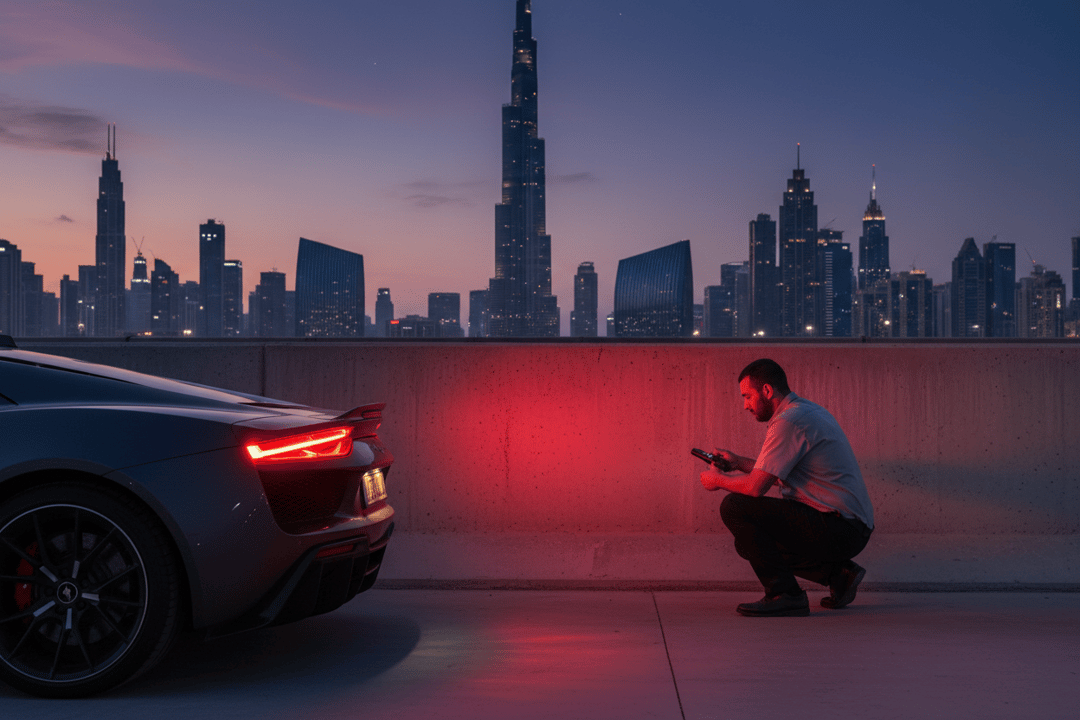
Exterior lighting is not about aesthetics — it is about safety. Every light on a vehicle serves a specific communication purpose: telling other drivers you are braking, turning, reversing, or simply present on the road. A single non-functional light creates a gap in that communication, and in UAE highway driving at speeds exceeding 120 km/h, that gap can have serious consequences.
17 Lighting Checkpoints: Front to Rear
AutoFay tests 17 individual exterior lighting points. Headlights are checked at both Low Beam and High Beam — rated Working, Dim, One Out, or Not Working. Dim headlights reduce visibility and can result from aging bulbs, corroded wiring, or a failing alternator not providing enough voltage. Automatic High Beams and Adaptive Headlights are tested where equipped — these systems adjust beam pattern based on oncoming traffic and steering angle.
Daytime Running Lights are verified — they keep the car visible during daylight, which is particularly important during sandstorm conditions in the UAE when visibility drops suddenly. Front Turn Signals and Rear Turn Signals are tested, with Fast Blink noted as a specific finding — a turn signal that blinks faster than normal indicates a burnt-out bulb on that circuit. Side Mirror Turn Signals are checked separately.
Tail Lights, Brake Lights, and Reverse Lights
Tail Lights are rated Working, Dim, One Out, or Not Working. A dim tail light makes the car harder to see from behind at night. Brake Lights are critical — Working, One Out, or Not Working. The Third Brake Light mounted at the top of the rear window is tested independently because it is the first brake light visible to drivers several cars back. Reverse Lights are checked for function — Working, One Out, or Not Working. Non-functional reverse lights are both a safety issue and a common reason for failing vehicle registration renewal inspections.
Fog Lights, Hazards, and Specialty Lighting
Fog Lights are tested as Working, Not Working, or N/A. In the UAE, fog lights are useful during early morning fog events in the winter months and during sandstorms. Hazard Lights are verified — a critical safety feature for breakdowns on fast-moving highways. License Plate Lights are checked because non-functional plate lights are a traffic violation and inspection failure point. Courtesy Lights on mirrors and door handles are tested where equipped — these illuminate the ground when approaching the car.
Headlight Lens Condition: Clarity Affects Everything
Headlight Lens Condition is rated Clear, Hazy, Yellowed, or Cracked. This is one of the most impactful lighting checks because even perfect bulbs are undermined by degraded lenses. Hazy or yellowed lenses are extremely common on UAE cars because UV exposure breaks down the polycarbonate lens coating. A car with yellowed headlight lenses can lose a significant portion of its light output, making night driving genuinely dangerous. The difference between clear and yellowed lenses is immediately noticeable — clear lenses project a sharp, bright beam while yellowed lenses scatter light and reduce throw distance.
Cracked lenses allow moisture inside the headlight assembly, which causes further deterioration and can short-circuit electrical components. Lens restoration is a temporary fix; replacement assemblies are the permanent solution, and they vary significantly in cost depending on the vehicle — especially for models with LED or laser headlight technology.
AutoFay checks 410+ checkpoints including 17 exterior lighting checkpoints, with HD photos and a detailed PDF report. On-location inspection across all 7 Emirates. Book at autofay.ae or call +971-54-258-4458.
0 Comments
No comments yet. Be the first to share your thoughts!