

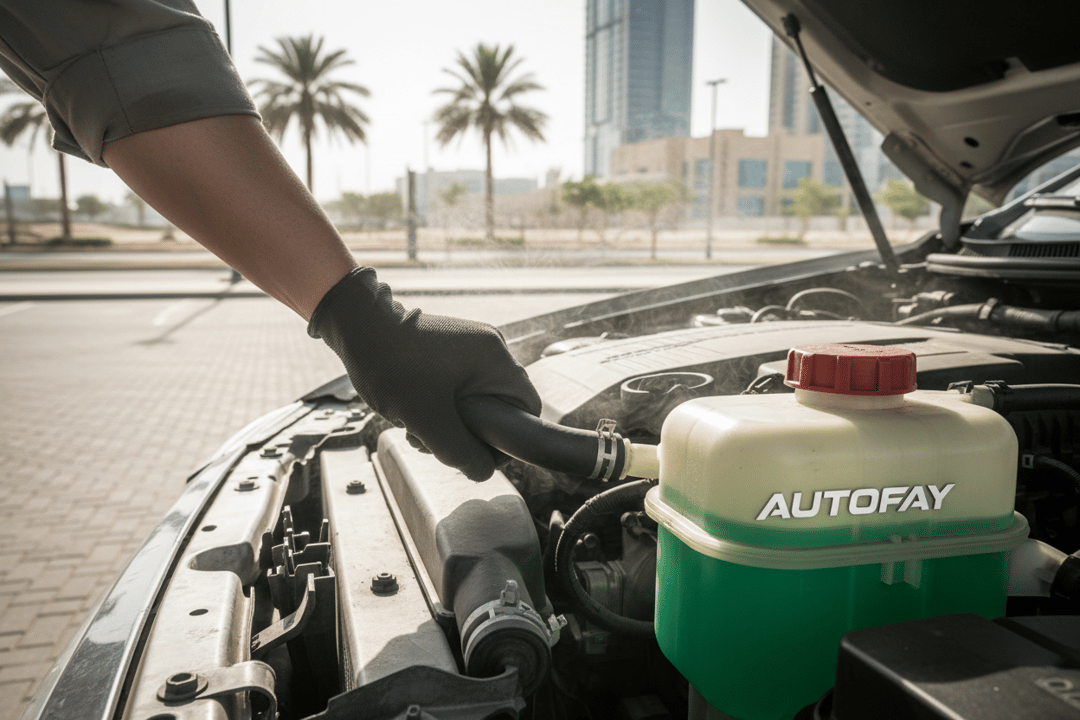
The cooling system prevents the engine from destroying itself. In the UAE, where ambient temperatures routinely exceed 45°C and road surface temperatures climb even higher, this system works under constant stress. A cooling system failure does not just mean pulling over — it can mean a warped cylinder head or a cracked engine block, turning a running car into scrap metal.
8 Cooling System Checkpoints
AutoFay's cooling system inspection covers 8 distinct components. The Radiator Condition is assessed as No Visible Fault, Dirty, Damaged, or Leaking. A dirty radiator with clogged fins cannot dissipate heat efficiently — this is common in the UAE where sand and dust accumulate between the fins. A damaged or leaking radiator needs replacement before driving the car through summer.
The Radiator Cap is checked as Good, Worn, or Faulty. This small component maintains system pressure, which raises the boiling point of the coolant. A faulty cap allows pressure to escape, meaning the coolant boils at a lower temperature — the car may overheat in traffic even with an otherwise healthy system. Cooling Fans are tested as Working, Noisy, or Not Working. Electric cooling fans activate when the car is stationary or moving slowly — if they fail, the car overheats in stop-and-go traffic, which is where UAE drivers spend significant time.
Water Pump: The Heart of the System
The Water Pump circulates coolant through the engine and radiator. It is rated Working, Noisy, Leaking, or Needs Replacement. A noisy water pump has worn bearings — the pump still functions but failure is approaching. A leaking water pump drips coolant from the weep hole, which is a designed failure indicator. Once the weep hole leaks, the internal seal has failed and the pump needs replacement. A water pump failure at highway speed can cause catastrophic overheating within minutes.
The Coolant Overflow Tank is checked as Good, Cracked, or Leaking. This tank allows coolant to expand and contract with temperature changes. A cracked tank slowly loses coolant, causing the level to drop over time. Drivers may not notice until the temperature gauge spikes.
Hoses and Connections: Where Leaks Begin
Cooling Hoses are rated Good, Soft, Cracked, or Leaking. Rubber hoses deteriorate from the inside out — UV exposure and heat break down the rubber compound. A soft hose feels spongy when squeezed, indicating the rubber has lost structural integrity. It may not leak today, but it is at risk of bursting under pressure. Cracked hoses show visible surface deterioration and should be considered due for replacement.
Hose Clamps are checked as Good, Loose, or Corroded. A loose clamp allows coolant to seep at the connection point, especially when the system is under pressure during highway driving. Corroded clamps can break during service, making a routine hose replacement more complicated and expensive. Coolant Leaks are assessed overall as None, Minor, or Major. Our inspectors check under the car and around all connection points for evidence of coolant loss — green, orange, or pink stains on the ground or dried residue on hoses and fittings.
Cooling System and UAE Driving Conditions
The cooling system in a UAE-driven car endures conditions that would be considered extreme anywhere else. Idling in traffic with the AC at full blast puts maximum load on the cooling system — the engine generates heat, the AC condenser adds more heat in front of the radiator, and there is minimal airflow. This is a daily scenario in Dubai and Abu Dhabi traffic. Cars that have spent their life in UAE traffic often show cooling system wear that would take twice as long to develop in a moderate climate. Every component matters because the system works as a chain — one weak link can lead to engine failure.
AutoFay checks 410+ checkpoints including 8 cooling system checkpoints, with HD photos and a detailed PDF report. On-location inspection across all 7 Emirates. Book at autofay.ae or call +971-54-258-4458.




0 Comments
No comments yet. Be the first to share your thoughts!