

The UAE market presents a unique challenge for vehicle buyers: the prevalence of luxury vehicles, particularly Mercedes-Benz models, that have been subjected to long-term storage. Whether left idle for a season or a year, a Mercedes that has not been driven regularly undergoes specific chemical and mechanical changes that are not immediately visible to the untrained eye. The intense UAE heat accelerates the degradation of non-active components, creating a false sense of security for the uninitiated buyer. A vehicle sitting static for an extended period presents a complex diagnostic puzzle that standard walk-arounds simply cannot solve. To navigate this market safely, one must understand the specific vulnerabilities of stored luxury vehicles and the rigorous inspection parameters required to verify their condition.
The Fluid Degradation Risk
The most immediate and critical threat to a long-term stored Mercedes is the breakdown of its fluids. Engine oil, transmission fluid, coolant, and brake fluid are designed to circulate and lubricate moving parts. When a vehicle remains stationary, these fluids stagnate, losing their ability to suspend contaminants and protect metal components. Over time, the oil separates into sludge and solvents, which can clog oil filters and starve the engine of lubrication when it is finally started. Transmission fluid, in particular, loses its viscosity and friction modifiers, leading to potential failure during the first shifts.
Furthermore, brake fluid is hygroscopic, meaning it absorbs moisture over time. In a stored vehicle, this moisture can cause the fluid to boil at lower temperatures, resulting in a spongy brake pedal and reduced stopping power. Inspectors must prioritize checking fluid levels and clarity. A stored vehicle often requires a fluid flush before safe operation, a cost that the buyer must factor into the negotiated price. The condition of the oil pan gasket and valve covers is also critical, as prolonged exposure to high UAE temperatures can cause rubber seals to dry out and crack, leading to leaks once the engine is run.
Tire Integrity and Suspension Hardening
Tires are often the first casualty of long-term storage, though the damage is not always visible. When a car sits for months, the weight of the vehicle compresses the rubber in specific spots, causing "flat spotting." This results in a vibration that mimics a wheel balance issue or a bent rim, which can be costly to repair if a tire is replaced prematurely. Additionally, the rubber compound in high-performance Mercedes tires can harden and crack when not subjected to the flexing motion of driving. Inspectors must look for dry rot, sidewall cracking, and uneven wear patterns that indicate the tires were not rotated during storage.
Suspension bushings and mounts are made of synthetic rubber that degrades significantly faster under the relentless UAE sun. A vehicle that has sat idle may exhibit a harsh ride quality or unusual clunking noises over bumps simply because the rubber dampers have become brittle and lost their shock-absorbing properties. The air suspension systems common in many modern Mercedes models are particularly susceptible. Compressors can fail from disuse, and air lines can develop leaks that are hard to find visually without a pressure test. The inspection of the suspension geometry and bushing condition is therefore a non-negotiable checkpoint for any stored luxury vehicle.
Electrical System Vulnerabilities
Mercedes-Benz vehicles are renowned for their complex electrical architectures, and long-term storage is a significant issue scenario for these systems. The primary enemy of a dormant battery is sulfation. When a lead-acid battery is not charged for weeks, sulfate crystals form on the plates, permanently reducing the battery's capacity. Even if the battery tests "okay" with a load tester, the starter may still struggle to turn over a cold engine, causing excessive strain on the starter motor and solenoid.
Beyond the battery, the electronics module can suffer from moisture ingress. The extreme temperature fluctuations between day and night in the UAE can cause condensation to form inside electronic enclosures, leading to corrosion on circuit boards and connector pins. This often manifests as intermittent malfunctions, such as flickering dashboard lights, non-functional infotainment systems, or erratic sensor readings. A vehicle with a history of long storage may require a complete electrical system diagnostic scan to identify faults that are not triggering a "Check Engine" light but are affecting vehicle performance and safety systems.
The Importance of a Comprehensive Diagnostic Scan
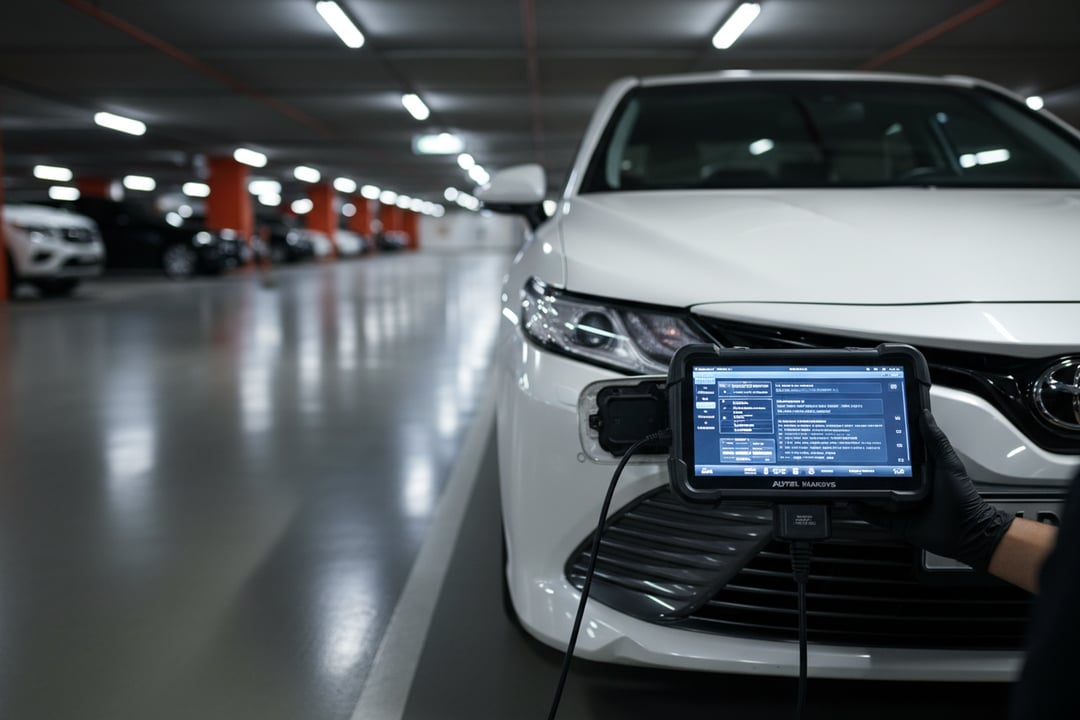
One of the most effective tools for uncovering hidden issues in a stored Mercedes is the On-Board Diagnostics (OBD) system. Unlike a visual inspection, a scan tool can read manufacturer-specific codes and live data streams that reveal the health of the engine, transmission, and safety systems. For a stored vehicle, the OBD scan is essential to verify that the catalytic converters are not blocked and that the oxygen sensors are responding correctly to exhaust gases.
Furthermore, the ABS and airbag modules often store "freeze frame" data regarding power cycles and crash events that may not be evident physically. A professional inspection service can determine if the stored vehicle's electronics have been reset improperly, which may indicate tampering or accidental resets during a failed start attempt. Checking for pending trouble codes can prevent a buyer from purchasing a vehicle that requires immediate electronic repairs.
Inspection Packages and Methodology
Given the complexity of a stored Mercedes-Benz, a basic inspection is rarely sufficient. Buyers must utilize a professional inspection service that offers specific packages tailored to uncovering these latent issues. A comprehensive approach involves checking the chassis for corrosion, inspecting the paint for previous accidents, and performing a detailed road test.
When selecting a service provider in the UAE, it is vital to choose a company that emphasizes on-location inspection and covers all seven Emirates. An inspector can bring the necessary diagnostic equipment directly to the location of the vehicle, ensuring the inspection happens in the environment where the vehicle resides. The inspection should cover 25 distinct categories, ranging from the condition of the fuel injectors to the integrity of the braking system.
| Service Package | Price (AED) | Best For |
|---|---|---|
| Computer Diagnostic | 99 | Identifying engine, transmission, and ABS error codes. |
| Body & Computer | 250 | Assessing collision damage and verifying electronic health. |
| Comprehensive | 399 | Full 410+ checkpoint inspection including frame, tires, and fluids. |
The Comprehensive AED 299 package is highly recommended for stored vehicles. It covers a 410+ checkpointlist that includes a panel-by-panel body and paint inspection to detect prior repairs, a frame inspection to check for structural integrity, and a detailed road test to evaluate acceleration, braking, and noise levels. This level of scrutiny ensures that no aspect of the vehicle's condition is overlooked, providing a transparent picture of its history.
Brake and Safety Component Analysis
Brake systems are critical safety components that suffer significantly when a car sits idle. During storage, brake calipers can seize onto the rotors due to the buildup of rust and adhesive brake dust. This requires professional removal and cleaning, often replacing frozen slide pins and protecting the threads. The inspection must include a visual check of the brake fluid condition and a measurement of brake pad thickness to ensure they have not worn excessively due to the caliper seizing.
Suspension components, including ball joints and tie rod ends, also face increased risk of dryness and corrosion from lack of use. A experienced inspector will check for play in these components during the road test. Additionally, the tire manufacturing date is a crucial detail; tires older than six years should be replaced regardless of tread depth, as the rubber has likely degraded due to the storage environment. The inspection report should confirm the manufacturing date to ensure the buyer is not purchasing a vehicle with expired tires.
Summary of Inspection Priorities
To successfully navigate the purchase of a used Mercedes-Benz that has undergone long-term storage, the buyer must adopt a systematic approach. The focus must shift from cosmetic appeal to mechanical longevity. The priority list should include:
- Fluid Analysis: Verify the condition of engine oil, transmission fluid, coolant, and brake fluid for discoloration or contamination.
- Electrical Diagnostics: Perform a full OBD scan to rule out electrical faults and battery sulfation issues.
- Suspension Integrity: Inspect rubber bushings, air suspension components, and tire flat-spotting.
- Structural Safety: Check the frame alignment, brake caliper function, and tire manufacturing dates.
A vehicle that has been properly maintained during storage will transition back to service with minimal fuss. However, a neglected Mercedes will reveal its history through fluid leaks, electrical gremlins, and suspension noise. Utilizing a licensed inspection service ensures that these issues are identified before the vehicle is registered or purchased.
The expertise provided by a professional inspection company is the only reliable method to de-risk a high-value purchase in the UAE market. By relying on a service that offers detailed reporting and mobile convenience, buyers can make objective decisions based on data rather than assumptions.
AutoFay inspects 410+ checkpoints with HD photos and PDF report. Book at autofay.ae or call +971542584458




0 Comments
No comments yet. Be the first to share your thoughts!