


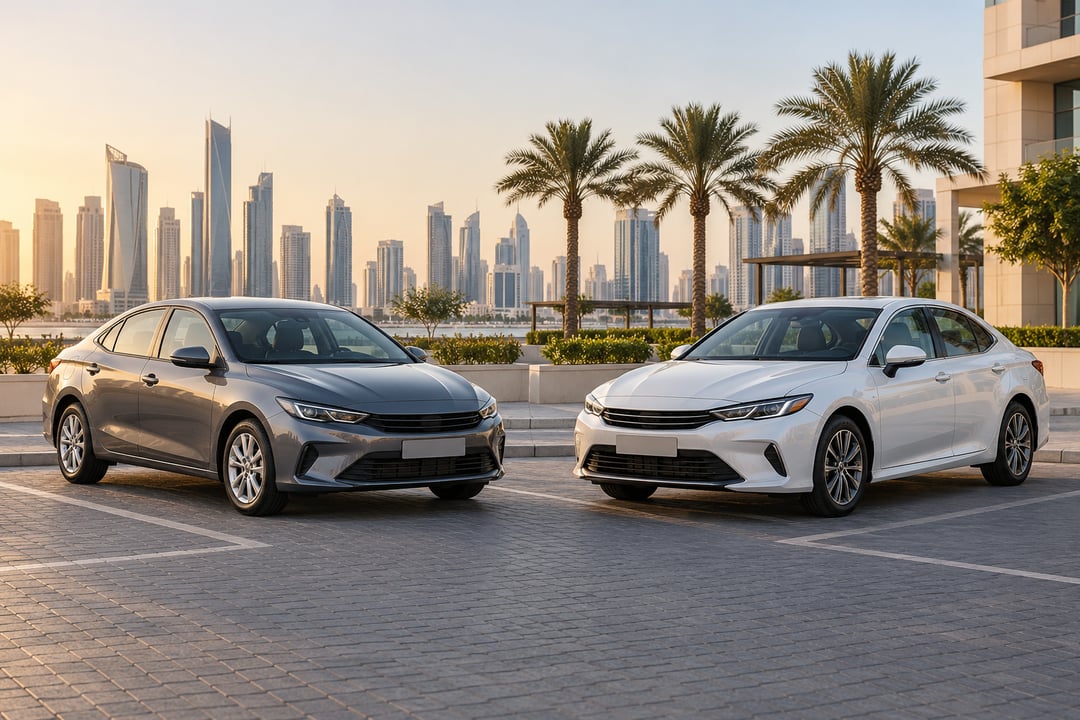
Choose between a 2021 Hyundai Elantra and a 2020 Toyota Camry by trying the space you actually need, then weighing it against each car's condition and commitments. Consider the Camry when its seating demonstrably suits your passengers better and its footprint fits your parking. The Elantra may meet your daily needs without moving to a larger class. The model-year gap and badge reputation do not establish the quality of the two cars for sale.
Compact versus midsize: what changes for you?
Hyundai describes the 2021 Elantra as a seventh-generation compact sedan with a low roofline and driver-oriented cabin in its official launch release. The document expressly covers US-market specifications that can vary by country. Its engine, screen and driver-assistance features do not establish what a Gulf-market example has.
Toyota's 2019 European engineering introduction presents the eighth-generation Camry as a midsize sedan and explains its lowered cabin floor and seating hip points. This is background on the generation's design, not a Gulf-market trim specification for the 2020 Camry. A larger class alone does not prove easier entry or comfort for a particular person. Try both cars with the same passengers.
First establish the model year, original supply market, trim, engine and transmission using vehicle documents and distributor information for the VIN. First registration is not a substitute. If one candidate is a hybrid or comes from another market, separate its specification and assessment requirements rather than treating every Elantra or Camry advertisement as the same version.
The rear-seat trial that can change your decision
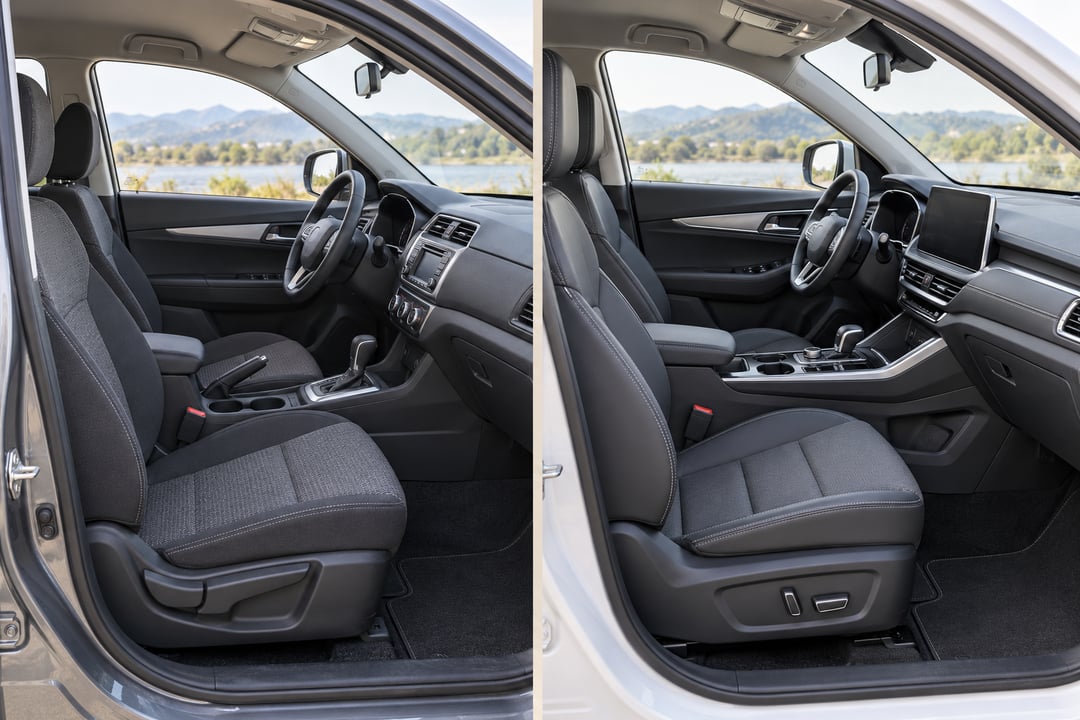
Set the driver's seat to your normal driving position, leave it there and sit behind it in each car. Check knee clearance, space for your feet beneath the front seat, thigh support and head-restraint position. Sit naturally upright. Reclining yourself or moving the driver forward merely to create a spacious photograph does not represent daily use.
Get in and out more than once. Do you have to duck substantially beneath the doorway? Is standing up awkward for you? Let your regular passengers try for themselves, particularly if they are taller or have different mobility needs. Knee room alone does not answer the headroom or entry question, and one passenger's trial does not establish centre-seat or shoulder-to-shoulder comfort.
If your family uses child seats, try the actual seats with the seller's permission and follow both vehicle and child-seat instructions. Check the relevant anchors, belts and access, then reassess the front passenger's position. Do not infer that the Camry accepts a particular arrangement from its class name, or dismiss the Elantra for family use before this trial.
Extra space needs an outside-the-cabin test too
| Your usual use | What to try in both cars | How it affects the choice |
|---|---|---|
| Mostly alone or with a front passenger | Driving position, visibility and control reach, then the rear space you actually need. | A larger class may add little daily benefit to justify a price or condition difference. |
| Regular rear passengers | Your usual passengers behind the normal driving position, including entry and exit. | Use the fit you experienced as the reason to prefer a car. |
| Narrow parking or a turning entrance | The actual version's length and width, door-opening space and parking visibility. | Make sure your preferred cabin belongs to a car that also fits the location. |
With permission in a safe parking area, try direct visibility and the fitted sensors or camera. Their presence and operation need checking rather than inferring from a trim label. Run the air conditioning from the seats you expect to use and check available airflow and controls; do not assume every example has the same climate system or performance.
Condition and records can outweigh the space advantage
Request maintenance invoices tied to the vehicle, a coherent sequence of recorded odometer readings and available repair records. Ask about previous use and body repairs, then compare the answers with documents and visible observations. A roomier car with unclear history needs explanation; a newer model year does not establish sound condition or lighter use.
Look at panel differences and accessible repair traces, the seats, belts and tyres, and the operation of windows, locks and lights. During an authorised drive, record vibration, unusual noise or response delays if present and obtain appropriate assessment. A noise alone does not diagnose a water pump or timing-chain tensioner, and an odometer reading does not set a fixed failure date.
When does the Camry justify the deal difference?
If your passengers are demonstrably more comfortable in the Camry and it suits your parking, weigh that benefit against the negotiated price, servicing due and written quotations for identified observations. If the Elantra fits comfortably with clearer history and better condition, it may match your needs more closely. Obtain an insurance quote for the actual version and avoid assuming a fixed fuel-cost or resale advantage without comparable evidence.
An experienced AutoFay inspector comes to the vehicle for a visual, non-intrusive, non-mechanical inspection, with computer diagnostics and functional observations according to the package and available conditions. This does not include dismantling parts or examining internal engine or transmission components. Some observations need workshop diagnosis; an inspection does not guarantee detection of every fault or prevent future failures. Review the available inspection packages before booking.
Prepared by AutoFay. Editorial update: October 28, 2026.



0 Comments
No comments yet. Be the first to share your thoughts!