

The popularity of SUVs in the United Arab Emirates stems from their commanding driving position and cargo versatility. However, the elevated center of gravity and substantial mass of these vehicles introduce specific challenges regarding stability and impact absorption. A vehicle with a high safety rating on paper may fail to provide actual protection if its physical components have degraded or been compromised. Verifying the operational status of safety systems requires more than a visual check; it demands a technical assessment of mechanical integrity and electronic functionality.
The Relevance of Global Crash Test Standards
Global safety ratings, such as those provided by Euro NCAP or the National Highway Traffic Safety Administration (NHTSA), offer a baseline for vehicle performance in controlled environments. These ratings evaluate how well a vehicle protects occupants during frontal, side, and rollover collisions. However, these scores do not account for the degradation of safety hardware over time, such as the weakening of airbag inflators or the corrosion of structural steel due to the UAE’s saline environment. A vehicle that was once a five-star rated model may lose structural rigidity if its frame has been bent in a minor accident and subsequently repaired incorrectly. Understanding these ratings helps buyers distinguish between a vehicle designed for safety and one that has maintained that design over its lifespan.
Essential Passive Safety Features to Verify
Passive safety systems are designed to minimize injury once a collision has occurred. Inspecting these features requires a detailed examination of both hardware and the vehicle's structural skeleton.
- Structural Pillars (A, B, and C-pillars): The pillars act as the main load-bearing structures that transfer impact energy away from the cabin. In an SUV, these components must remain rigid to prevent roof collapse during a rollover. Inspectors look for misaligned panels or gaps that suggest the frame has been bent and straightened, which permanently compromises the load path.
- Seatbelt Systems: This includes the webbing condition and the pre-tensioner mechanisms. A frayed seatbelt will not restrain the occupant effectively in a crash. Furthermore, electronic sensors within the seatbelt buckles must function correctly to trigger airbags and pre-tensioners simultaneously.
- Airbag and Curtain Modules: These components must be present and free of physical damage. The deployment sensors and wiring harnesses connecting the airbags to the main computer must be intact. Even a minor puncture in the curtain airbag can render it useless in a side-impact scenario.
Active Safety Systems and Mechanical Integrity
Active safety systems work proactively to prevent accidents from occurring. In the context of a UAE inspection, verifying these systems is critical due to the high speeds on highways and the intense heat affecting rubber and electronics.
- Braking Systems: The braking performance of an SUV is directly linked to its stopping distance. Worn brake pads result in prolonged stopping distances, significantly increasing the risk of collision. The inspection process measures pad thickness and checks for potential leaks in the brake fluid system. A compromised braking system can lead to brake fade, especially when descending tall buildings or steep highways.
- Electronic Stability Control (ESC): This system prevents the vehicle from losing control during evasive maneuvers. A malfunction in the ESC module, often triggered by a faulty wheel speed sensor, disables this critical safety feature. An OBD scan is required to detect these hidden electronic faults.
- Tyre Condition and Date: In the UAE’s extreme heat, the rubber compound of tyres degrades faster than in temperate climates. Inspectors verify the manufacturing date and tread depth. Sidewalls that are cracking or bulging indicate that the tyre has exceeded its service life and poses a sudden blowout risk at high speeds.
Structural Integrity: The Frame and Pillars
For SUVs, the chassis is the foundation of safety. Unlike sedans, SUVs are more prone to axle deformation and frame twisting during off-road or low-speed collisions. Inspecting the frame requires a meticulous examination of the chassis rails, rocker panels, and suspension mounting points.
| Component | Inspection Focus | Safety Risk |
|---|---|---|
| Chassis Rails | Alignment, corrosion, straightness | Uneven tire wear, poor steering response, compromised load path |
| A-Pillar | Gap consistency, paint match, weld seams | Roof collapse risk, visibility obstruction |
| B-Pillar | Door alignment, intrusion bars | Structural weakness during side-impact collisions |
The AutoFay Inspection Approach to Safety
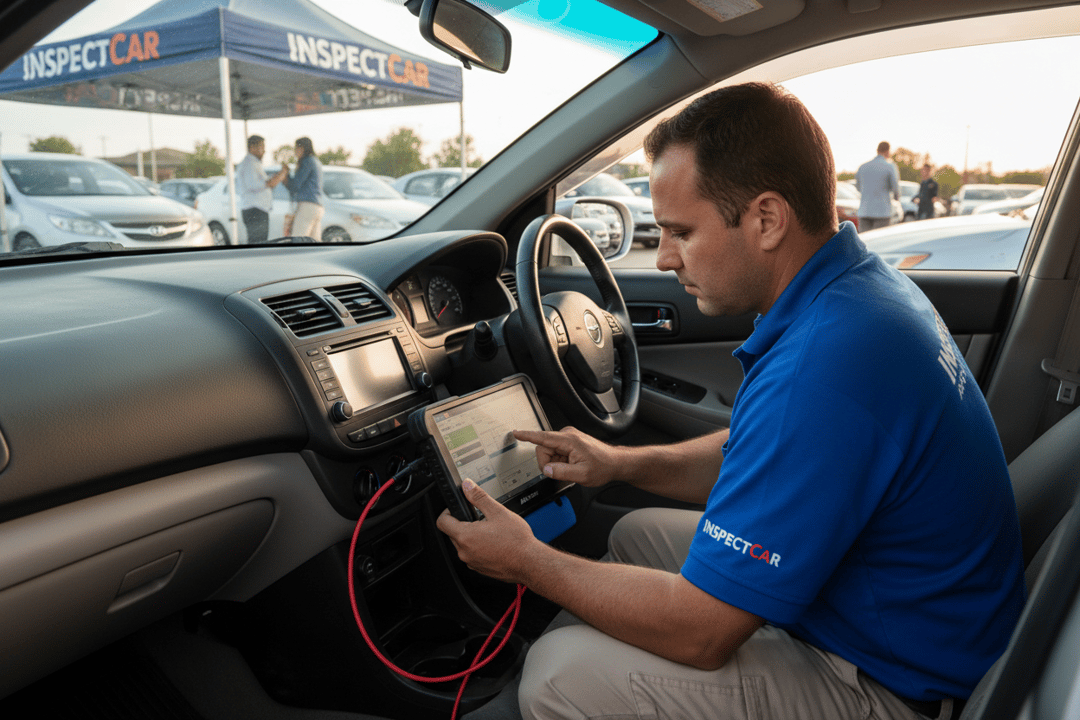
Professional inspection goes beyond surface appearance to reveal hidden safety hazards. A thorough audit involves a combination of visual checks and diagnostic tools to ensure every safety-critical component is functioning as intended.
The inspection process covers 410+ checkpoints across 25 categories to ensure comprehensive coverage. A standard "Computer Diagnostic" check for AED 99 can reveal hidden error codes in the ABS, SRS (Supplemental Restraint System), and electronic stability modules. For a more detailed assessment of the vehicle's physical safety status, the "Body & Computer" package at AED 250 evaluates panel-by-panel condition and scans for transmission faults that could impair acceleration control. The most rigorous option, the "Comprehensive" package at AED 299, integrates a full road test. This test measures acceleration, braking performance, and noise levels to ensure the vehicle handles safely and predictably on UAE roads.
Important safety categories examined include the frame, engine mounts, and suspension components. Engine mounts that are worn can cause excessive vibration, transmitted to the steering wheel and pedals, which may mask mechanical issues or distract the driver during an emergency maneuver. Suspension components, such as ball joints and control arms, must be secure to maintain tire contact with the road. Fluid levels are also checked; low brake fluid or power steering fluid indicates potential leaks that will degrade braking and steering performance over time.
Common Safety-Related Faults Revealed by Inspections
Many safety defects are not visible to the untrained eye but are easily identified during a professional inspection.
- Altered VIN Numbers: If the Vehicle Identification Number has been tampered with, the vehicle’s history—including prior accidents and recalls—cannot be verified, leaving the buyer unaware of potential structural damage.
- Hidden Collision Damage: Repainted bumpers or misaligned doors often mask frame damage that compromises the vehicle's geometry and safety systems.
- Electrical Faults: Faulty wiring behind the dashboard may disable multiple airbags simultaneously, rendering the passive safety system useless in a crash.
Ensuring an SUV is safe for the road requires a professional eye. AutoFay inspects 410+ checkpoints with HD photos and PDF report. Book at autofay.ae or call +971542584458.


0 Comments
No comments yet. Be the first to share your thoughts!