

Crossovers dominate the UAE automotive landscape due to their blend of passenger car comfort and utility. However, this popularity makes the pre-owned market a breeding ground for hidden structural and mechanical issues. A visual inspection often misses the subtle signs of frame damage or electrical faults common in imported vehicles. Buyers must understand that the price tag reflects the vehicle's current condition, not its potential future value. Skipping a professional inspection risks significant financial loss and safety hazards on UAE roads.
Exterior and Paint Analysis
The exterior provides the first clues about a vehicle's history, specifically whether it has been involved in accidents. Crossovers with plastic body cladding often hide bumper-to-bumper impacts that may result in misalignment. Paint shade discrepancies are a definitive sign of panel replacement, which requires stripping the entire section for matching. Professional inspectors look for "orange peel" texture, indicating poor spray gun technique or cheap resprays. Uneven gaps between panels suggest a previous collision or poor assembly.
Inspectors also check for clear coat failure, which accelerates in the UAE due to intense sunlight. This peeling paint compromises the metal beneath and eventually leads to rust formation at the edges of panels. Headlight lenses should be crystal clear; yellowing indicates UV degradation and reduces visibility at night. Additionally, check the condition of the windshield for chips or cracks, as structural integrity can be compromised if the glass is replaced incorrectly.
Chassis and Structural Integrity
Unlike body-on-frame trucks, most modern crossovers use a unibody design where the body and frame are welded together. This means the chassis is the primary load-bearing component; any damage here compromises the entire vehicle's safety. A experienced inspector looks at the A-pillars, B-pillars, and roof rails for bending or stress fractures. A damaged firewall can prevent airbag deployment in a collision, leaving occupants unprotected.
Rust is a silent killer in the UAE's coastal cities, accumulating in the wheel arches and rocker panels. Inspectors use a magnet to detect body filler hiding rust bubbles, which are common in older imported models. The floor pans must be checked for signs of water ingress or previous repairs, as this indicates flood damage or structural repairs. AutoFay technicians examine the frame rails and floor pan to ensure the vehicle retains its original structural rigidity.
Engine and Transmission Diagnostics
Under the hood, the engine must be assessed for both internal wear and external leaks. A running engine should have smooth acceleration without hesitation or stalling. Cold starts provide critical data; white smoke indicates coolant burning (head gasket failure), while blue smoke signals oil consumption. Black smoke points to a rich fuel mixture, which can harm the catalytic converter.
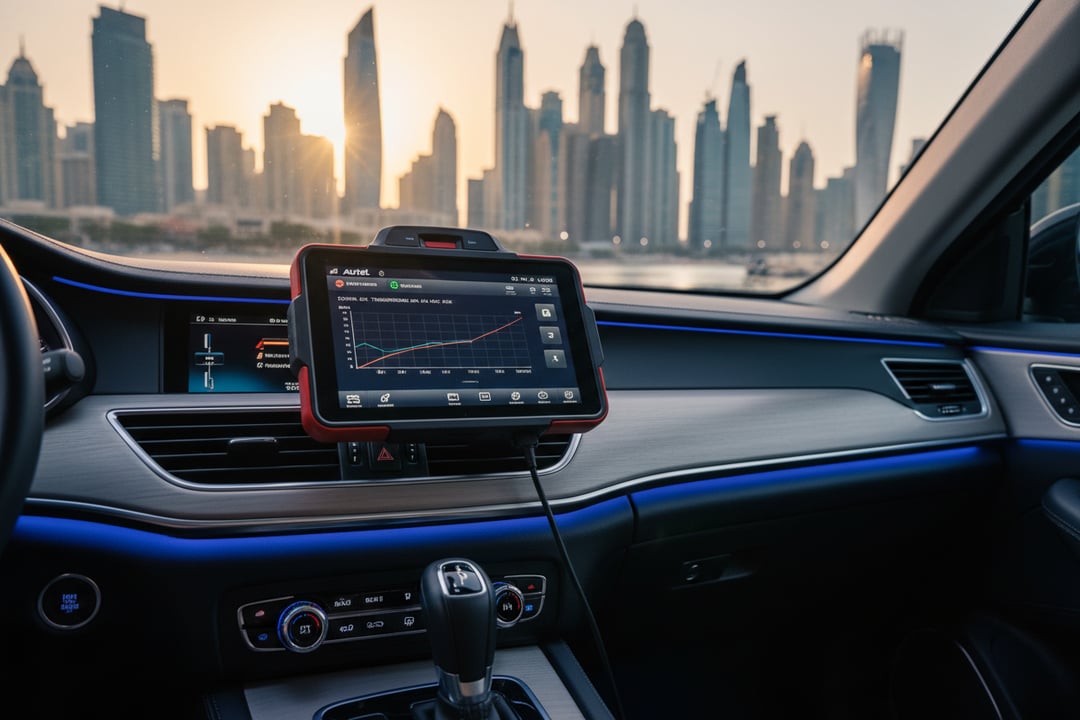
Electrical faults are increasingly common in modern vehicles. A professional inspection includes an OBD scan to retrieve fault codes for the engine, transmission, ABS, and airbag systems. Ignoring a Check Engine Light often leads to expensive catalytic converter replacements. Inspectors also check the engine and transmission mounts, which stabilize the powertrain; worn mounts cause excessive vibration and noise during acceleration.
Braking, Suspension, and Tires
Braking systems are the most critical safety feature, especially for larger, heavier crossovers. Inspectors use a digital brake meter to measure the remaining thickness of the brake pads. A rating system usually assigns a percentage; pads below 50% will fail a technical inspection and require immediate replacement. Listen for grinding noises, which indicate metal-on-metal contact and worn rotors.
Suspension components control the vehicle's handling and ride quality. Worn control arm bushings or ball joints create a clunking noise over speed bumps and uneven road surfaces. Crossovers are prone to bottoming out on speed bumps due to their high center of gravity; worn suspension springs can exacerbate this issue. Tires must be inspected for uneven wear patterns, which indicate alignment or suspension problems. Inspectors also verify the tire manufacturing date to ensure the rubber has not aged and cracked due to UV exposure.
Fluids and Under-Carriage Health
Fluids serve as the blood and oil of the vehicle, offering a snapshot of maintenance history. Transmission fluid should be bright red and smell sweet; if it is brown or smells burnt, the gearbox is nearing failure. Engine oil should be amber, not black or gritty, indicating neglect. Brake fluid absorbs moisture over time, which lowers its boiling point and degrades braking performance.
The under-carriage section is often neglected during private sales. Inspectors look for oil leaks from the valve cover, oil pan, or differential. Coolant leaks can be identified by looking for green or orange crusty residue around the radiator or water pump. These leaks are symptoms of gasket failure or poor seals, which are expensive to repair. AutoFay technicians check the level and condition of all fluids to prevent breakdowns on the highway.
Recommended Inspection Packages
Investing in a professional inspection mitigates the risk of purchasing a vehicle with latent defects. The following table outlines the key services included in AutoFay's on-location inspection packages:
| Package | Price (AED) | Includes |
|---|---|---|
| Computer Diagnostic | 99 | OBD scan for engine, transmission, ABS, and airbag codes. |
| Body & Computer | 250 | Includes computer scan plus body panel inspection, paint checks, and frame assessment. |
| Comprehensive | 399 | Full on-location inspection including road test, brakes, suspension, tires, and fluids. |
AutoFay inspects 410+ checkpoints with HD photos and PDF report. Book at autofay.ae or call +971542584458.




0 Comments
No comments yet. Be the first to share your thoughts!