

Assessing a 2017 Toyota Corolla for heat and dust starts with the particular car's condition and history, not an assumed model-wide fault list. Before purchase, seek an explanation for recurring coolant loss or air-conditioning complaints and maintenance that matches the version and its use. Driving on a dusty road is different from driving across sand; a “desert heat” description does not establish dune suitability.
Match the version before choosing maintenance specifications
Confirm the VIN, original market and grade, and obtain the appropriate owner's manual and maintenance schedule. Do not infer timing-drive type, fluid specifications or replacement intervals from the 2017 model year alone. If the seller relies on a booklet or invoice, establish that it relates to the actual car and version.
Ask for records of cooling-system and air-conditioning work and whether a complaint returned after repair. A replaced hose or fluid top-up is not a complete explanation of previous overheating. The useful questions are what cause was diagnosed, what work was done and how the result was followed up.
What does a visible coolant level establish?
NHTSA's summer-driving guidance directs owners to the vehicle manual for coolant requirements and recommends appropriate assessment of leaks and cooling-system condition. This is general guidance, not a coolant specification or inspection result for a Gulf-market 2017 Corolla.
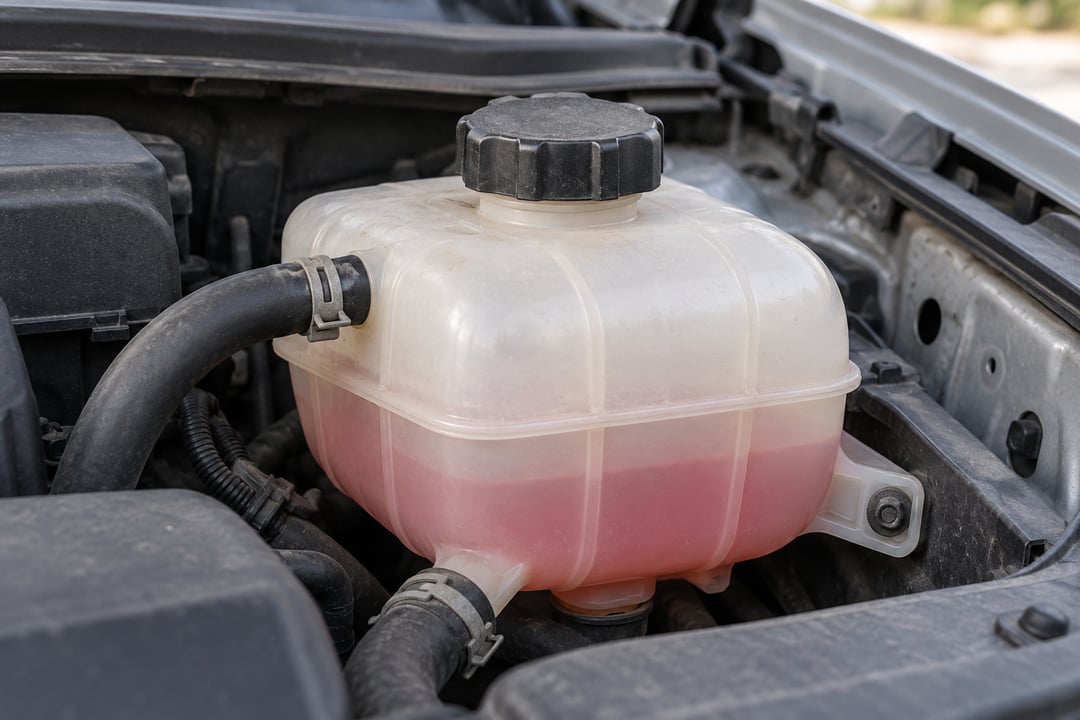
Where a level can be seen through a translucent reservoir without intervention, record what is visible and compare it with the applicable instructions. A single observation does not establish that the level remains stable in use or that the system is leak-free, and fluid colour alone does not establish its specification. If the owner repeatedly tops it up, seek an explanation and follow-up records rather than accepting the presence of fluid during the viewing.
Visible wetness or deposits deserve recording, but do not alone establish the leak source or the component that needs replacing. If access conditions prevent an observation, retain it as an unresolved follow-up point rather than a reassuring result.
Separate an A/C complaint from a compressor diagnosis
Ask for the available functions to be demonstrated and observe airflow and control response, recording the viewing conditions and duration. A cool cabin during a brief visit or mild weather does not establish performance throughout your normal journeys. Weak cooling alone also does not establish compressor failure or a rule that this model's compressors fail after a set number of summers.
If there is a complaint, obtain appropriate diagnosis before agreeing on a repair and its cost. A general description such as “only needs refrigerant” does not replace knowing what was checked and what remains uncertain.
Dust should lead to specific maintenance questions
Ask about engine-air and cabin-filter maintenance according to the car's equipment, schedule and use, and request available invoices. Do not assign one replacement mileage to every vehicle or treat visible dust as proof of an internal fault or an explanation for coolant loss.
Record visible dirt, fluid traces or external damage in accessible areas without dismantling parts to confirm an assumption. Do not classify every colour change as corrosion or attribute a noise to suspension or brakes without appropriate verification. Symptoms and observations begin a follow-up process; they are not an automatic parts-replacement list.
When should you postpone relying on the car?
Recurring unexplained coolant loss, previous overheating without a clear repair outcome, a dashboard warning or a persistent A/C complaint needs resolution before relying on the car for hot-weather commuting. An absent symptom during the viewing does not guarantee it will not return. Bring the records, observations and test limitations together in the purchase decision without an invented repair budget or promise of higher resale value.
An AutoFay inspector comes to the vehicle for a visual, non-intrusive, non-mechanical inspection, with computer diagnostics and functional observations according to the package and available conditions. The work does not dismantle parts, examine internal engine or transmission components, or service cooling-system internals; some observations require workshop diagnosis. Inspection does not guarantee detection of every fault or future reliability.
When choosing a pre-purchase inspection service, share the 2017 Corolla's records and any overheating, A/C or repeated fluid-top-up complaint to establish appropriate follow-up before purchase.
Prepared by AutoFay. Editorial update: October 28, 2026.


0 Comments
No comments yet. Be the first to share your thoughts!