

A 2010 Toyota Corolla's summer readiness depends on the particular car's condition, everyday functions and servicing commitments, together with how you use, park and leave it. Model year alone does not predict a fault, and working air conditioning does not establish the condition of the whole vehicle. For a used purchase, seek understandable records, explained observations and a maintenance plan before depending on it daily.
Before the first trip, try the functions you use every day
Verify model year, original supply market, trim, engine and transmission from documents and distributor information for the VIN, then obtain the matching manual. Another Corolla advertisement does not establish the timing-system type, fluids or maintenance intervals for this car.
While safely parked, adjust the seat and mirrors and try windows, locks and door opening from the positions you will use. Review belt and buckle condition, lights, wipers and washers. These details matter in an older car that you will repeatedly enter, leave and park.
Run the air conditioning and record the test conditions, including stationary operation or an authorised drive and the comfort of airflow at the occupied seats. Weak cooling, an odour or a noise does not automatically diagnose the compressor. Obtain appropriate assessment, and do not turn one successful short trial into a promise of consistent future performance.
Make the end of the journey a clear routine
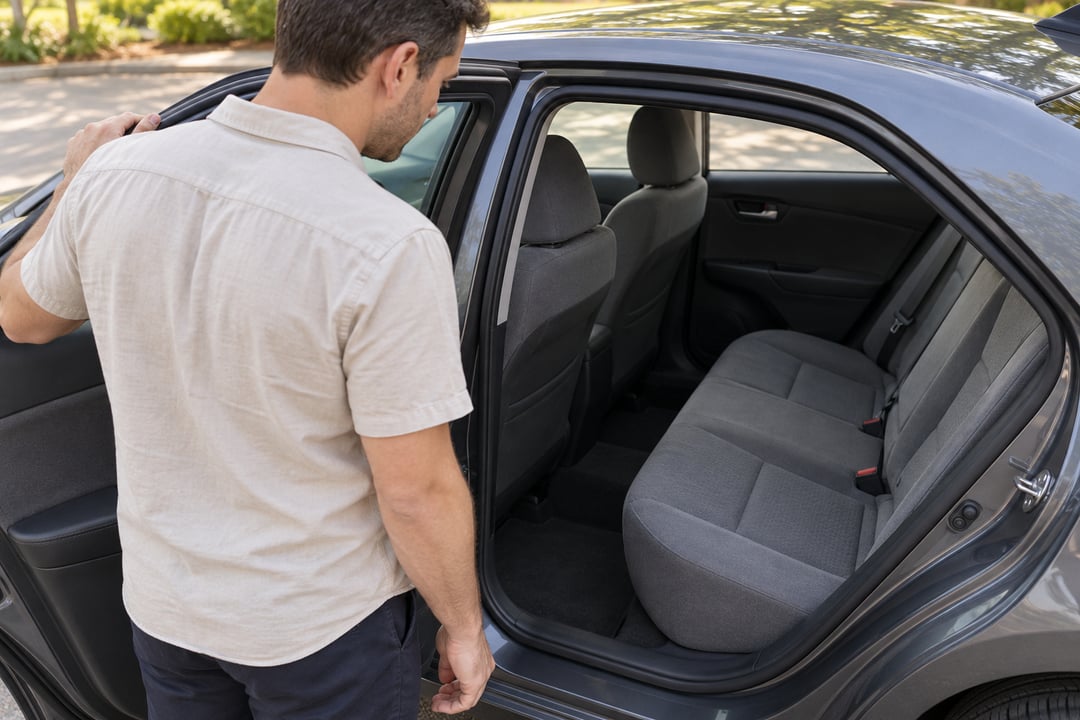
NHTSA's summer-driving guidance advises checking the rear seating area before leaving a parked vehicle and never leaving a child unattended inside. Make the visual check a fixed step, including days when the driver, return route or passenger routine changes.
- Park safely according to the vehicle instructions, then organise passenger exit while keeping any child under adult supervision.
- Before walking away, look through the rear seating area and floor, confirming everyone has left rather than relying on memory alone.
- If more than one adult shares responsibility for the journey, identify who performs the final check rather than assuming someone else has done it.
- After confirming the car is empty, secure it and check the doors according to its instructions before leaving.
Working air conditioning or an earlier successful inspection does not change the rule against leaving a child unattended.
When returning to a car parked on a hot day
Allow time to prepare the cabin, seating position and destination before driving, following the vehicle's ventilation and air-conditioning instructions. Check that visibility is clear, mirrors are adjusted and objects do not obstruct pedals or belts. Do these checks while stationary rather than becoming distracted at the start of the drive.
If there is an unusual warning, visible leakage or deteriorating response, follow the vehicle manual and seek appropriate help before continuing use. Do not dismiss it as inevitable with age or select a replacement part by guesswork.
For the cooling system, NHTSA's guidance refers fluid requirements to the vehicle instructions; recurring loss or visible leakage needs assessment by an appropriate service provider. Confirm the requirements against the matching manual and service assessment, resolving the observation before relying on the car daily.
Make planned maintenance part of the purchase decision
Request maintenance invoices, a sequence of odometer records and available repair history, and weigh them against visible condition. Ask what was actually done and what remains due under the correct manual instead of accepting a general “summer ready” description. An odometer reading alone does not set a water-pump, compressor or suspension failure date.
Obtain written quotations for servicing and supported repairs, showing parts, labour, tax, warranty and expected booking time. Arrange alternative transport if the car needs workshop time, and build fuel and operating estimates from records and quotations relevant to your use. An older car can suit your needs when its commitments are understood and fit your use and budget.
An experienced AutoFay inspector comes to the vehicle for a visual, non-intrusive, non-mechanical inspection, with computer diagnostics and functional observations according to the package and available conditions. This does not include dismantling parts, examining internal engine or transmission components or performing mechanical servicing. Some observations need workshop diagnosis; an inspection does not guarantee detection of every fault or prevent future failures. Review the available inspection packages before booking.
Prepared by AutoFay. Editorial update: October 28, 2026.


0 Comments
No comments yet. Be the first to share your thoughts!