

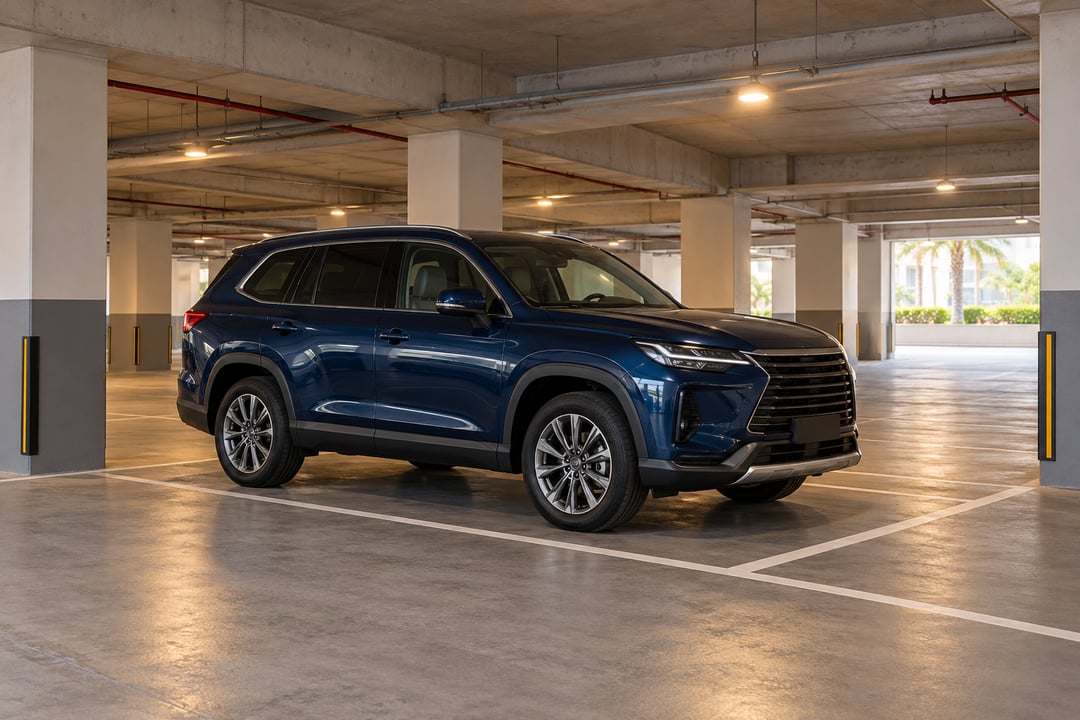
Does a 2026 Lexus LX 700h suit your daily commute? Assess it on your route and in your actual parking conditions, rather than relying on engine output or a grade name. Access, visibility, parking, passenger comfort and running costs determine whether the particular vehicle fits your routine.
Identify the version before comparing specifications
Lexus' official 2026 information describes the LX 700h with a twin-turbo V6 hybrid system, not a V8. It is a US-market reference; economy figures and grade features are not assumed to apply to every UAE car. Confirm the VIN, grade and supplying market against the documents and relevant dealer information.
Obtain the correct owner's manual and verify the actual seating and equipment. Do not rely on an advertisement photo of another car, particularly across grades or imports. If wheels, suspension or exterior accessories have been changed, request their documentation before assessing everyday suitability.
Start with your parking entrance and bay
Check the actual vehicle dimensions against your entrance and available height, accounting for fitted accessories. A general figure for another version cannot establish clearance. If clearance is uncertain, arrange an appropriate measurement rather than attempting entry by guesswork.
With permission in a safe, permitted location, try parking conditions resembling your routine. Assess door-opening space, boot access and passenger exit. Set the mirrors and observe any fitted cameras and sensors according to the manual without deliberately approaching people or obstacles to trigger them. Assistance features do not remove the driver's responsibility to watch the surroundings.
Try comfort against your real needs
While stopped, adjust the seat, steering wheel and controls, then assess your view of the road and instruments. Try passenger access and seating with normal luggage. A solo commuter's priorities may differ from those of a family needing child seats or everyday cargo space.
On a safe route with permission, observe moving away, stopping, gentle response and air conditioning. Record any noise, vibration, delay or warning. One symptom does not establish a battery, suspension or transmission fault. An unexplained concern needs suitable assessment before you commit.
Estimate costs without assuming failures
A hybrid badge does not establish that the car will be cheapest on your route, and one published economy figure cannot determine your bill. Use your distance, traffic conditions and substantiated consumption where possible, then add current fuel prices, parking, road charges, insurance and necessary version-specific maintenance.
For a used example, review invoices, repair history and any specialist hybrid-system report. Ask what was tested, when and with what limitations. Reading diagnostic codes is not measuring remaining battery capacity; an absence of warnings cannot prove every component is sound. Obtain repair quotations after diagnosis instead of assuming replacement at a fixed mileage.
What AutoFay adds to the buying assessment
An experienced inspector comes to the vehicle. The inspection is visual, non-intrusive and non-mechanical, with computer diagnostics and functional observations according to package and conditions. Paint and visible underbody areas may be assessed within the package scope where safe access is available. Review the packages and service scope.
The inspection does not dismantle components or examine internal engine, transmission or hybrid-battery parts. Some findings require workshop diagnosis. A report cannot guarantee discovery of every fault or prevent future failures. Combine its observations with records, parking and comfort checks and an understood budget to decide whether this vehicle fits your commute.
Prepared by AutoFay. Editorial update: October 28, 2026.



0 Comments
No comments yet. Be the first to share your thoughts!