

Crossing the 30,000-kilometer mark in the UAE presents a critical juncture for vehicle ownership. The intense desert climate, combined with frequent highway driving and stop-and-go traffic in city centers, subjects vehicle components to accelerated stress. Many drivers operate under the misconception that standard service intervals are sufficient; however, proactive maintenance at this specific mileage is essential to prevent significant failures and ensure long-term reliability. A higher mileage service is not merely about changing fluids; it involves a comprehensive audit of safety-critical systems, including brakes, suspension, and structural integrity.
Engine Health and Fluid Condition
The engine is the heart of the vehicle, and at higher mileage, internal components have undergone significant thermal cycling. Engine oil degrades chemically over time, losing its viscosity and its ability to neutralize acids produced by combustion. If oil service is neglected, sludge forms, restricting oil flow to critical bearings and causing microscopic scoring on pistons. This leads to reduced engine efficiency and potential seizure.
Equally critical is the cooling system. The coolant in the radiator is responsible for dissipating heat generated by the engine block. After three decades of operation, coolant additives lose their corrosion inhibitors. Without these, the aluminum components of the radiator and engine block begin to corrode, leading to leaks and potential engine overheating. Transmission fluid also requires attention at this stage. Modern automatic transmissions rely on fluid to provide hydraulic pressure for gear shifts and to cool the transmission itself. Old transmission fluid becomes thick and varnishes, causing harsh shifting, delayed response, and premature transmission failure.
Key Fluids to Inspect and Replace
- Engine Oil: Verify the condition of the oil filter and ensure the oil meets the viscosity grade recommended by the manufacturer.
- Coolant: Inspect the level and check for the presence of rust or contamination, which indicates degradation of the anti-corrosive properties.
- Transmission Fluid: Check for color and smell. Bright red indicates freshness; brown or burnt smells suggest the fluid has overheated and lost its lubricating properties.
- Power Steering Fluid: Inspect for air bubbles or debris, which can damage the pump and rack.
Brake System Assessment
The braking system is a safety-critical component that undergoes the most direct physical interaction with the road surface. at higher mileage, brake pads typically reach the end of their effective life. Brake pads function by using friction material to slow the vehicle; once the friction material wears down to the steel backing plate, the metal grinds against the rotor. This not only destroys the rotor but also drastically increases the stopping distance of the vehicle.
Inspection should also extend to the brake calipers and lines. Calipers must move freely to apply even pressure to the pads; if they seize, the vehicle will pull to one side during braking. Brake fluid must be bled to remove moisture, which lowers its boiling point. In the UAE, where brakes work hard during sudden stops, low-boiling-point fluid can cause brake fade, where the pedal feels soft and the brakes fail to engage effectively.
Suspension and Steering Components
The suspension system is responsible for maintaining tire contact with the road and isolating the cabin from road imperfections. Shocks and struts absorb the kinetic energy of bumps. Over higher mileage, strut cartridges can leak hydraulic fluid or the internal valving can fail. When this happens, the vehicle will bounce excessively, making tire contact inconsistent and reducing cornering stability.
Another common failure point at this mileage is the tie rod ends and ball joints. These components connect the steering rack to the wheels. Worn tie rods cause play in the steering wheel, leading to imprecise handling and uneven tire wear. Bushings, which are rubber mounts connecting metal suspension parts, often crack due to UV exposure and heat. A failing bushing creates clunking noises over bumps and allows the chassis to flex unnaturally, compromising the vehicle's ability to handle emergency maneuvers.
Tire Condition and Manufacturing Age
Tires provide the only point of contact between the vehicle and the abrasive desert roads. at higher mileage, tread depth is often approaching the legal limit in the UAE, which is 1.6 millimeters. However, tread depth is only one metric to consider. Tires have a limited shelf life due to the degradation of the rubber compounds over time, regardless of usage.
Every tire sidewall contains a DOT code indicating the week and year of manufacture. A tire older than six years is at high risk of dry rot and cracking, even with low mileage. Uneven wear patterns on the tires can reveal suspension misalignment or improper inflation. Continuing to drive on worn or aged tires significantly increases the risk of hydroplaning during sudden rainstorms and creates a catastrophic blowout at highway speeds.
Body, Paint, and Structural Integrity
While often overlooked, the structural health of the vehicle is paramount for passenger safety. At the higher mileage milestone, it is prudent to inspect the vehicle for the effects of minor accidents that may have occurred post-purchase. Panel-by-panel inspection reveals whether bodywork has been done professionally. Poorly repainted panels often have inconsistent color or orange peel texture, indicating rushed repairs that may hide rust or filler cracks.
More importantly, the frame requires examination. The unibody structure includes the floor pans, rocker panels, and pillars. These areas are susceptible to rust in coastal areas or corrosion from road salt. A structurally compromised frame alters the vehicle's geometry, affecting alignment and safety in the event of a collision. Inspecting the undercarriage for rust or damage to the frame rails ensures the vehicle has not suffered structural deformation.
Why a Professional On-Location Inspection is Essential
Performing a higher mileage service checklist accurately requires specialized equipment and trained eyes. Generic service centers often focus on the basics, missing subtle but expensive issues. For a thorough evaluation, a comprehensive inspection is required. AutoFay provides a on-location inspection service that covers all seven Emirates, delivering a detailed report without the customer needing to visit a workshop.
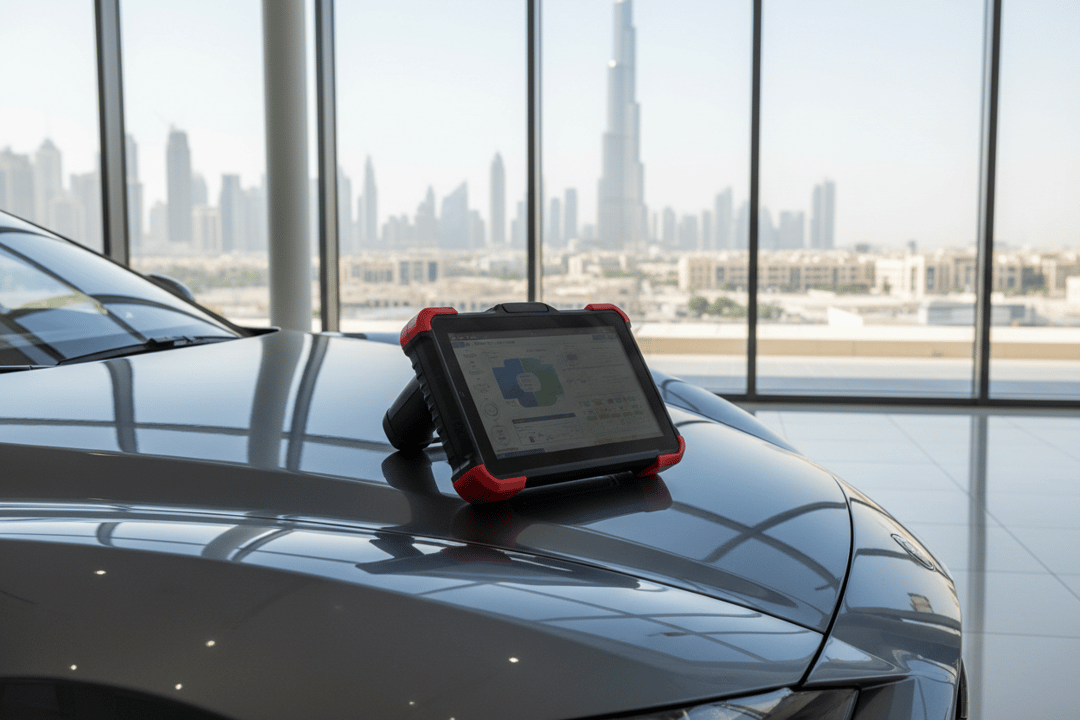
Using advanced diagnostic tools, an AutoFay inspector can plug into the vehicle's onboard computer to scan for error codes in the engine, transmission, ABS, and airbag systems. This diagnostic capability is vital for identifying electrical faults or sensor failures that a visual inspection might miss. The service categorizes findings into clear groups: Body & Paint, Frame, Engine sound and mounts, OBD scan, Brake pad percentage rating, Suspension, Tires, Fluids, and a comprehensive Road Test.
| Service Package | Key Inclusions | Price |
|---|---|---|
| Computer Diagnostic | OBD scan for Engine, Transmission, ABS, Airbag codes; Engine sound and mount inspection. | AED 99 |
| Body and Computer | Includes Computer Diagnostic services plus panel-by-panel Body & Paint inspection for original/repainted/repair status. | AED 250 |
| Comprehensive | Full inspection covering Body & Paint, Frame (rails, pillars, floor pan), Engine, OBD scan, Brakes, Suspension, Tires, Fluids, and Road Test. | AED 299 |
Investing in a comprehensive inspection at higher mileage provides a digital roadmap for necessary repairs. It prevents the "guesswork" of vehicle maintenance and ensures that no component is overlooked. The detailed reports generated by professional inspectors allow for informed decisions regarding the vehicle's future.
AutoFay inspects 410+ checkpoints with HD photos and PDF report. Book at autofay.ae or call +971542584458



0 Comments
No comments yet. Be the first to share your thoughts!