

The used car market presents a constant debate: is it better to buy a newer car with high mileage or an older car with low mileage? In most climates, this is a straightforward calculation. In the UAE, the answer is more nuanced because the extreme heat, UV radiation, and sand exposure cause age-related degradation that would take much longer in temperate climates. A professional inspection reveals both age-related and mileage-related wear, allowing buyers to make decisions based on data rather than assumptions.
Components That Age Regardless of Mileage
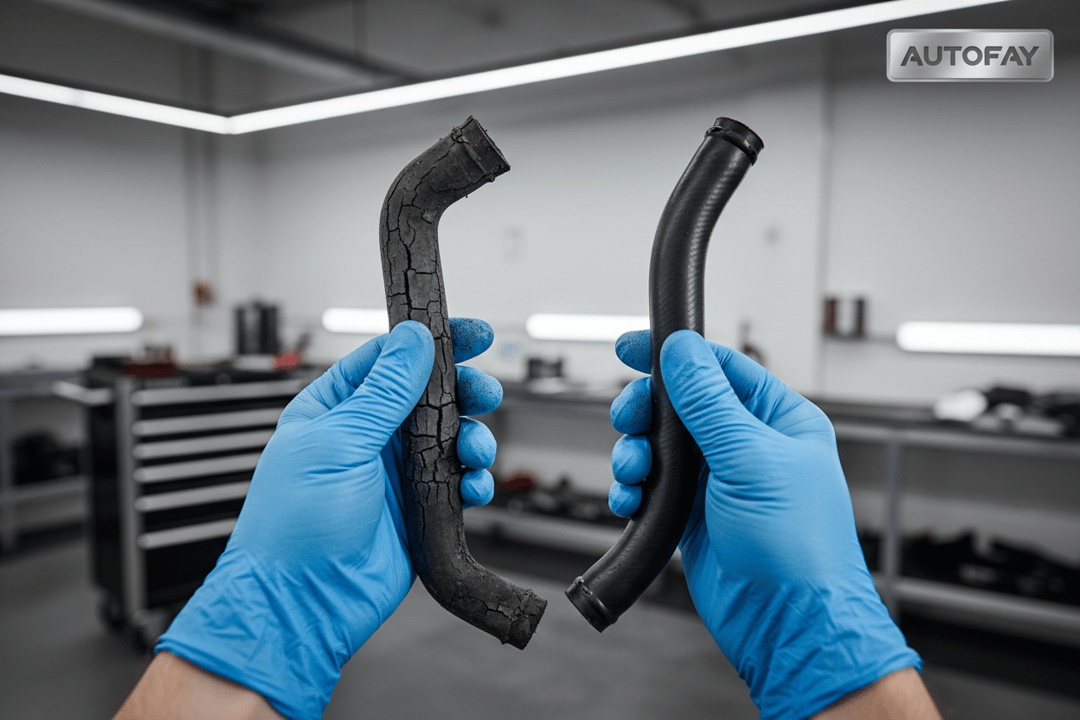
Certain vehicle components degrade with time, not use. Rubber is the primary casualty of age in the UAE. Door rubber seals — rated No Visible Fault, Worn, Torn, or Missing — deteriorate from UV exposure and heat cycling regardless of how far the car has driven. Cooling hoses (Good, Soft, Cracked, or Leaking) become brittle and soft from heat exposure over years. CV boots (Good, Cracked, Torn, or Leaking) crack from environmental exposure. Brake hoses (Good, Cracked, Swollen, or Leaking) lose flexibility with age, becoming prone to failure.
Tires are a clear age-dependent component. Our per-wheel inspection records the manufacturing year for each tire. Regardless of tread depth, tires older than four to five years in UAE conditions have compromised grip due to hardened rubber. A car with higher mileage on eight-year-old tires is less safe than a car with higher mileage on two-year-old tires, despite the tread depth difference.
Battery capacity degrades with age and heat. Our under-the-hood inspection records battery capacity and checks terminals, cables, and mount. A battery in the UAE typically lasts two to three years regardless of mileage because heat accelerates the chemical degradation of the battery plates. A low-mileage car is just as likely to have a weak battery as a high-mileage one if both have the same age battery installed.
Components That Wear With Mileage
Mechanical components wear from use, not time. Brake pads — rated Good (above 50%), Average (25-50%), Worn (below 25%), or Needs Replacement — wear proportionally to how many times the brakes are applied. A car with higher mileage will almost certainly need brake attention regardless of age. Brake rotors (Good, Scored, Warped, or Needs Replacement) develop scoring and warping from repeated heat cycling during braking.
Transmission operation — rated Smooth, Slight Delay, Hard Shifting, or Slipping — deteriorates with use. Clutch packs in automatic transmissions wear from the thousands of gear changes accumulated over high-mileage driving. Transmission fluid degrades from heat generated during operation. Suspension components — ball joints, tie rod ends, control arms, bushings — wear from the cumulative impact of every road surface the car has traveled. Wheel bearings develop noise from accumulated rotation.
Engine internals wear with mileage. Engine oil seals and valve cover gaskets tend to show more seeping or leaking on higher-mileage engines. Engine compression — reflected indirectly through exhaust smoke (None, White, Blue, or Black) and engine performance (Excellent, Good, Sluggish, or Poor) — decreases with cylinder wear over hundreds of thousands of kilometers.
The UAE Heat Multiplier
What makes the UAE different is that heat accelerates both age-related and mileage-related degradation. A cooling system that would last fifteen years in Germany may show problems at seven years in the UAE. Transmission fluid that would last higher mileage in a mild climate may degrade at higher mileage under UAE summer conditions. This multiplier effect means that both age and mileage matter more in the UAE than in temperate markets.
Interior degradation follows a combined pattern. Dashboard condition (No Visible Fault through Damaged) depends on both age (UV exposure over years) and use (driver interaction). Steering wheel wear reflects hours of use. Seat condition reflects both UV exposure and occupant weight and movement over time. The headliner tends to sag more from age and heat than from use.
What Inspection Reveals
The value of a professional inspection is that it measures actual condition rather than relying on age or mileage as proxies. A five-year-old car with higher mileage of well-maintained highway driving may inspect better than a ten-year-old car with higher mileage that sat in an outdoor parking lot for extended periods. The inspection reports what it finds: fluid conditions, component ratings, structural integrity, and system functionality — each based on the car's actual state regardless of the numbers on the odometer or registration card.
Our recommendation: do not buy based on age alone or mileage alone. Buy based on documented condition from a comprehensive inspection. AutoFay's 410+ checkpoint inspection eliminates the guesswork by telling you exactly what condition each component is in right now.
AutoFay inspects 410 checkpoints measuring actual condition, with HD photos and a detailed PDF report. On-location inspection across all 7 Emirates. Book at autofay.ae or call +971-54-258-4458.


0 Comments
No comments yet. Be the first to share your thoughts!