

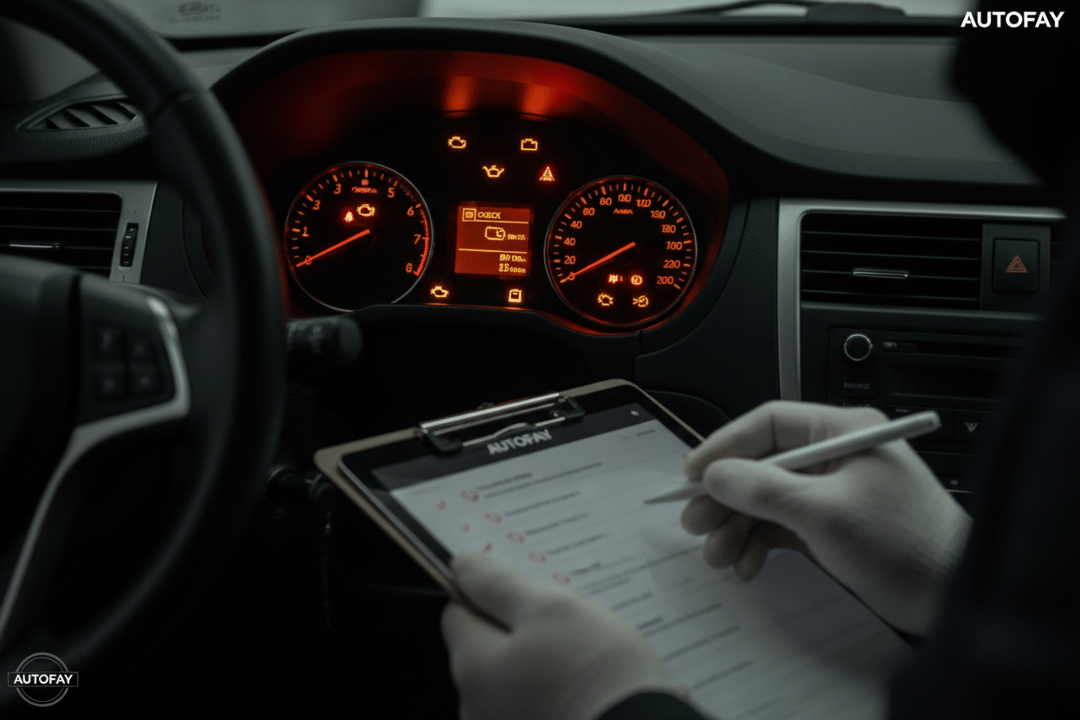
Modern vehicles use dashboard warning lights to communicate the status of critical systems to the driver. When buying a used car, the presence or absence of warning lights during the initial engine start tells an important story. AutoFay's inspection begins with the Engine Start and Operation category, which directly checks for warning lights and gauge cluster function — but the story those lights tell connects to nearly every other inspection category.
The Key-On Bulb Check
When you turn the ignition to the ON position without starting the engine, all warning lights should illuminate briefly. This is the bulb check — the car verifying that each warning light is capable of working. If a warning light does not illuminate during this check, the bulb may have been removed or the warning circuit disabled to hide a problem. AutoFay's gauge cluster inspection rates the instrument cluster as All Working, Partial, or Not Working. A cluster rated Partial may have specific warning lights that do not illuminate during the bulb check — a red flag that something has been intentionally hidden.
After the engine starts, all warning lights should turn off within a few seconds. Lights that remain on indicate active system faults. Our check engine light checkpoint rates it as Off, On, or Flashing. The warning lights checkpoint covers ABS, Airbag, Oil, Battery, and Multiple — each representing a system that our 410+ checkpoint inspection examines in depth.
Red Lights: Stop Driving
Red warning lights indicate critical conditions that require immediate attention. The oil pressure warning means the engine is not receiving adequate lubrication — continued driving can destroy the engine within minutes. Our engine inspection checks oil pressure (Normal, Low, or High) and engine oil level (Full, Low, Overfilled, Empty, or Sealed Unit). The temperature warning indicates engine overheating — connected to our cooling system inspection that checks the radiator, cooling fans, water pump, coolant level, and cooling hoses.
The brake warning light can indicate low brake fluid, parking brake engagement, or brake system failure. Our brake inspection covers brake fluid level (Full, Low, or Empty), parking brake function (Working, Weak, Not Holding, or Not Working), and the complete brake system. The battery/charging warning indicates the alternator is not charging properly — our under-the-hood inspection checks the alternator (Working, Weak Output, or Not Working) and battery capacity. The airbag/SRS warning means the supplemental restraint system has a fault — our safety systems inspection checks the airbag system (No Warning, Warning Light On, or Deployed) and individual airbag presence.
Yellow/Amber Lights: Attention Needed
Yellow warning lights indicate conditions that need attention but are not immediately dangerous. The check engine light is the most common — it means the engine management computer has detected a fault. This connects directly to our OBD scanner inspection, which reads engine fault codes (No Faults, Stored Codes, or Active Faults). A steady check engine light usually indicates an emissions or sensor issue; a flashing check engine light indicates an active misfire that can damage the catalytic converter and requires immediate attention.
The ABS warning means the anti-lock braking system has a fault. The vehicle can still brake, but ABS will not function in emergency braking. Our inspection checks ABS system (Working, Warning Light On, or Not Working) and ABS fault codes. The traction control and stability control lights (Working, Warning Light, or Not Working) indicate problems with systems that prevent wheel spin and loss of control. The TPMS warning connects to our tire inspection — TPMS sensors (All Working, Warning On, or Faulty) indicate a pressure problem or sensor fault.
Information Lights and Their Inspection Connections
Some dashboard indicators are informational rather than warning-based, but they still connect to inspection checkpoints. The maintenance reminder indicates due service — relevant to engine oil condition and filter checks. The 4WD indicator shows which drive mode is engaged — relevant to our transfer case and 4WD/AWD engagement tests. The adaptive cruise control and lane departure icons indicate active driver assistance systems — each checked as Working or Not Working in our safety systems inspection.
The heads-up display (Working, Dim, Not Working, or N/A) projects information onto the windshield. If this system shows errors or dim output, it may indicate a failing projector unit or a windshield that has been replaced with non-HUD-compatible glass — connecting back to the glass inspection showing Aftermarket or Replaced windshield.
Why Warning Light Status Matters When Buying
A used car with no warning lights during your visit may have had its codes cleared minutes before you arrived. This is why the OBD scan is essential — it reads stored codes that persist after the dashboard reset. A car with a check engine light on is actually more honest than one that was recently cleared. Our inspection documents the complete picture: the visual state of the dashboard, the OBD scan results, and the physical condition of every system those lights monitor. This combination makes it impossible for a cleared dashboard to hide real problems.
AutoFay inspects 410 checkpoints including engine start diagnostics and comprehensive OBD scanning, with HD photos and a detailed PDF report. On-location inspection across all 7 Emirates. Book at autofay.ae or call +971-54-258-4458.




0 Comments
No comments yet. Be the first to share your thoughts!