

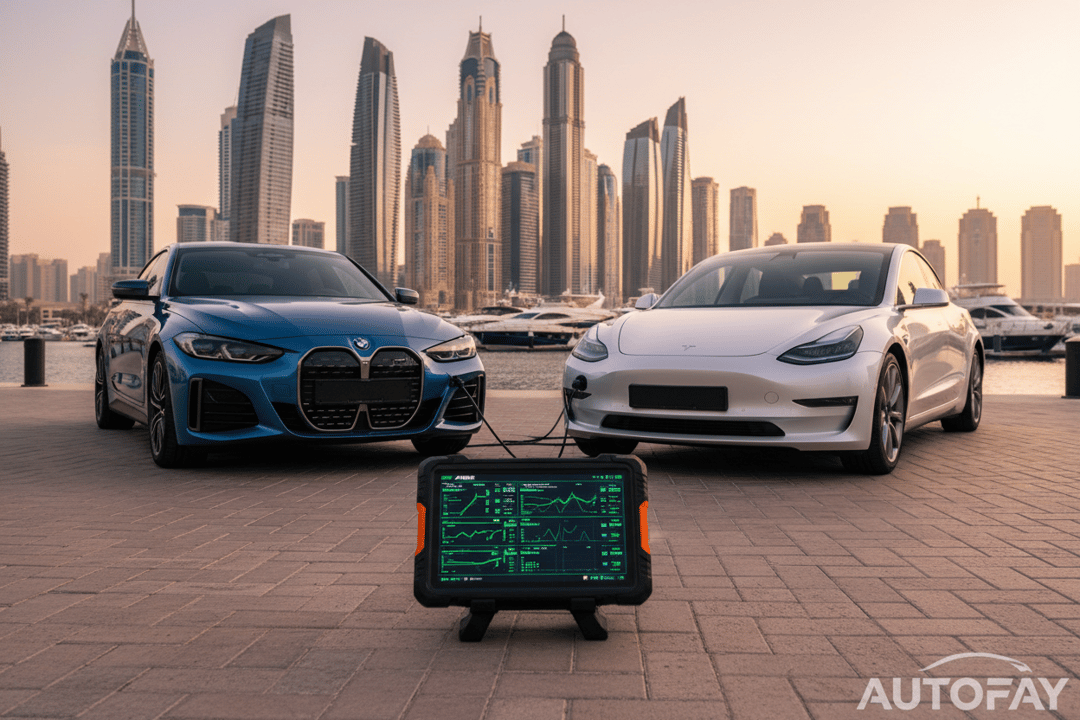
The United Arab Emirates automotive market has witnessed a decisive shift toward electric mobility, creating a competitive landscape where established legacy manufacturers and cutting-edge tech firms vie for dominance. The Tesla Model 3 and the BMW i4 represent two distinct philosophies in this electric transition: the pure-play software-defined vehicle versus the mechanically refined, heritage-based luxury sedan. For buyers navigating the pre-owned market in the UAE, distinguishing between these two involves understanding not just performance metrics, but underlying reliability architecture and specific failure points. A vehicle inspection is not a luxury; it is a necessary prerequisite to avoid inheriting latent defects that compromise safety and long-term value.
Core Architecture and Reliability Profiles
Reliability in electric vehicles is defined differently by their core architecture. The Tesla Model 3 relies on a proprietary software stack that controls nearly every aspect of the car’s operation, from the steering angle to the regenerative braking force. This integration offers efficiency but places a heavy burden on the central control unit; a software glitch or sensor failure can render critical systems inoperable. Conversely, the BMW i4 utilizes a hybrid architecture derived from the proven BMW 4 Series platform. While it shares the electric drivetrain components with other BMWs (like the iX3), the structural chassis and secondary systems are mechanically robust and familiar to the extensive BMW service network in the Emirates.
Inspectors must look for the operational maturity of the specific drivetrain. The Model 3’s electric motor is generally more robust due to its simplicity, but the complexity lies in the 12-volt auxiliary systems which often fail in Teslas after a few years. The i4, however, brings the complexity of a luxury vehicle with its infotainment integration, climate control systems, and high-voltage battery management that requires precise calibration. Understanding these architectural differences allows a buyer to gauge the potential "unknowns" hidden under the bodywork.
The Inspection Imperative: What You Miss Visually
A visual inspection is inadequate for electric vehicles due to the complexity of high-voltage components and the prevalence of cosmetic repainting in the UAE market. Professional inspection goes beyond the surface to verify integrity. Without a thorough check, a buyer risks purchasing a vehicle that appears pristine but possesses compromised structural safety or expensive hidden electrical faults.
Key Categories for the Tesla Model 3
- Body & Paint Integrity: The Model 3 has distinct panel gaps that can widen over time. Inspectors check for recent filler work on the hood or doors, which may indicate impact damage concealed by primer.
- Frame & Structural Rails: Because the Model 3 is unibody, accidents can compromise the structural rigidity. Inspectors verify the integrity of the floor pan and rocker panels to ensure the car has not been in a major collision.
- Water Ingress: Tesla vehicles are prone to water leaks, particularly in the rear trunk area and door seals. Inspectors look for rust or dampness in the spare wheel well and electrical console.
- OBD & Electronic Systems: The Tesla's central screen controls the vehicle diagnostics. An inspector checks for error codes related to the battery management system, 12-volt battery failures, and autopilot sensor alignment.
Key Categories for the BMW i4
- Brake System Health: The i4 utilizes regenerative braking to extend range, which significantly reduces pad wear compared to traditional combustion vehicles. However, the calipers and rotors require checking for corrosion, especially in coastal UAE environments.
- Suspension & Drivetrain: Inspectors listen for unusual noises during a road test that might indicate worn bushings or high-voltage inverter issues common in BMW electric models.
- Fluid Levels & Condition: While there is no engine oil, the high-voltage battery coolant and the thermal management fluids require specific attention to ensure no leaks are occurring from the heat exchangers.
- Tire Specifics: Inspectors check the manufacturing dates of tires. Worn tires on an electric vehicle indicate aggressive driving habits, which reflect on the battery's long-term degradation cycle.
Decoding Maintenance and Diagnostic Expenses
One of the primary advantages of electric vehicles is the reduction in moving parts, but this does not eliminate maintenance entirely. The cost of ownership is heavily influenced by the discipline of diagnostic testing. Skipping a professional diagnostic scan to save a few hundred dirhams often leads to significantly higher expenses down the line.
- The False Economy of Skipping Diagnostics: A buyer who skips a diagnostic scan risks purchasing a vehicle with a "check engine light" active. In electric vehicles, this light often relates to the battery's State of Health (SOH) or thermal management efficiency, which are expensive to rectify.
- Software Updates and Calibration: Unlike combustion engines, electric vehicles require frequent software updates and battery calibration after major repairs. These services are not covered by standard insurance and can incur significant labor charges.
- Thermal Management Failures: The cooling systems in both the Model 3 and i4 are complex. A failure in the cooling pump or hoses can lead to overheating, which permanently damages the battery cells. Early detection through a diagnostic scan is critical to preventing this total battery replacement scenario.
To mitigate these risks, utilizing a professional diagnostic service is the only logical approach. At AutoFay, the Computer Diagnostic package at AED 99 provides immediate access to the vehicle's electronic brain, revealing transmission errors, ABS faults, and airbag codes without digging into the vehicle's interior.
Smart Used Purchase Strategy
Determining which vehicle is the "smarter" purchase depends on the buyer's tolerance for risk and their technical aptitude. The Tesla Model 3 generally holds its value better in the UAE due to brand prestige and the lack of direct competition in the compact luxury segment. However, the older the Model 3, the higher the risk of battery degradation and software quirks.
The BMW i4 depreciates faster, offering a lower entry price point for a vehicle with a higher standard of build quality and a more traditional driving dynamics profile. However, the price reduction often mirrors the vehicle's history of depreciation. A smart purchase requires verifying that the price aligns with the vehicle's actual condition.
| Feature | Tesla Model 3 | BMW i4 |
|---|---|---|
| Core Reliability | Highly dependent on software updates; simpler electric motor, complex 12V systems. | Derives from proven BMW chassis; robust mechanical redundancy, complex thermal management. |
| Inspection Focus | Water ingress, panel gap consistency, screen functionality, battery calibration. | Brake pad wear (low due to regen), coolant leaks, suspension bushings, tire condition. |
| Diagnostic Value | Essential to check for software faults and sensor misalignments affecting Autopilot. | Essential to verify battery health and high-voltage contactor status. |
| Resale Risk | Lower; strong brand demand and consistent production. | Higher; quicker depreciation curve, but potentially better value for money on pre-owned models. |
Final Verdict
The decision between the Tesla Model 3 and the BMW i4 is a trade-off between software ecosystem integration and mechanical heritage. The Tesla offers a superior infotainment experience and generally better range efficiency, but it demands a higher level of comfort with technology. The BMW i4 provides a more traditional, stable driving experience with higher build quality materials, making it a safer bet for those who prefer proven mechanical systems.
Regardless of which model captures your interest, the only way to ensure you are making a financially sound purchase is to verify the physical and electronic reality of the vehicle. Relying on a visual walkthrough is insufficient for these sophisticated machines.
AutoFay inspects 410+ checkpoints with HD photos and PDF report. Book at autofay.ae or call +971542584458


0 Comments
No comments yet. Be the first to share your thoughts!