
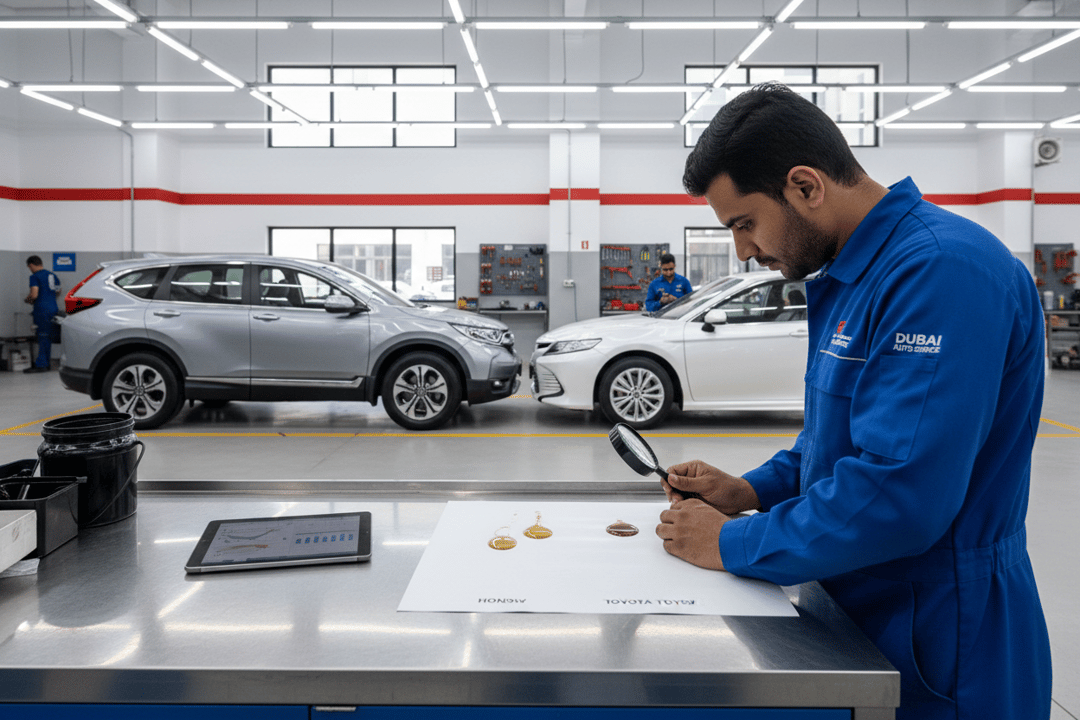
Honda and Toyota dominate the UAE's used car market for a reason — both brands deliver reliable, practical vehicles that hold their value well. But lumping them together as simply "Japanese cars" misses important differences in how they age and what inspectors find when examining them. Understanding these differences helps buyers make smart choices based on what the inspection data actually shows.
Engine Inspection: Different Philosophies, Different Wear
AutoFay's engine inspection covers engine start and idle, abnormal noises, engine vibration, valve cover gaskets, oil seals, and exhaust smoke. Toyota engines tend toward simplicity and durability — their naturally aspirated V6 and V8 engines in models like the Camry and Land Cruiser typically show minimal issues even at high mileage. Engine start is usually rated Normal, and abnormal engine noises are uncommon findings.
Honda engines, while equally reliable, are often tuned more aggressively for performance. VTEC engines in models like the Accord and Civic are designed to deliver more power per liter, which means tighter tolerances. Engine oil condition matters more on Hondas — the turbo engines in newer Civic and CR-V models are particularly sensitive to oil quality and change intervals. An engine oil condition rated as Dirty on a turbocharged Honda is more concerning than on a naturally aspirated Toyota, because the turbo depends on clean oil for bearing lubrication.
Transmission: CVT vs Traditional Automatic
The drivetrain inspection checks transmission operation — Smooth, Slight Delay, Hard Shifting, or Slipping. Toyota uses traditional automatic transmissions in most models, and these typically rate Smooth across the mileage spectrum when properly maintained. Transmission fluid condition on Toyotas is usually Good or Acceptable because the robust design tolerates moderate neglect.
Honda has adopted CVT (Continuously Variable Transmission) in many models. A CVT does not shift in the traditional sense — it operates on a belt and pulley system. During inspection, CVT operation is assessed for smoothness and any unusual whining noise. CVTs are sensitive to fluid condition — transmission fluid rated as Dirty or with Burnt Smell on a Honda CVT is more urgent than the same rating on a Toyota conventional automatic, because CVT fluid degrades differently and affects the belt and pulley contact surfaces directly.
Body and Paint: Market Differences
The body, paint, and damage inspection checks every panel individually. Both Honda and Toyota models show good paint durability in the UAE market. The key difference is in how they are typically used. Toyotas in the UAE span from city sedans to full-size SUVs used for desert driving, so body inspection findings vary widely by model. Honda's lineup in the UAE is more sedan and crossover focused — Accord, Civic, CR-V, Pilot — which means body damage is more often parking-related rather than off-road related.
Body panel alignment tends to rate well on both brands. Corrosion is rarely found on either Honda or Toyota in the UAE climate, except on imported vehicles from humid or coastal markets — our inspectors check for corrosion and rust specifically on any vehicle with an import history.
Interior and Electronics: Practical vs Feature-Rich
The interior inspection rates dashboard condition, seat condition, steering wheel wear, and all comfort features. Toyota interiors are designed for durability — materials resist wear well, and controls remain functional over time. The infotainment systems are typically simpler, which means fewer potential failure points. Honda interiors offer more design ambition — materials are sometimes softer and more luxurious feeling, but this can mean earlier wear on steering wheels and seat bolsters.
The digital and infotainment inspection on Hondas sometimes reveals glitchy infotainment screens or intermittent Bluetooth connectivity, particularly on models from the mid-2010s transition period. Toyota's newer infotainment systems are more stable but sometimes have outdated navigation maps. Both brands' Apple CarPlay and Android Auto implementations are checked for proper function.
Safety Systems: Both Strong, Toyota More Conservative
The safety and security systems inspection checks all ADAS features present on the vehicle. Toyota Safety Sense and Honda Sensing are both comprehensive suites. Our inspectors verify each function individually — blind spot detection, lane departure warning, automatic emergency braking, and adaptive cruise control. Both systems generally test as Working across the board, though camera and radar sensor contamination from sand is a common cause of intermittent function in either brand.
AutoFay inspects 410 checkpoints on every Honda and Toyota, with HD photos and a detailed PDF report. On-location inspection across all 7 Emirates. Book at autofay.ae or call +971-54-258-4458.

0 Comments
No comments yet. Be the first to share your thoughts!