

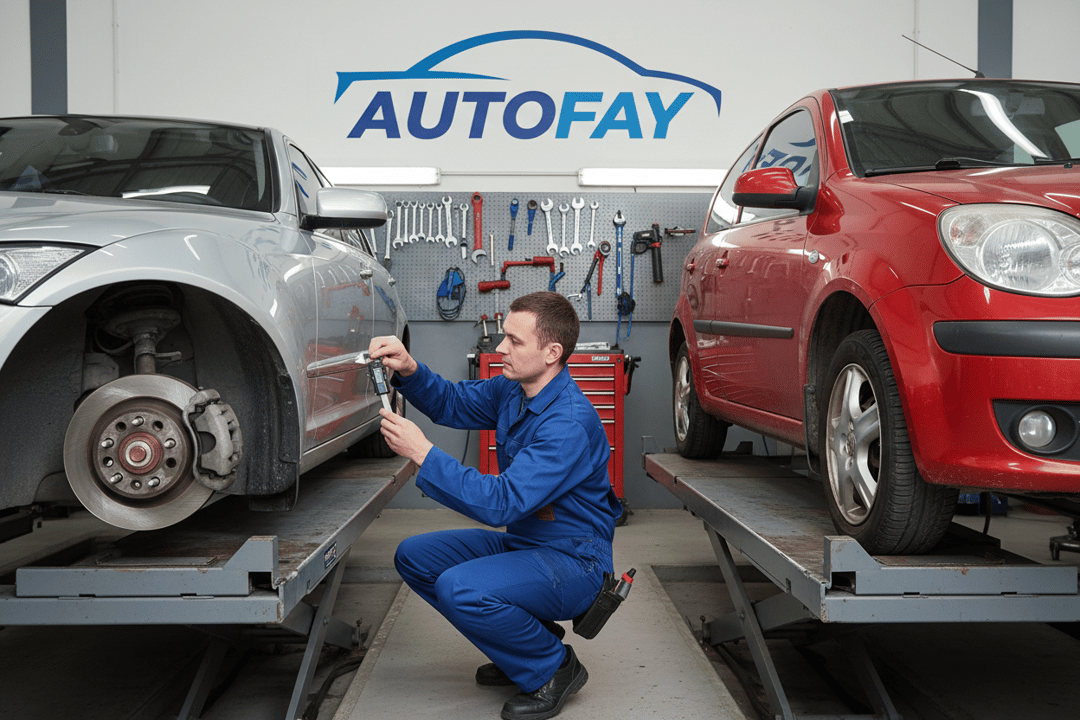
Not all kilometers are created equal. A car with higher mileage of highway driving between Abu Dhabi and Dubai is in a fundamentally different condition than a car with higher mileage of stop-and-go traffic through Sharjah and Deira. The type of driving determines which components wear faster, and a professional inspection reveals these patterns clearly across multiple systems.
Brakes: The Starkest Difference
City driving destroys brakes. Constant stopping and starting at traffic lights, roundabouts, and in congestion means the brake pads and rotors work continuously. AutoFay's brake inspection rates front brake pads as Good (above 50%), Average (25-50%), Worn (below 25%), or Needs Replacement. A city-driven car at higher mileage may already show front pads at Average or Worn, while a highway-driven car at the same mileage often still has pads rated Good. The brake pedal feel — rated Firm, Soft, Spongy, or Pulsating — is more likely to show Soft or Pulsating on a city car due to heat cycling of the rotors.
Highway cars apply brakes infrequently but at higher speeds, which means the braking events are more intense individually. Brake rotors on highway cars are more likely to show scoring or warping from hard braking at speed. Front brake rotors are rated Good, Scored, Warped, or Needs Replacement. Both driving patterns wear brakes, but city driving wears them faster and more evenly, while highway driving creates fewer but higher-stress events.
Transmission: Shift Count vs Sustained Load
An automatic transmission in city traffic shifts constantly — first to second, second to third, back down to first at every stop. Each shift generates heat and wear on the clutch packs and bands. Our drivetrain inspection rates transmission operation as Smooth, Slight Delay, Hard Shifting, or Slipping. City-driven cars are more likely to develop Slight Delay or Hard Shifting at lower mileage because of the sheer number of gear changes. Transmission fluid in city cars degrades faster — rated from Good through Acceptable, Dirty, to Burnt Smell or Contaminated.
Highway driving keeps the transmission in a high gear for sustained periods, generating less heat per kilometer. However, sustained high-speed operation puts continuous load on the torque converter and differential. The rear differential on highway cars may develop noise earlier than on city cars — rated Good, Noisy, or Leaking. Transfer case operation on AWD vehicles is also stressed differently: highway driving maintains constant engagement, while city driving cycles between modes frequently.
Engine and Cooling: Temperature Profiles
City engines spend more time at operating temperature in traffic, with less airflow across the radiator. The cooling system works harder — cooling fans run more frequently, and the water pump cycles through more thermal stress. AutoFay checks radiator condition (No Visible Fault, Dirty, Damaged, or Leaking), cooling fans, water pump (Working, Noisy, Leaking, or Needs Replacement), and all cooling hoses. City cars show more cooling hose degradation because rubber expands and contracts more in constant heat cycling.
Highway engines benefit from consistent airflow and stable operating temperature. However, they accumulate more combustion chamber deposits at sustained high RPM. Exhaust smoke — rated None, White, Blue, or Black — can appear differently: city cars tend toward Black smoke from rich fuel mixtures in traffic, while highway cars may show Blue smoke from oil consumption at sustained high speeds if valve seals have degraded.
Suspension: Speed Bumps vs Stability
City driving in the UAE means speed bumps — hundreds of them over the life of the car. Every speed bump stresses ball joints, control arms, bushings, and shock absorbers. AutoFay's suspension inspection rates ball joints from No Visible Fault through Worn, Loose, to Needs Replacement. Sway bar links — rated No Visible Fault, Worn, or Broken — fail earlier on city cars because they absorb lateral forces at low speed over bumps. Bushings crack from repeated compression and rebound cycles.
Highway cars experience fewer vertical impacts but more sustained lateral forces during lane changes and curves at speed. Tire wear pattern tells the story: city cars show more Even wear or Inner Wear from frequent turning, while highway cars show patterns related to alignment — Slight Pull or Needs Alignment from road camber effects over thousands of kilometers. Steering play — rated None, Slight, or Excessive — develops differently as well: city driving wears tie rod ends from constant small corrections, while highway driving wears the steering rack from sustained load.
What This Means for Buyers
Neither driving profile is inherently better or worse — they simply wear different components at different rates. When buying a used car, understanding its driving history helps you predict future maintenance. A highway car may need differential service and alignment before a city car does, but a city car may need brakes, suspension bushings, and transmission service sooner. AutoFay's 410+ checkpoint inspection captures both patterns and gives you the data to make an smart choice regardless of the car's driving history.
AutoFay inspects 410 checkpoints covering every wear pattern, with HD photos and a detailed PDF report. On-location inspection across all 7 Emirates. Book at autofay.ae or call +971-54-258-4458.


0 Comments
No comments yet. Be the first to share your thoughts!