

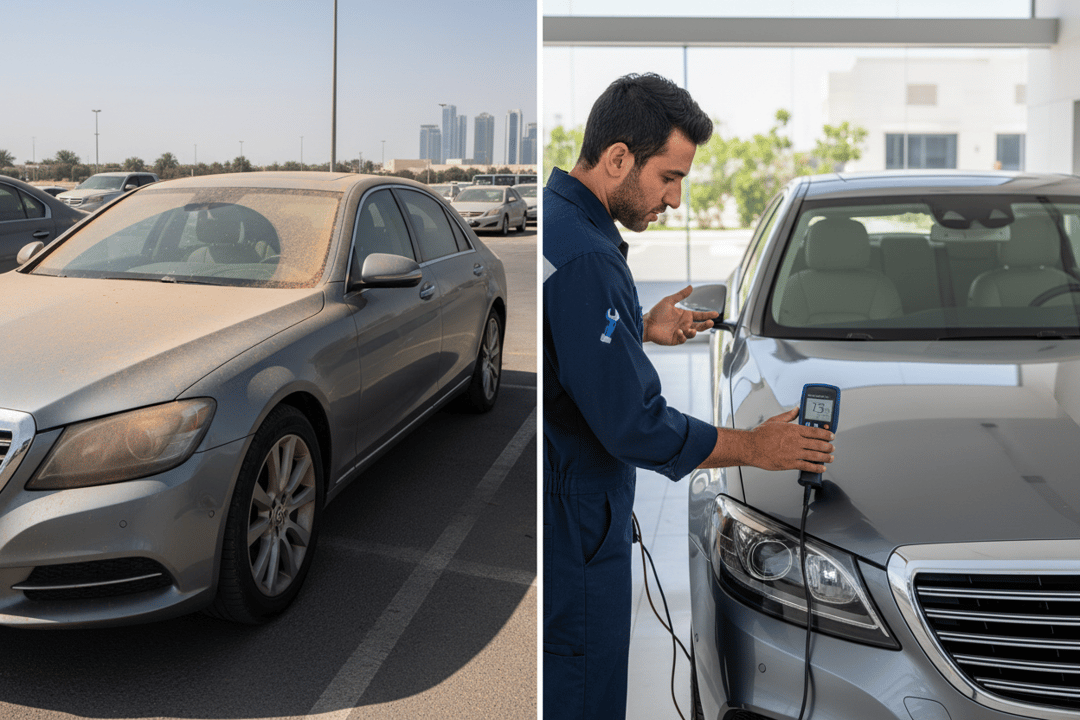
The UAE used car market is national, but the cars themselves are local. A vehicle that spent five years in Dubai has had a fundamentally different life than one that spent those same years in Abu Dhabi. The roads, the driving patterns, the distances, and even the maintenance culture differ between the two emirates. Understanding these differences helps buyers know what to look for — and why inspection findings vary by region.
Driving Patterns: City Miles vs Highway Miles
Dubai driving involves more stop-and-go traffic. The city's dense road network, frequent traffic signals, and higher congestion mean more brake wear, more transmission stress from constant shifting, and more heat cycling on the engine. AutoFay's brake inspection rates front and rear pads from Good (over 50%) to Needs Replacement — Dubai-driven cars tend to show more brake pad wear at the same mileage compared to Abu Dhabi vehicles.
Abu Dhabi driving involves longer highway stretches. The distances between destinations are greater, and the road network features more open highway driving. This means sustained high-speed use that stresses tires, wheel bearings, and cooling systems differently. Tire wear patterns on Abu Dhabi cars often show more even wear from highway use rather than the inner-edge wear common in Dubai cars from frequent turning in tight urban spaces.
Road Surface and Speed Bumps
Dubai has an extensive network of speed bumps in residential and commercial areas. These take a measurable toll on suspension components — shock absorbers, ball joints, bushings, and sway bar links all wear faster with frequent speed bump impacts. AutoFay's suspension inspection checks each of these individually, and Dubai cars often show worn bushings and weakened shocks at lower mileage than Abu Dhabi equivalents.
Abu Dhabi roads tend to be wider with smoother surfaces on the main highways, but the emirate also has more areas where sand accumulates on road shoulders. Cars driven in the western region of Abu Dhabi near the desert encounter more sand exposure, which affects the air intake system — rated Good, Dirty, or Damaged — and the engine air filter condition.
Parking and Body Condition
Dubai's denser parking environments mean more door dings, bumper scrapes, and parking lot contact. The body and paint inspection checks every panel for condition and paint originality. Cars from Dubai statistically show more repainted panels from minor parking incidents. The tight multi-story parking structures common in Dubai create door contact that results in dings on side panels — front and rear door condition is noted individually.
Abu Dhabi cars are more likely to show front-end paint damage from highway driving — stone chips on the hood and front bumper from sustained high-speed travel. Paint chips are rated None, Minor, Moderate, or Severe. A car from Abu Dhabi with Minor paint chips on the front is typical wear; the same pattern on side panels would be unusual and worth investigating.
Climate and Coastal Effects
Both emirates share the same extreme heat, but Abu Dhabi's higher humidity in certain coastal areas and during specific seasons creates additional challenges. Electrical components — fuse box condition, battery terminals, engine wiring — can develop more corrosion in higher humidity environments. Interior moisture-related issues like musty interior smell are more common in coastal areas where cars may be parked near the sea.
The headliner — rated No Visible Fault, Good, Sagging, or Damaged — sags more frequently in humid conditions. Headlight lens yellowing also accelerates with combined UV and humidity exposure. These are not mechanical failures but affect the overall condition assessment and vehicle value.
Maintenance Culture Differences
Abu Dhabi historically has a higher proportion of agency-maintained vehicles due to the emirate's government and oil sector fleet culture. Dubai's more diverse market includes more independently maintained vehicles. While this is a generalization, the fluid inspection often tells the story — engine oil condition (Clean vs Dirty), transmission fluid quality, and coolant condition reveal maintenance consistency regardless of what the seller claims about service history.
What This Means for Buyers
Neither emirate produces inherently better or worse cars. But knowing where a car was primarily driven helps you interpret inspection findings correctly. A Dubai car with worn suspension at higher mileage is consistent with city driving. An Abu Dhabi car with highway-pattern tire wear and front-end stone chips is consistent with its environment. AutoFay's inspection documents the actual condition regardless of origin — giving you facts rather than assumptions about how the car was used.
AutoFay checks 410+ checkpoints with HD photos and a detailed PDF report. On-location inspection across all 7 Emirates. Book at autofay.ae or call +971-54-258-4458.


0 Comments
No comments yet. Be the first to share your thoughts!