

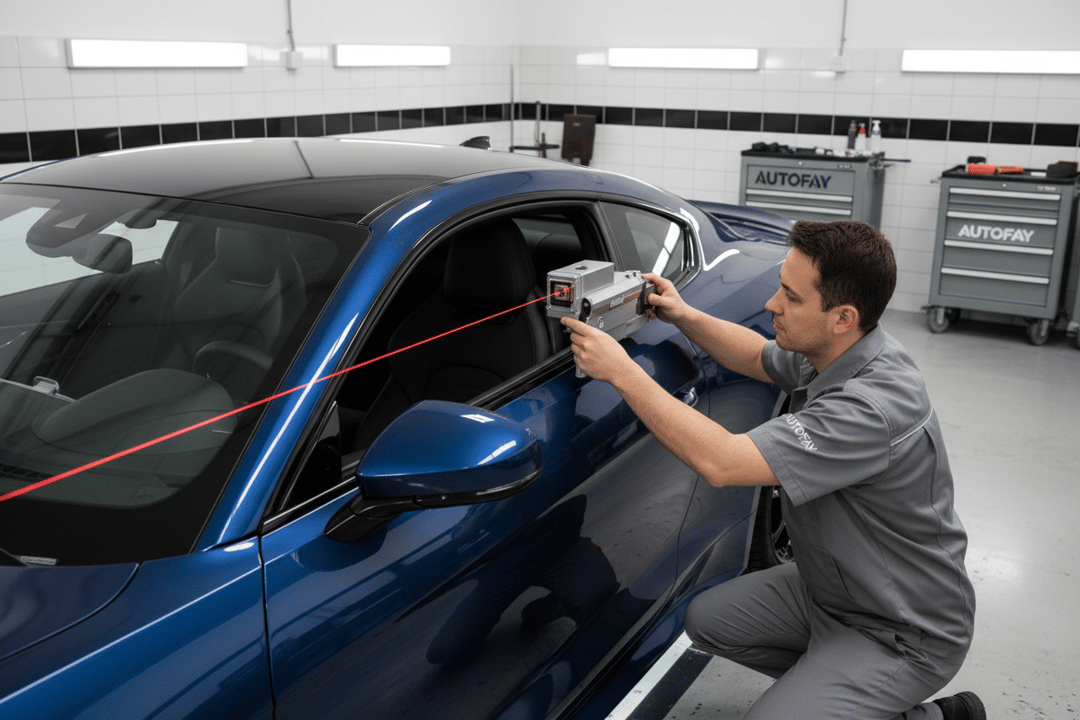
The body style of a vehicle determines its structural design, and structural design determines how the car wears, how it behaves in collisions, and what inspection points deserve the most attention. In the UAE market, sedans dominate daily transportation while coupes serve the enthusiast and luxury segments. Understanding the inspection differences helps buyers evaluate either body style with appropriate expectations.
Door and Pillar Structure
The most obvious structural difference is the number of doors and pillars. A sedan has four doors, supported by A, B, and C pillars on each side. AutoFay's frame inspection checks each pillar individually — Left A-Pillar, Right A-Pillar, Left B-Pillar, Right B-Pillar, Left C-Pillar, and Right C-Pillar — each rated from No Damage through Minor Dent, Repaired, Welded, Replaced, to Bent. A sedan's B-pillar provides critical structural support between the front and rear doors, contributing to side-impact protection.
A coupe typically has two doors and may have only A and C pillars, with no B-pillar or a reduced B-pillar design. This means each remaining pillar carries more structural responsibility. A damaged or repaired A-pillar on a coupe is more significant than the same damage on a sedan because the coupe has fewer structural members to compensate. Coupe doors are substantially longer and heavier than sedan doors, which puts more stress on door hinges — rated No Visible Fault, Worn, Squeaky, or Needs Replacement. Coupe door hinges wear faster due to the increased weight and use of longer doors.
Body Panel Differences
AutoFay's body inspection checks each panel for condition and paint. On a sedan, there are more individual panels to assess — front and rear doors on each side means eight door surfaces plus fenders, quarter panels, hood, trunk, and bumpers. On a coupe, there are fewer doors but larger quarter panels that extend from the door to the rear of the car. These larger quarter panels are more expensive to repair or repaint if damaged, and a repainted quarter panel on a coupe affects a larger visual area than the same repair on a sedan.
Rocker panels — Left and Right Rocker Panel/Sill condition, rated from No Visible Fault through Damaged — are more exposed on coupes because the doors are longer and riders step closer to the sill when entering. Sedan rear doors provide some protection for the rocker panels in the rear section. Body panel alignment (Good, Slight Misalignment, or Major Misalignment) is checked across all panels; misalignment on a coupe's longer panels can be more difficult and expensive to correct because of the larger panel surface area.
Interior Access and Rear Seat Wear
Coupe rear seats, accessed by folding the front seats forward, show different wear patterns than sedan rear seats with their own doors. The front seats on a coupe endure additional mechanical stress from the fold-forward mechanism — front seats movement is rated Working, Stiff, or Not Working. A coupe with a non-functioning front seat fold mechanism effectively makes the rear seats inaccessible. Seat memory functions (Working or Not Working) on coupes often include a memory position for the entry/exit fold, and failure of this function creates a significant usability issue.
Sedan rear seats tend to show more wear because they are more accessible and used more frequently. Rear seats condition (No Visible Fault through Damaged) and child seat anchors/ISOFIX (Present, Missing, or Damaged) are more commonly used on sedans. The folding rear seats mechanism (Working or Not Working) is typically simpler on sedans — a straightforward 60/40 split that either works or does not.
Driving Dynamics and Related Wear
Coupes are often driven more aggressively than sedans of the same model. This driving style shows up across multiple inspection categories. Brake pads and rotors may show more wear relative to mileage. Tire wear pattern — Even, Inner Wear, Outer Wear, Center Wear, or Cupping — may show more aggressive patterns from cornering. Suspension components — shocks, ball joints, sway bar links — may show earlier wear. Engine and transmission may carry more OBD fault codes from spirited driving. These are not inherent coupe problems — they are usage-pattern indicators that the inspection captures.
During the road test, steering feel (Precise, Loose, Heavy, or Vibrating) and ride comfort (Comfortable, Firm, Bouncy, or Harsh) may differ between a coupe and a sedan of the same model because coupes often have sportier suspension tuning from the factory. What matters is whether the readings fall within expected ranges for the body style and model.
Convertible Coupes: Additional Inspection Points
Some coupes in the UAE market are convertibles, adding another layer of inspection complexity. The convertible top — rated Working, Slow, Leaking, or Not Working — is a mechanical system with hydraulic cylinders, motors, and fabric or hardtop panels. A leaking convertible top causes water damage to the interior, affecting carpet/flooring condition (Clean, Stained, Worn, or Damaged) and potentially causing trunk floor water damage. The power features inspection checks convertible top operation specifically, and any issues represent significant repair costs.
AutoFay inspects 410 checkpoints tailored to every body style, with HD photos and a detailed PDF report. On-location inspection across all 7 Emirates. Book at autofay.ae or call +971-54-258-4458.


0 Comments
No comments yet. Be the first to share your thoughts!