


Many hotel operators assume a clean exterior guarantees a reliable guest transport vehicle, yet hidden wear often tells a different story.
What the Inspection Covers
The AutoFay guest transport vehicle inspection focuses on the 25 core categories that reveal structural integrity, mechanical health, and safety performance. Inspectors rate each body panel as, Repainted, or Replaced, while dents, scratches, and damage receive a clear severity label; a Repainted hood paired with a replaced front bumper typically signals a prior collision.
Frame Condition checks include bumper supports, cross members, and chassis rails, each graded for structural damage; any distortion in the A‑pillar or floor pan triggers a recommendation for professional repair. Glass evaluation records chips or cracks on windshields, side windows, and mirrors, and notes any aftermarket replacements that could affect sensor calibration.
Mechanical scrutiny spans Engine Start & Operation, OBD Scanner fault codes, Fluids quality, Cooling System pressure, and Drivetrain smoothness. Brake pads are measured against wear thresholds (>50 % remaining is acceptable, <25 % demands replacement), while Suspension & Steering components receive a pass/fail rating based on play, leaks, and alignment.
Interior and technology checkpoints verify dashboard warning lights, infotainment screen responsiveness, HVAC cooling output, and the condition of power features such as windows and seat adjustments. Safety & Security reviews encompass airbags, ABS sensors, lane‑assist cameras, and parking‑sensor functionality, ensuring every alert is either active or cleared.
Finally, a Road Test records acceleration, braking distance, steering feel, and cabin noise, providing a real‑world feel that static checks cannot capture.
Ford Territory 2025 – Agency Fleet
For the 2025 Territory, the inspection emphasizes the adaptive headlights, electronic parking brake, and dual‑zone climate control, all of which are rated for lens clarity, sensor alignment, and cooling capacity. The chassis rail and rear suspension receive a detailed scan for fatigue, a concern for vehicles that frequently navigate Dubai’s high‑speed highways.
Under the hood, the battery terminals and starter motor are examined for corrosion, while the transmission fluid is assessed for color and particulate content, indicators of long‑term wear in a vehicle that may log over 30 000 km per year.
Ford Territory 2023 – Comprehensive Fleet
The 2023 model’s inspection highlights the push‑button start system, keyless entry sensors, and rear‑view camera integrity, each for proper operation and signal latency. Frame Condition checks focus on the front rails and firewall, areas prone to stress when the vehicle carries multiple passenger loads.
Brake performance is measured on a dynamometer, and the pad wear percentage is recorded; a reading below 30 % signals the need for immediate service to maintain safe stopping distances in urban traffic.
Honda HR‑V 2022 – Agency Fleet
Inspection of the HR‑V concentrates on the compact SUV’s roof‑mounted antenna and side‑mirror heating elements, both of which can suffer from sand ingress in the UAE. The glass panel assessment records any micro‑cracks that could compromise the built‑in rain sensor.
Engine diagnostics include checking for stored ABS fault codes that often remain hidden after a minor service, a factor that can affect the vehicle’s stability control during sudden stops.
Jetour Dashing 2025 – Comprehensive Fleet
The Dashing’s evaluation targets its panoramic sunroof seal condition and the operation of the electric tailgate, components that are vulnerable to dust and heat exposure. Exterior Lights are inspected for adaptive LED functionality and lens discoloration caused by UV radiation.
Suspension bushings and CV axle boots are examined for wear patterns that indicate excessive side‑load, a common issue when the vehicle traverses sandy resort roads.
Mitsubishi Eclipse Cross 2024 – Agency Fleet
For the Eclipse Cross, the inspection verifies the integrity of the roof‑rail mounting points and the condition of the rear‑view camera’s housing, both critical for safe passenger loading. The HVAC system’s compressor is pressure‑ to ensure it can sustain cooling cycles for ten months of the year.
Fuel system checks include a smell test for vapor leaks and a visual inspection of the fuel pump’s mounting bolts, preventing potential safety hazards in high‑temperature environments.
What Buyers Miss Without Inspection
Hidden frame damage often escapes a casual visual check; a repaired A‑pillar can weaken crash protection and lead to costly realignment work later. Professional inspection reveals such issues by rating each rail and bulkhead for straightness and weld quality.
Stored OBD fault codes, especially those related to ABS or airbag modules, remain dormant until a diagnostic scan is performed. Ignoring these codes can result in reduced braking efficiency or delayed airbag deployment during an accident.
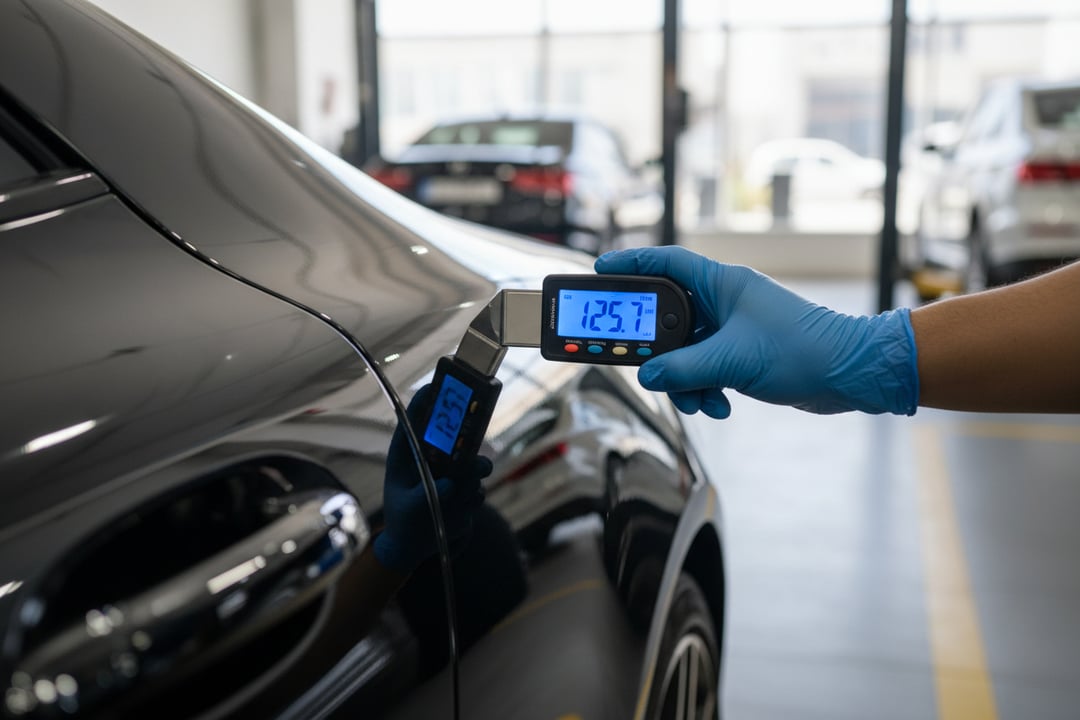
Paint depth readings differentiate a factory finish from a thin touch‑up; a Repainted bumper with a shallow paint layer may indicate prior impact repair that could conceal underlying corrosion.
Transmission fluid that appears dark or contains metal particles signals internal wear, a condition that typically manifests only after high mileage. Without a fluid color assessment, buyers risk acquiring a vehicle that will require a costly rebuild.
UAE‑Specific Considerations
Extreme heat forces AC compressors to operate at full capacity for most of the year; a compressor that struggles to reach 15 °C below ambient temperature often shows wear in the clutch plates, a detail captured during the HVAC performance test.
Sand intrusion through worn door seals can corrode electronic control units and degrade interior upholstery. The inspection checks door rubber integrity and verifies that all power windows and lock actuators are of abrasive particles.
High humidity in coastal emirates accelerates rust formation on the underbody. Frame Condition and under‑the‑hood checks include a visual inspection for early rust spots on the radiator support and floor pan, preventing future structural degradation.
Frequent use of rear‑door lift‑gates on guest transport vans stresses the hydraulic latch; the Power Features assessment measures latch actuation force and looks for fluid leaks that could impair operation.
AutoFay evaluates over 410+ checkpoints, provides high‑definition photos, and delivers a detailed PDF report to your inbox. Inspector comes to the vehicle covers all seven Emirates; book at autofay.ae or call 971‑50‑8066937.



0 Comments
No comments yet. Be the first to share your thoughts!