

The suspension system acts as the interface between the vehicle chassis and the road surface. In the United Arab Emirates, this interface is subjected to unique and aggressive conditions. Drivers navigate speed bumps, undulating highways, and extreme heat daily. These factors accelerate wear on shock absorbers, compromising vehicle handling and safety. A experienced inspector must recognize the specific signs of suspension failure to determine a vehicle’s true condition.
The UAE Environment and Suspension Failure
The harsh climate in the Emirates subjects vehicle fluids to thermal degradation more rapidly than in temperate climates. High ambient temperatures increase the viscosity of hydraulic fluid inside the shock absorber, reducing its ability to dampen oscillation efficiently. Furthermore, the prevalence of speed bumps in residential and commercial areas subjects the chassis to repeated vertical impact forces. This impact force compresses the shock absorber at a high velocity, potentially causing internal seals to rupture. Consequently, the shock absorber loses its ability to control spring movement, leading to a "soft" or wallowy ride.
The Bounce Test: Visual Inspection Techniques
The most common method for assessing shock absorber condition is the physical bounce test. This requires the inspector to push down firmly on each corner of the vehicle’s bumper. The vehicle should oscillate up and down two or three times before coming to a complete stop. If the rebounds continue for more than two cycles, the hydraulic fluid inside the absorber is no longer resisting the spring’s force, indicating a failure. This test reveals whether the suspension is merely worn or structurally compromised.
- Excessive Rebound: If the vehicle bounces violently after being pushed down, the damping coefficient is too low. This results in poor road holding and increased stopping distance.
- Stiffness: If the vehicle feels rigid or refuses to settle after the bounce, the internal valves may be stuck open, preventing the fluid from flowing correctly.
- Uneven Height: Visual inspection of the wheel arch gap is critical. If one corner of the car sits significantly lower than the others, the shock absorber on that side may have failed or a spring may be broken.
Oil Leaks and Physical Damage
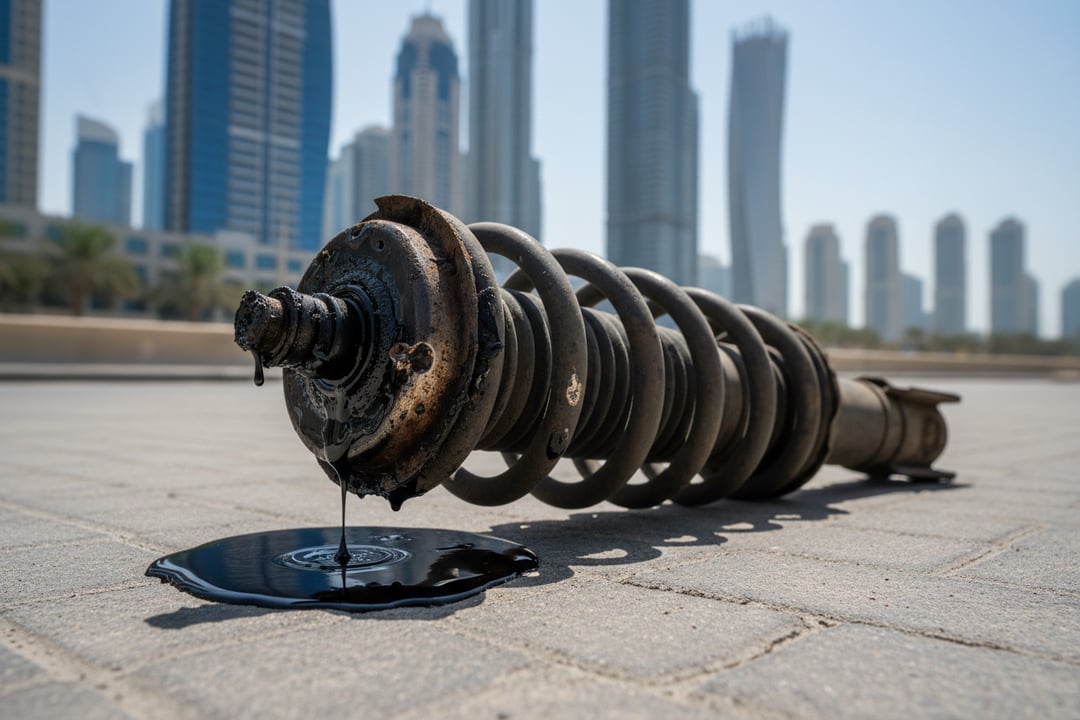
Shock absorbers rely on a sealed hydraulic system to function. Over time, the seals degrade, especially under the stress of speed bumps. Inspecting the piston rod at the top of the shock absorber is essential. Oil leaks manifest as wet streaks, dripping fluids, or a reddish-brown residue on the strut housing. Even a small oil leak compromises the fluid level, reducing the pressure necessary to dampen the spring. Internal seal failure is often the precursor to complete absorber collapse, rendering the suspension ineffective.
Uneven Tire Wear Patterns
When shock absorbers fail, the tires cannot maintain consistent contact with the road surface. This inconsistency leads to irregular tire wear patterns that are visible during a visual inspection. A experienced inspector analyzes the tread depth across the width of the tire to identify these anomalies. Worn shocks cause the tire to bounce, resulting in choppy wear known as "cupping" or "scalloping." This pattern appears as series of dips along the tire's tread blocks.
| Tire Wear Pattern | Diagnosed Suspension Issue |
|---|---|
| Cupping or Scalloping | Suspension bouncing, loose bushings, or worn shock absorbers. |
| Bald Spots on Inner/Outer Edges | Improper wheel alignment caused by worn shocks affecting tire contact patch. |
| One-Way Wear (Feathering) | Steering instability resulting from inability to control tire movement. |
The Road Test and Handling Implications
A static inspection provides limited data; a dynamic road test is necessary to verify handling characteristics. During the test, the inspector evaluates the vehicle's response to steering inputs and braking. Worn shock absorbers fail to transfer weight during cornering, causing the vehicle to lean excessively. This body roll reduces driver confidence and increases the likelihood of understeer or oversteer in emergency maneuvers. Additionally, during braking, worn shocks prevent the vehicle from settling forward, causing the nose to dip sharply. This reaction reduces the effective braking power of the rear tires and can obscure the brake response of the front tires.
Professional Inspection Services
Determining the health of the suspension requires a comprehensive approach that goes beyond the bounce test. Professional services employ 410+ checkpoints across 25 categories to ensure a thorough evaluation. Technicians examine the suspension components, including springs, bushings, and control arms, to identify structural damage. If you suspect suspension issues, a on-location inspection service is the most efficient option. Services like AutoFay offer comprehensive packages that include a detailed road test and analysis.
- Computer Diagnostic AED 99: Ideal for identifying electronic faults that may indirectly affect suspension sensors or ABS systems.
- Body & Computer AED 250: Combines a visual body inspection with computer diagnostics, covering essential electrical and structural checks.
- Comprehensive AED 299: The most thorough package, covering 25 categories including suspension, tires, frame integrity, fluids, and a full road test.
Every inspection includes HD photos and a detailed PDF report, allowing for an objective record of the vehicle's condition. AutoFay provides this professional service across all seven Emirates. Do not rely solely on visual observation; book a professional inspection today to ensure your vehicle handles safely in UAE conditions.
AutoFay inspects 410+ checkpoints with HD photos and PDF report. Book at autofay.ae or call +971542584458





0 Comments
No comments yet. Be the first to share your thoughts!