


Automotive diagnostics in the United Arab Emirates require precise interpretation of Electronic Control Unit (ECU) data. When purchasing a pre-owned vehicle, distinguishing between engine faults and chassis faults is critical for operational safety and legal compliance. While engine codes often relate to performance or fuel efficiency, chassis codes—specifically those starting with "C0"—indicate issues with the car's safety-critical structural and control systems. An automotive inspector must understand these codes to determine if a vehicle is roadworthy or if hidden mechanical failures pose a risk to the driver and occupants.
What Are Chassis Codes and Why Do They Matter?
Onboard Diagnostics (OBD) systems categorize trouble codes to help technicians identify fault locations. Codes starting with "P" typically relate to the Powertrain (engine and transmission), while "B" codes indicate Body systems and "C" codes refer to Chassis systems. When a vehicle's Electronic Stability Control (ESC) or Anti-lock Braking System (ABS) detects a malfunction, it logs a chassis code to alert the driver.
In the UAE, where vehicles face extreme temperatures and heavy traffic loads, chassis systems endure significant stress. A chassis code does not always mean the vehicle is immediately unsafe to drive, but it indicates the system is no longer operating at 100 percent efficiency. Ignoring these codes can lead to total system failure, resulting in a vehicle that cannot maintain traction or stop effectively during emergencies.
The Role of the ABS System and Wheel Speed Sensors
The Anti-lock Braking System prevents the wheels from locking up during sudden braking, allowing the driver to maintain steering control. This system relies on four wheel speed sensors, usually located in the wheel hubs or brake rotors. If one of these sensors detects a discrepancy in wheel rotation speed compared to the others, the system triggers a C0 code.
Common causes for ABS codes include a damaged speed sensor wiring harness, a corroded sensor connector, or a worn wheel bearing that has affected the sensor's magnetic reading. In a technical inspection, a malfunctioning speed sensor means the ABS module will disengage the braking force distribution temporarily to protect the electrical system. The consequence for the driver is reduced braking stability; the car may take longer to stop, and the steering wheel may become difficult to maneuver if the wheels lock up.
- Wheel Speed Sensor Failure: Often caused by heat-induced wire degradation in older models.
- Wheel Bearing Issues: Play in the bearing can cause the sensor to read erratic data.
- Brake Rotor Imperfections: Warped rotors can prevent the sensor from generating a proper signal.
Traction Control and Stability Control Integration
Traction Control (TC) and Electronic Stability Control (ESC) are extensions of the ABS system. These systems use the same wheel speed sensors and yaw rate sensors to monitor the car's direction and grip levels. When a C0 code appears in conjunction with traction or stability codes, it usually signifies a communication error between these safety modules.
For example, if the Stability Control computer cannot communicate with the ABS module, the car will disable all three systems. This is a common issue in vehicles with aftermarket stereos or radio installations, where wiring harnesses for the ABS were accidentally cut or short-circuited during service. The consequence is a vehicle that lacks modern safety assistance; the driver must rely entirely on their own driving skills to prevent the car from sliding on gravel, sand, or wet roads, which is a significant risk in UAE conditions.
The Critical Function of the Steering Angle Sensor (SAS)
The Steering Angle Sensor is located in the steering column and measures the position and direction of the steering wheel. It sends this data to the Stability Control computer to determine if the car is turning left or right as intended. If the SAS drifts from its calibration, the Stability Control system will trigger a C0 code to prevent the car from attempting to correct a turn that does not exist.
Calibration of the SAS is required after any steering rack replacement or front-end collision repair. If a vehicle has been in an accident in another country and repaired without this calibration, the steering angle sensor will continue to send incorrect data. The consequence is intermittent warning lights on the dashboard and, in some cases, the airbag system being disabled because the computer cannot determine the seating position relative to the steering wheel.
Why Visual Inspection is Insufficient for Chassis Codes
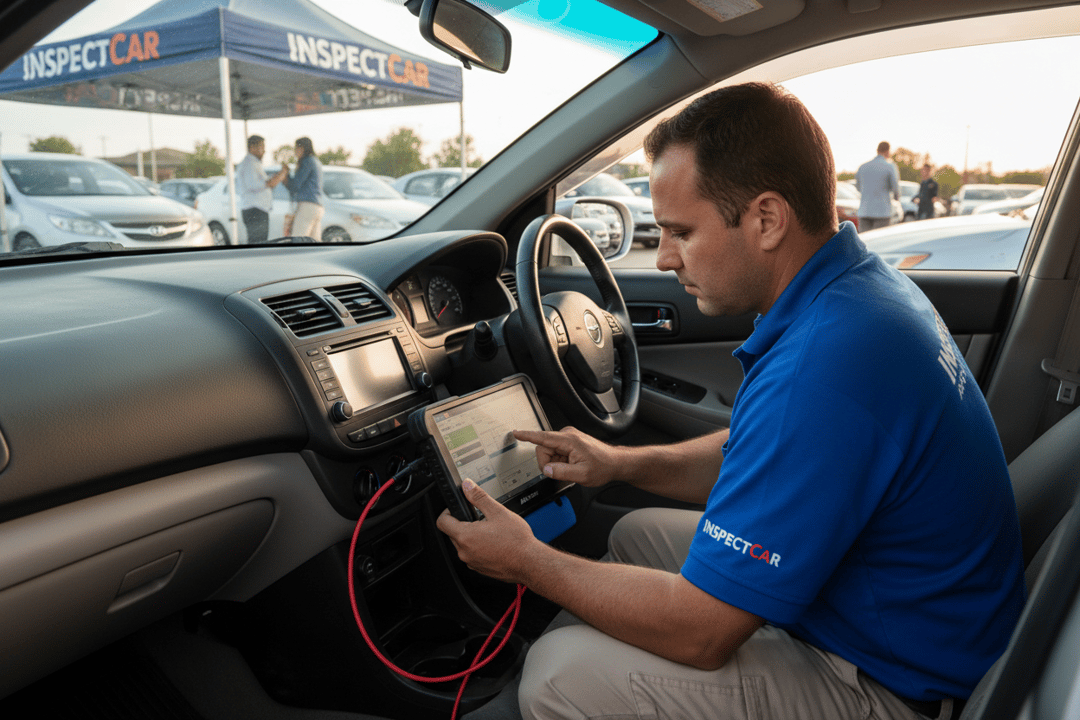
Many buyers assume that an inspection that does not involve scanning the computer will reveal hidden faults. However, visual inspection cannot detect internal sensor failures, corroded connections behind dashboards, or software glitches that prevent a warning light from illuminating. A experienced inspector must use an advanced diagnostic scanner to read the fault memory and clear codes to verify if the issue is permanent or intermittent.
At AutoFay, we utilize state-of-the-art diagnostic equipment to interrogate the vehicle's control modules. We perform a computer diagnostic check that reads engine, transmission, ABS, and airbag systems simultaneously. This ensures that a "check engine" light might be hiding a "check chassis" warning that could compromise safety.
AutoFay Inspection Packages for Chassis Safety
Understanding the severity of chassis faults allows buyers to choose the appropriate inspection depth. Basic mechanical checks often miss the nuances of electronic stability systems. We offer tiered inspection packages designed to address different levels of vehicle scrutiny based on the value and age of the asset.
| Inspection Package | Price (AED) | Key Inclusions |
|---|---|---|
| Computer Diagnostic | 99 | Engine, Transmission, ABS, and Airbag system scanning. |
| Body & Computer | 250 | Panel-by-panel paint analysis, frame integrity, and full computer diagnostics. |
| Comprehensive | 399 | Full 410+ checkpoint inspection covering Body, Frame, Engine, Brakes, Suspension, Tires, and Fluids. |
The Comprehensive AED 299 package is the most thorough option for high-value vehicles. It includes a road test to verify that the ABS and Traction Control systems engage correctly during braking and cornering. We also inspect the braking system pad percentage rating to ensure the mechanical hardware supports the electronic safety systems. Inspector comes to the vehicle is available across all 7 Emirates, bringing the inspection directly to the buyer or seller.
Chassis codes provide a roadmap to a vehicle's hidden mechanical history. By prioritizing a professional computer diagnostic, buyers can uncover critical safety defects before assuming the risk of ownership. Avoiding vehicles with unresolved C0 codes ensures that the car operates within the manufacturer's safety parameters.
AutoFay inspects 410+ checkpoints with HD photos and PDF report. Book at autofay.ae or call +971542584458




0 Comments
No comments yet. Be the first to share your thoughts!